
The order book is the real-time record of all resting limit orders in a market. Understanding how to read and interpret the order book (often displayed as the DOM, Depth of Market) is essential for Order Flow trading.
What is the Order Book?
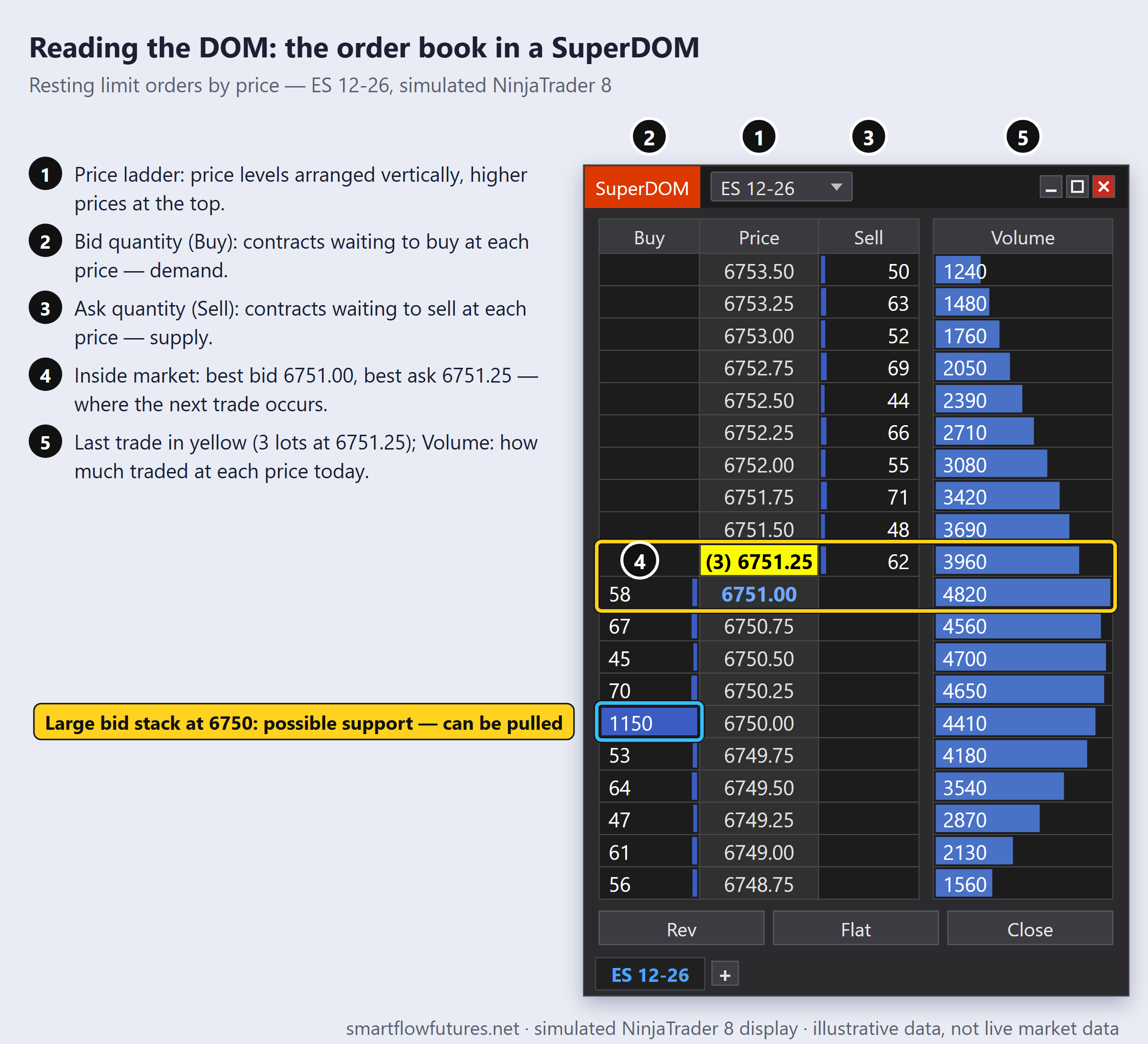
The order book is a list of all pending limit orders, organized by price. It shows:
Bid Side: All resting buy orders at the best bid and below. Represents demand. Traders willing to buy at those prices. Displayed typically on the left (the Buy column in NinjaTrader’s SuperDOM) or in green.
Ask Side: All resting sell orders at the best ask and above. Represents supply. Traders willing to sell at those prices. Displayed typically on the right (the Sell column in NinjaTrader’s SuperDOM) or in red.
The Inside Market: The best bid (highest buy order) and best ask (lowest sell order). This is where the next trade will occur.
Reading the DOM
The DOM displays order book information vertically:
Price Ladder: Price levels arranged vertically, usually with higher prices at the top.
Bid Quantity: Number of contracts waiting to buy at each price level.
Ask Quantity: Number of contracts waiting to sell at each price level.
Last Trade: Price where the most recent trade occurred.
Volume at Price: Many DOMs show how much has traded at each price today.
Order Book Depth
Market depth refers to the total quantity of orders at various price levels:
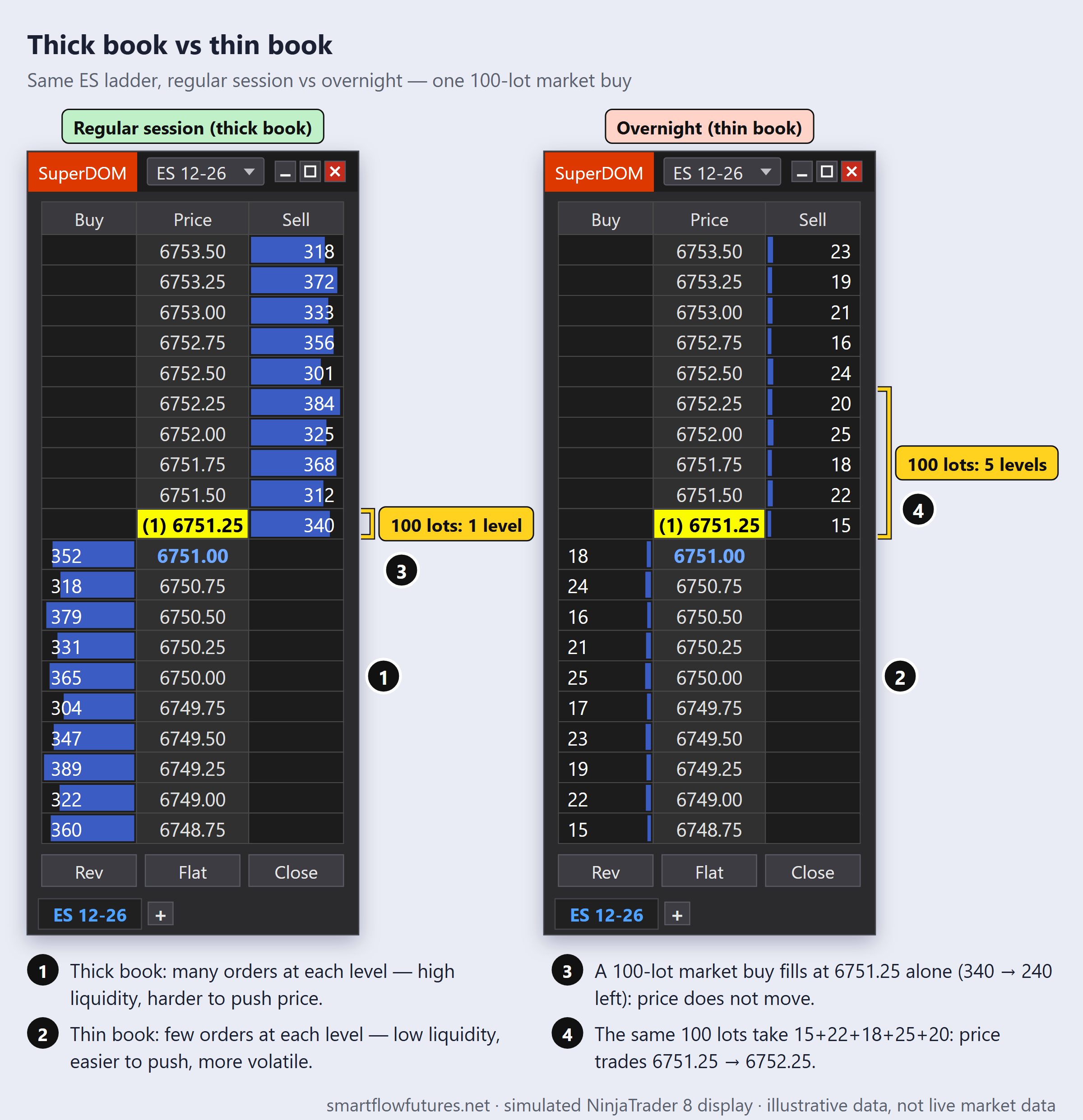
Thick Book: Many orders at each level. Indicates high liquidity. Price less likely to move quickly through these levels. Harder to push price.
Thin Book: Few orders at each level. Indicates low liquidity. Price can move quickly through these levels. Easier to push price but also more volatile.
Depth varies by: time of day (thinner overnight and during lunch), market conditions (thinner during high volatility), and distance from current price (not always thinner further away: in ES, displayed size often grows a few levels out).
Order Book Dynamics
The order book is constantly changing:
Orders Added: New limit orders enter the book. Adds liquidity at that price level.
Orders Canceled: Existing orders are withdrawn. Removes liquidity from that level.
Orders Filled: Market orders or crossing limit orders execute against resting orders. Removes liquidity and prints a trade.
Orders Modified: Existing orders change price or size. Can indicate changing intentions.
What the Order Book Shows
Visible Supply and Demand: The quantity at each price shows how much is willing to trade there. Large quantities suggest significant interest. Small quantities suggest little resistance.
Support and Resistance: Large bid quantities can act as support. Large ask quantities can act as resistance. But these levels are not static. They can be pulled.
Imbalances: When resting bid quantity significantly exceeds resting ask quantity (or vice versa), it may indicate directional pressure. Imbalances can precede moves. This is a book imbalance, not the footprint imbalance NinjaTrader’s Volumetric bars flag from traded volume.
What the Order Book Does NOT Show
Hidden Orders: Iceberg orders and hidden orders do not appear in full. You see only the displayed portion.
Market Orders: Incoming market orders are not visible until they execute. They hit the book without warning. See how a market order vs limit order actually fills once it reaches the book.
Intentions: Just because orders are there does not mean they will stay. Orders can be pulled instantly.
Orders Outside Range: Most DOMs show limited depth. Orders far from current price may not be visible.
Large Orders in the Book
When you see unusually large quantity at a price level:
Possible Interpretations: Genuine institutional interest at that price. A large trader accumulating or distributing. A market maker providing liquidity. A spoofing attempt (illegal but happens).
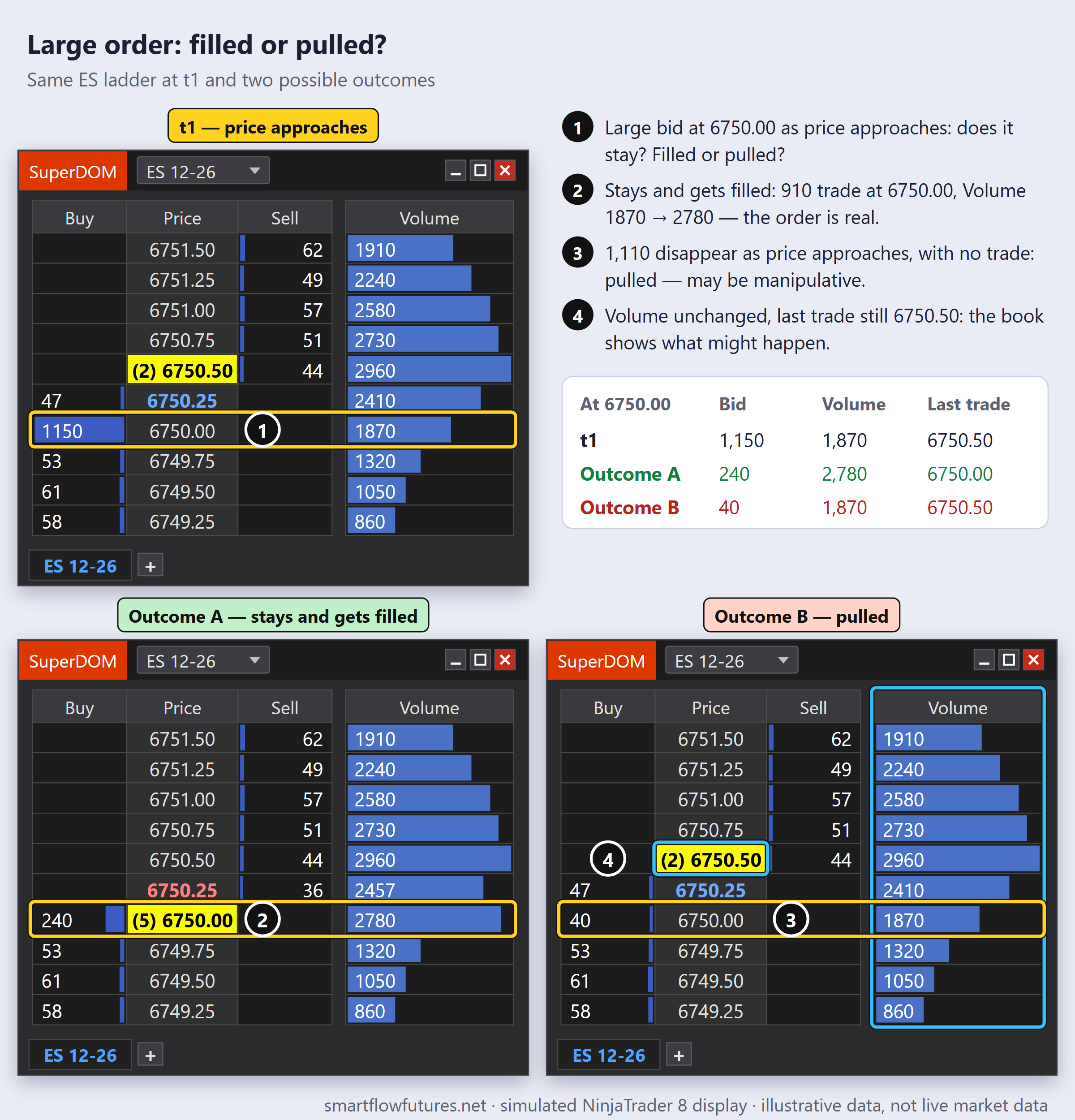
How to Evaluate: Does the order stay when price approaches? Does it get filled or pulled? Do similar orders appear consistently?
Large orders that stay and get filled are real, at least for the part that traded (an order can also be partly filled, then pulled). Large orders that disappear when price approaches may be manipulative.
Using Order Book Information
For Entry Timing: Thin book above suggests easier upward movement. Thick book above suggests resistance. Can inform entry timing and direction.
For Stop Placement: Place stops beyond significant book levels. If large bid stack at 6750, stop below might be safer.
For Target Selection: Large resting orders can act as targets. Price may pause or reverse at these levels.
Caution: Do not rely solely on order book levels. They change constantly and can be manipulated.
Order Book vs Price Action
The order book shows what might happen; price action shows what did happen.
Traders often over-weight order book information. Remember that orders can be pulled, hidden orders exist, and market orders can overwhelm visible orders.
Use order book as context for price action, not as a replacement for it.
Key Takeaways
The order book shows all resting limit orders organized by price. DOM displays this information for real-time analysis. Bid side represents demand; ask side represents supply. Market depth indicates liquidity. Thick is liquid, thin is not. Large orders may indicate significant interest but can be pulled or spoofed. Use order book as context, not as primary decision-maker.