
When a hedge fund needs to buy 10,000 ES contracts or a pension fund needs to sell a similar number of NQ contracts, they cannot simply hit the market button. Their size would move the market dramatically against them. Understanding how institutions actually execute their orders reveals the footprints we can identify in Order Flow.
The Institutional Challenge
Large traders face a fundamental problem:
Market Impact: Large orders move prices. Buying pressure raises prices. Selling pressure lowers prices. The larger the order relative to liquidity, the larger the impact.
Information Leakage: If others detect a large order is being worked, they may front-run it. They buy ahead of the order, then sell back once prices move higher.
The Goal: Execute the full order while minimizing market impact and information leakage. This requires sophisticated execution strategies.
Order Slicing: The Basic Approach
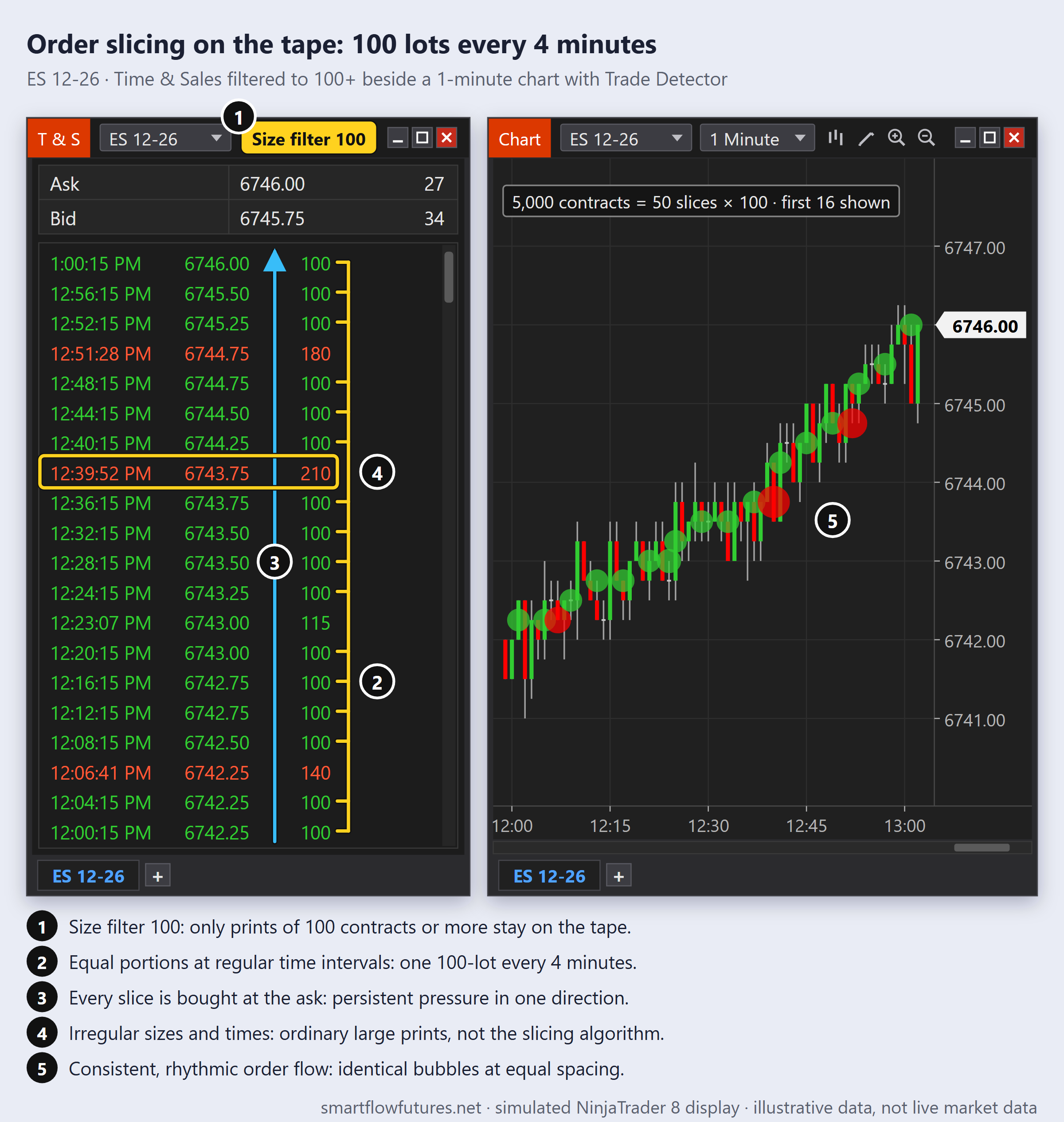
The simplest approach to large order execution is order slicing, which breaks the large order into smaller pieces executed over time.
Example: Instead of buying 5,000 contracts at once, buy 100 contracts every few minutes over several hours.
Benefits: Reduces immediate market impact. Allows liquidity to replenish between slices. Disguises the total order size.
Drawbacks: Takes time. The market may move against you during execution. Still detectable if pattern is obvious.
Algorithmic Execution Strategies
Modern institutions use sophisticated algorithms to execute orders:
TWAP (Time-Weighted Average Price): Executes equal portions at regular time intervals. Goal is to achieve average price over the execution period. Simple and predictable. Creates consistent, rhythmic order flow.
VWAP (Volume-Weighted Average Price): Executes more when volume is higher, less when volume is lower. Goal is to match the volume-weighted average price of the day. More sophisticated than TWAP. Creates order flow that tracks market volume patterns. Retail traders can use the same benchmark as a VWAP trading strategy indicator instead of just an execution algorithm.
Implementation Shortfall: Balances urgency against market impact. Executes faster if price is moving favorably. Slows down if market impact is high. More aggressive and adaptive than TWAP/VWAP.
Liquidity-Seeking: Actively hunts for liquidity across venues. Adjusts execution based on available liquidity. May pause when liquidity is thin.
Iceberg Orders
Iceberg orders display only a portion of the full order:
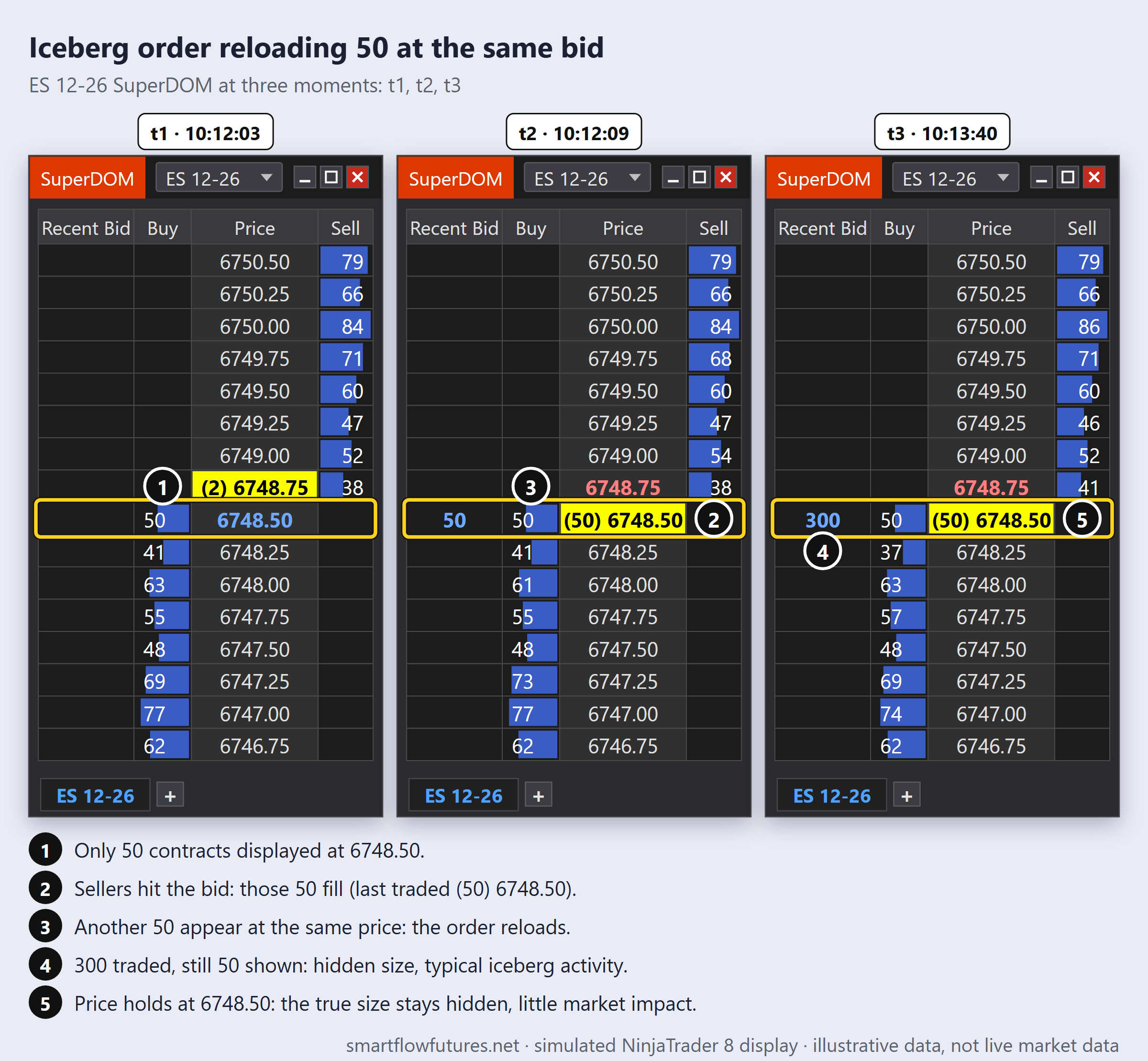
How They Work: A 1,000 contract order might display only 50 contracts. When those 50 fill, another 50 appear. This continues until the full order is complete.
Purpose: Hides the true size of institutional interest. Prevents front-running. Reduces market impact.
Detection: Watch for orders that consistently “reload” at the same price. After filling, similar size immediately reappears. This suggests iceberg activity.
Dark Pools and Hidden Liquidity
Some institutional execution happens in dark pools:
What They Are: Private exchanges where orders are not displayed. Large orders can match without revealing size. Common in equities, less so in futures.
For Futures: Futures are primarily exchange-traded. However, block trades can be negotiated privately and then reported to the exchange.
The Footprints Institutions Leave
Despite their efforts to hide, institutions leave detectable patterns:
Consistent Directional Pressure: Sustained buying or selling over extended periods. Not one big order, but persistent pressure in one direction.
Volume Anomalies: Higher than normal volume without corresponding news. Indicates large players accumulating or distributing.
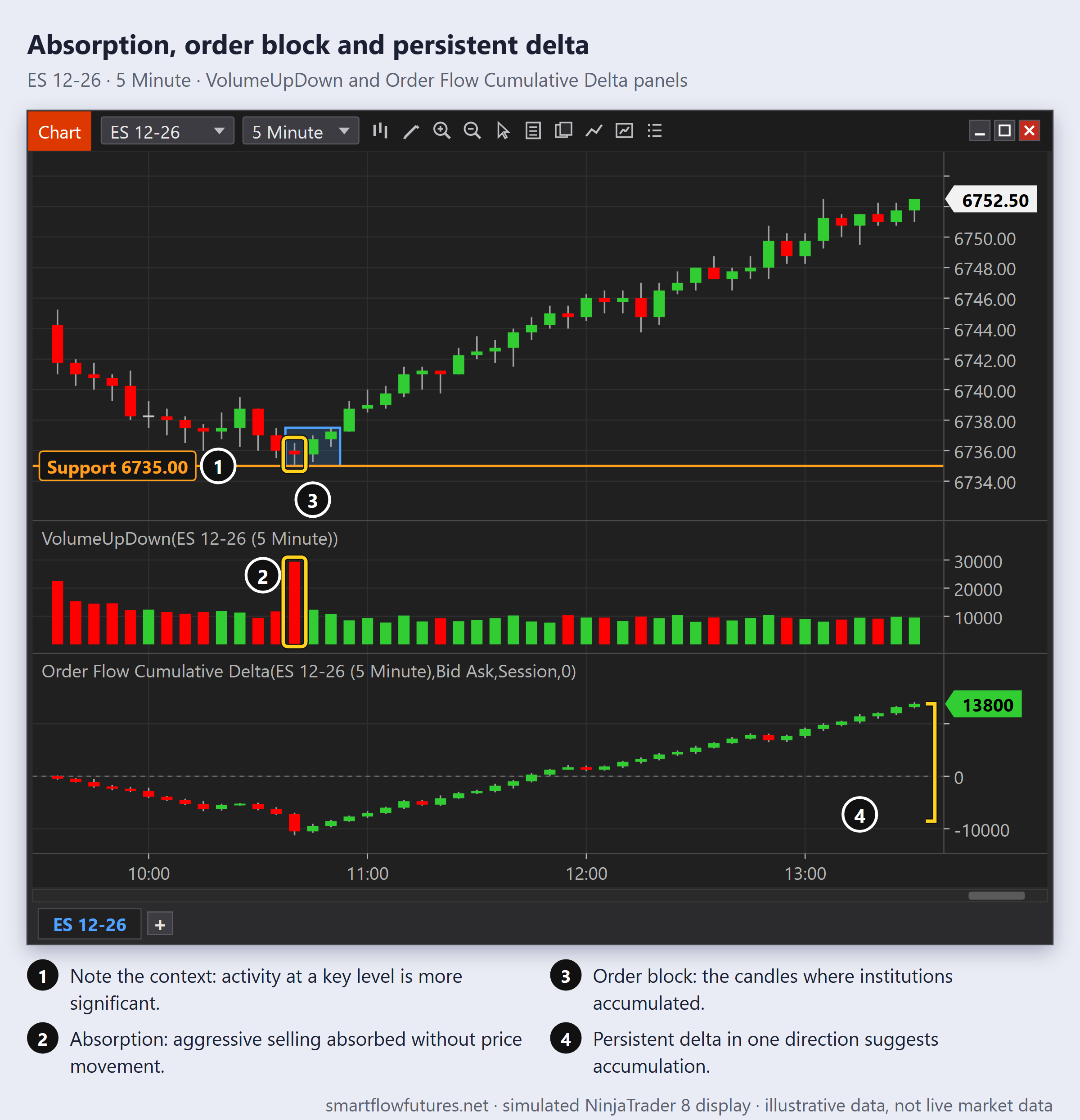
Absorption Patterns: Large passive orders absorbing aggressive flow. Visible on footprint as high volume at unchanged price.
Order Block Formation: The candles where institutions accumulated form order blocks. Price memory at these levels may reflect institutional cost basis.
Execution Around Events
Institutions time execution strategically:
Before News: May reduce execution speed before major announcements. Let news-driven volatility pass before continuing.
During High Volume: Execute more when volume is high. Easier to hide in the flow. Less market impact per contract.
Session Timing: Heavy execution often during US regular trading hours for ES and NQ, especially near the open and close. Avoid thin overnight markets.
Reading Institutional Activity
To identify institutional execution in real-time:
Watch Cumulative Delta: Persistent delta in one direction suggests accumulation or distribution. It is not proof: delta counts only aggressive orders, so passive buying (an iceberg on the bid) shows as negative delta, and negotiated block trades are not aggressive flow.
Watch for Absorption: Aggressive orders being absorbed without price movement. Indicates passive institutional presence.
Note the Context: Institutional activity at key levels (support, resistance, order blocks) is more significant. They are strategic about where they execute.
Trading Implications
Align with Institutions: When the order flow suggests institutional accumulation, consider buying with them. When it suggests distribution, consider selling.
Use Their Levels: Order blocks form where institutions executed. These levels can have significance because institutional cost basis may sit there.
Patience: Institutional execution takes time. Do not expect immediate moves after detecting activity. Let the position build before momentum kicks in.
Key Takeaways
Institutions slice large orders and use algorithms to minimize market impact. TWAP, VWAP, and implementation shortfall are common execution strategies. Iceberg orders hide true institutional size. Despite efforts, institutions leave footprints in Order Flow. Cumulative delta and absorption patterns can point to institutional activity. Order blocks form where institutions accumulated. Trade with this awareness.