
Multi-timeframe analysis (MTFA) is the backbone of professional trading. By examining the same market across multiple timeframes, you gain perspective that single-timeframe traders lack. This comprehensive view improves accuracy, timing, and trade management.
Why Multiple Timeframes Matter
Each timeframe tells part of the story:
Higher Timeframes: Reveal the dominant trend and major structure. These are the levels that institutions care about.
Medium Timeframes: Show the current swing and where price is within the larger context. These are your trading timeframes.
Lower Timeframes: Provide entry refinement and real-time price behavior. These are your execution timeframes.
Trading only one timeframe is like reading one chapter of a book and claiming to understand the whole story.
The Three-Timeframe Model
A practical approach uses three timeframes with specific purposes:
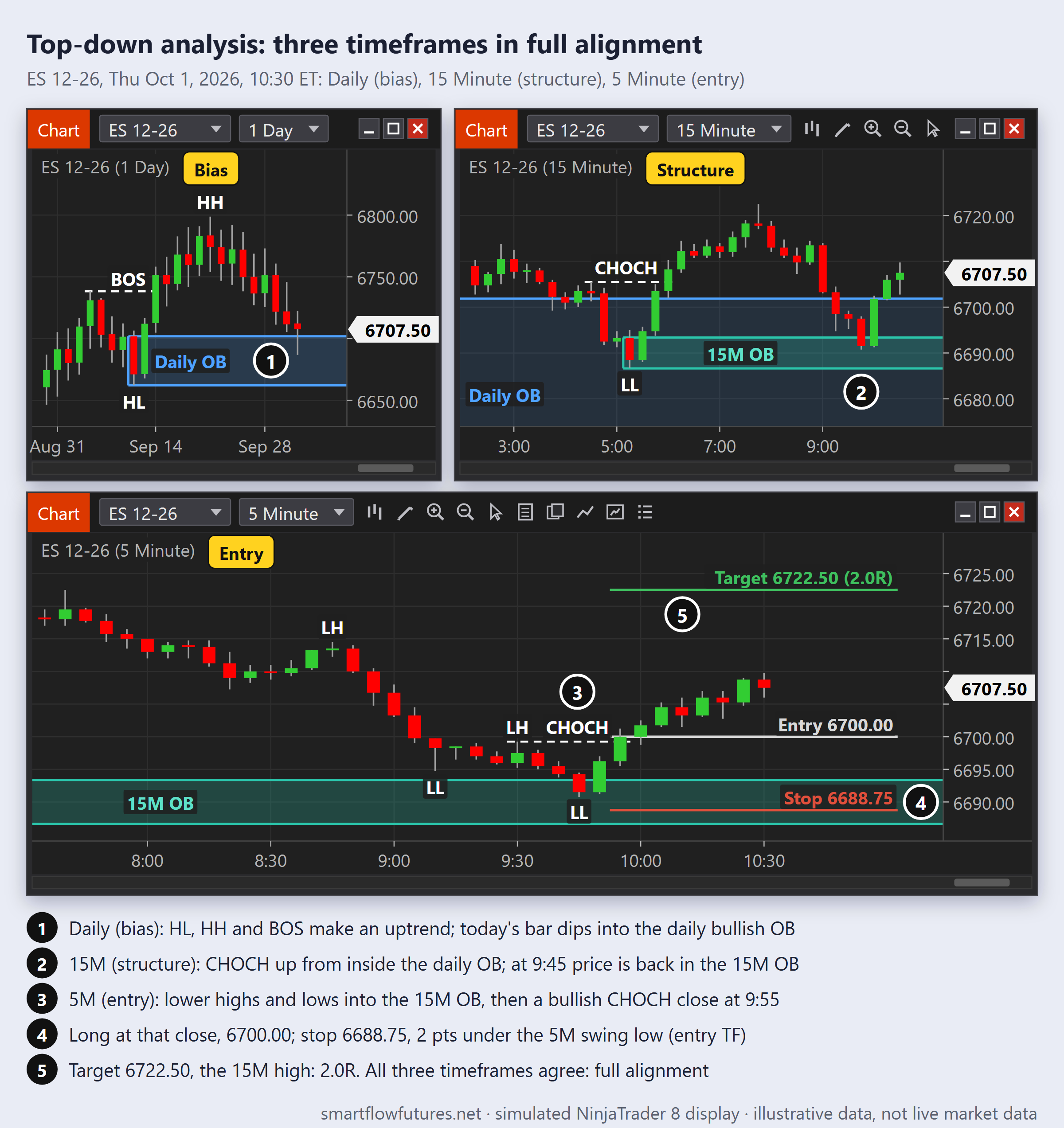
Bias Timeframe (Direction): Daily or Weekly for swing trading, 4H or Daily for day trading. Use this to determine your overall directional bias. What is the trend? Where are the major levels?
Structure Timeframe (Setup): 4H for swing trading, 1H or 15M for day trading. Use this to identify your specific trade setup. Where is the order block? Where is the FVG? What is the current structure?
Entry Timeframe (Execution): 1H or 15M for swing trading, 5M or 1M for day trading. Use this to time your entry precisely. Where exactly do you enter? Where is your stop?
Top-Down Analysis Process
Step 1: Start with the Bias Timeframe
Open your highest timeframe chart. Determine the trend: bullish, bearish, or ranging. Mark the major levels: significant order blocks, FVGs, and liquidity pools. Form your directional hypothesis: are you looking for longs or shorts?
Step 2: Move to Structure Timeframe
Zoom into your middle timeframe. Identify the current swing structure within the higher timeframe context. Mark the specific levels that align with your higher timeframe bias. Identify potential entry zones: order blocks, FVGs in premium or discount.
Step 3: Prepare Entry Timeframe
Wait for price to approach your structure timeframe levels. When it does, zoom into your lowest timeframe. Look for entry confirmation: CHOCH, BOS, rejection patterns. Execute with precision, placing stops based on the entry timeframe structure.
Timeframe Alignment
Trades are higher quality when all three timeframes align:
Full Alignment: Higher timeframe bullish, structure timeframe showing bullish pullback to order block, entry timeframe confirming with bullish CHOCH. All three agree: this is a higher-quality long.
Partial Alignment: Higher timeframe bullish, structure timeframe at a level, but entry timeframe showing indecision. Wait for full confirmation or skip.
No Alignment: Higher timeframe bullish, but structure timeframe making lower lows. The higher timeframe trend may be changing. Exercise extreme caution.
Practical Timeframe Combinations
For Swing Trading (holding days to weeks):
Bias: Weekly or Daily. Structure: 4H. Entry: 1H or 15M.
For Day Trading (intraday, closed by end of day):
Bias: Daily or 4H. Structure: 1H or 15M. Entry: 5M or 1M.
For Scalping (minutes to hours):
Bias: 4H. Structure: 15M. Entry: 1M or 5M.
Common Timeframe Mistakes
Trading Against Higher Timeframe: Taking shorts while the daily is clearly bullish. The higher timeframe usually wins.
Analysis Paralysis: Checking too many timeframes and becoming confused. Stick to three timeframes maximum.
Ignoring Lower Timeframe: Taking entries on higher timeframes without refinement, leading to unnecessarily large stops.
Inconsistent Timeframes: Switching timeframe combinations randomly. Develop a consistent approach.
SMC Concepts Across Timeframes
SMC concepts work on all timeframes, but significance varies:
Order Blocks: Higher timeframe order blocks are more significant. A weekly order block can hold for months; a 1M order block may only hold for minutes.
Fair Value Gaps: Higher timeframe FVGs may take days or weeks to fill. Lower timeframe FVGs often fill within the session.
Liquidity: Higher timeframe liquidity pools are major targets. Lower timeframe liquidity serves more as entry refinement.
Nested Structures
An advanced concept: structures nest within each other:
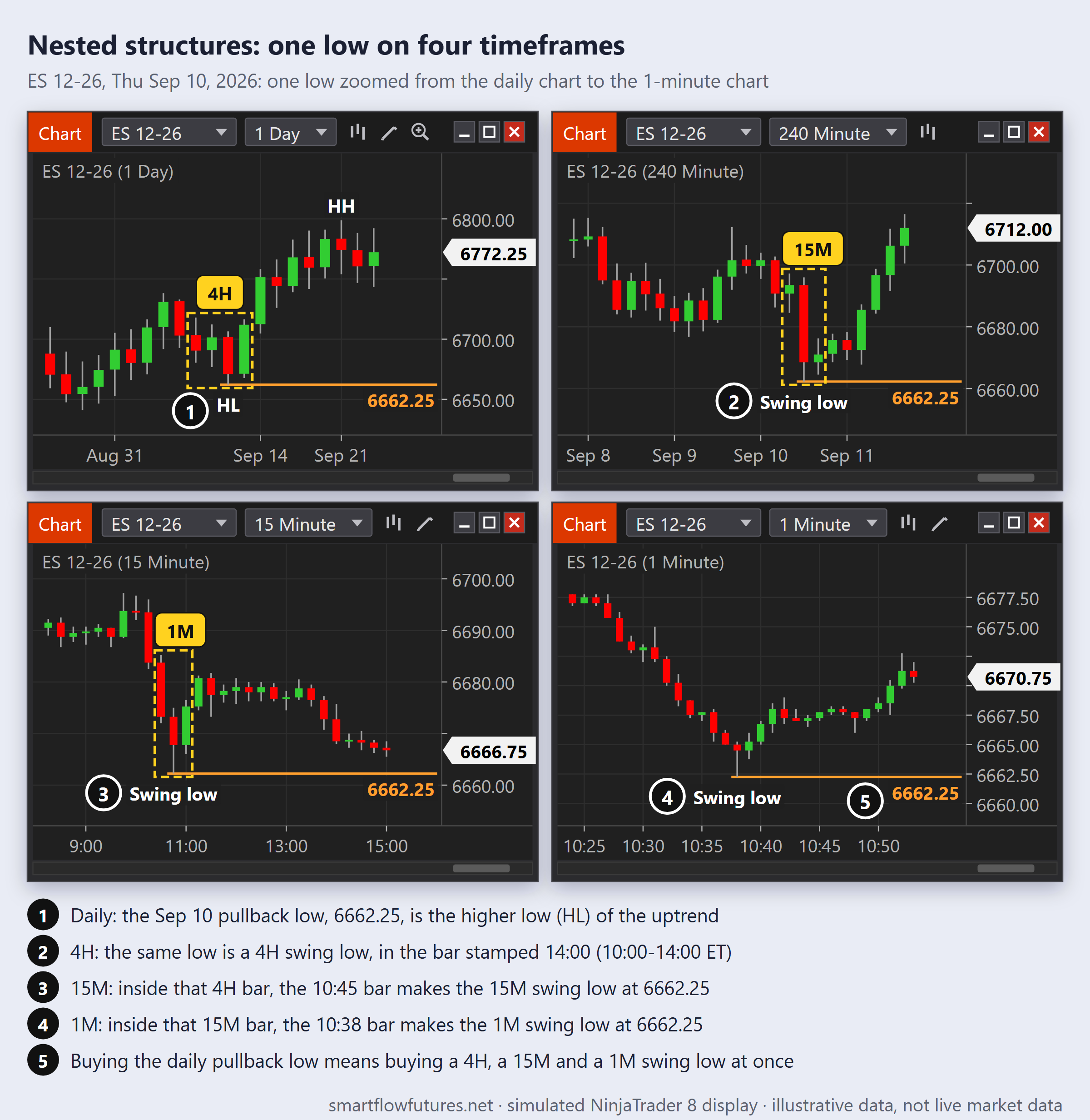
A daily bullish structure contains 4H swings. Each 4H swing contains 15M swings. Each 15M swing contains 1M swings.
When you buy a daily pullback, you are actually buying a 4H swing low, which is a 15M swing low, which is a 1M swing low. Understanding this nesting helps with entry and target selection.
Building Your MTFA Routine
Before Trading:
Check your bias timeframe for overall direction. Mark major levels that could be relevant today or this week. Form your trading plan: where will you look for trades?
During Trading:
Monitor your structure timeframe for setups. When price approaches your levels, switch to entry timeframe. Execute according to your plan with entry timeframe confirmation.
After Trading:
Review trades across all three timeframes. Did the higher timeframe support or work against you? How was your execution timing? Adjust your approach as needed.
Key Takeaways
Use three timeframes: bias (direction), structure (setup), and entry (execution). Always start analysis from higher to lower timeframe. Higher-quality trades have alignment across all three timeframes. Higher timeframe levels and structures carry more significance. Develop a consistent timeframe combination for your trading style.