
Sniper entries are the most precise form of SMC execution. By refining your entry on the 5M or 1M chart while maintaining directional accuracy, you can reach much larger risk-reward ratios, at the cost of more stop-outs. This article teaches the art of precision entry.
The Philosophy of Sniper Trading
Most traders accept unnecessarily large stop losses because they enter on higher timeframes without refinement. A sniper trader uses multiple timeframes to find the exact price level where risk is minimized, without changing the higher timeframe idea behind the trade.
The concept is simple: your thesis comes from the higher timeframe, but your execution comes from the lower timeframe. This separation allows for tight stops without sacrificing directional accuracy.
The Multi-Timeframe Sniper Process
Step 1: Higher Timeframe Direction (Daily/4H)
Establish your bias. Is the market bullish or bearish? Identify the major levels: order blocks, FVGs, and liquidity pools that matter on the higher timeframe.
Step 2: Trading Timeframe Setup (1H/15M)
Identify your trading zone. When price approaches a higher timeframe level, zoom into the 1H or 15M chart. Mark the specific order blocks, FVGs, or entry zones here.
Step 3: Execution Timeframe Entry (5M/1M)
Refine to the smallest timeframe. When price enters your trading zone, use the 5M or 1M chart to find the exact entry. Look for a CHOCH on that chart, tiny order blocks, or precise rejection patterns.
Sniper Entry Techniques
Technique 1: Lower Timeframe CHOCH Entry
Wait for price to reach your higher timeframe zone. Drop to the 5M or 1M chart. Wait for a Change of Character confirming your direction. Enter on the close of the candle that confirms the CHOCH, with stop beyond the micro-swing the breaking leg started from (the CHOCH origin).
Technique 2: Micro Order Block Entry
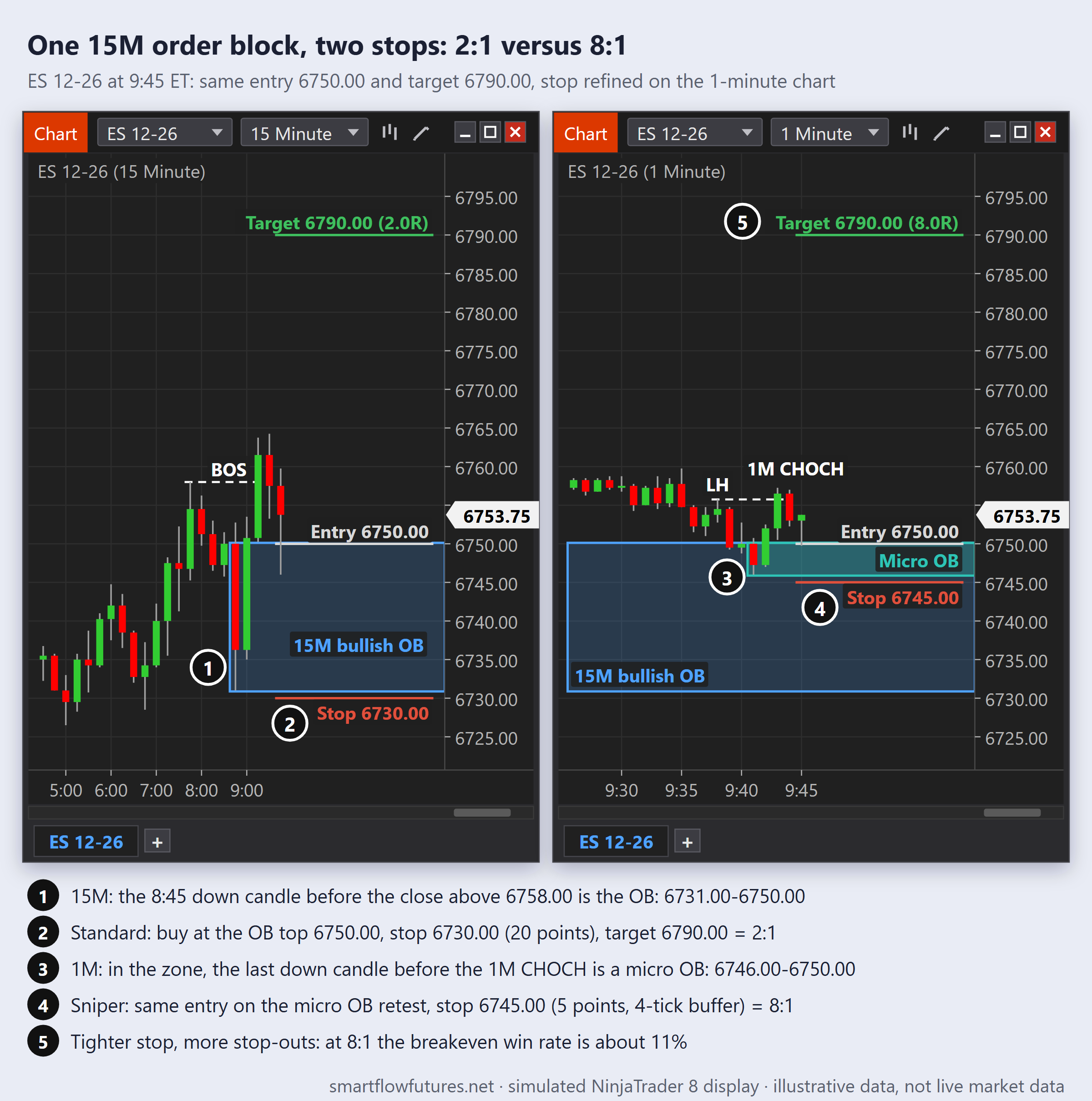
As price enters your zone, identify the smallest order block on the 1M chart. Enter precisely at this micro order block. Stop goes just beyond its far edge with a small buffer (2-4 ticks on ES, 8-20 ticks on NQ): typically only a few points on ES, about 10-15 points on NQ.
Technique 3: FVG Refinement Entry
You have a 15M FVG marked as your zone. When price enters this FVG, drop to the 1M chart. Look for a smaller FVG forming within the larger one. Enter at this refined FVG for a tighter stop.
Technique 4: Rejection Candle Entry
Wait for price to tap your zone and form a clear rejection candle (pin bar, engulfing). Enter at the close of the rejection candle. Stop goes beyond the rejection wick.
Risk-Reward Calculation
Sniper entries transform your risk-reward profile:
Standard Entry Example:
Entry at the top of a bullish 15M order block. Stop: 20 points below the entry (below the block with its buffer). Target: 40 points above the entry. Risk-Reward: 2:1.
Sniper Entry Example:
Same 15M order block, refined on the 1M: entry at the 1M micro-structure, at the same price as the standard entry. Stop: 5 points below the entry (just under the 1M structure, buffer included) instead of below the whole block. Target: the same level, 40 points above the entry. Risk-Reward: 8:1.
The target remains the same, but the entry precision shrinks the stop dramatically.
When Sniper Entries Work Best
Sniper techniques are most effective when:
Strong Higher Timeframe Level: Your zone has significant higher timeframe relevance. A daily order block refined to a 1M entry carries more weight than a minor intraday zone.
Clear Market Direction: The trend is established. Sniper entries against the trend are risky despite tight stops.
Killzone Timing: Entering during the London (2:00-5:00 AM ET) or New York AM (7:00-10:00 AM ET) killzone tends to give faster follow-through.
Confluence Present: The zone has multiple factors supporting it (OB + FVG + OTE, for example).
The Trade-Off
Sniper entries come with a trade-off: tighter stops mean higher probability of stop-out. You may get stopped more frequently, but when trades work, the reward is substantially larger.
At 8:1 the breakeven win rate is about 11% before commissions and slippage (one 8R winner pays for eight 1R losers), so the trade-off can be worth it; expect a lower win rate than with the wider stop, and track your own.
Practical Application
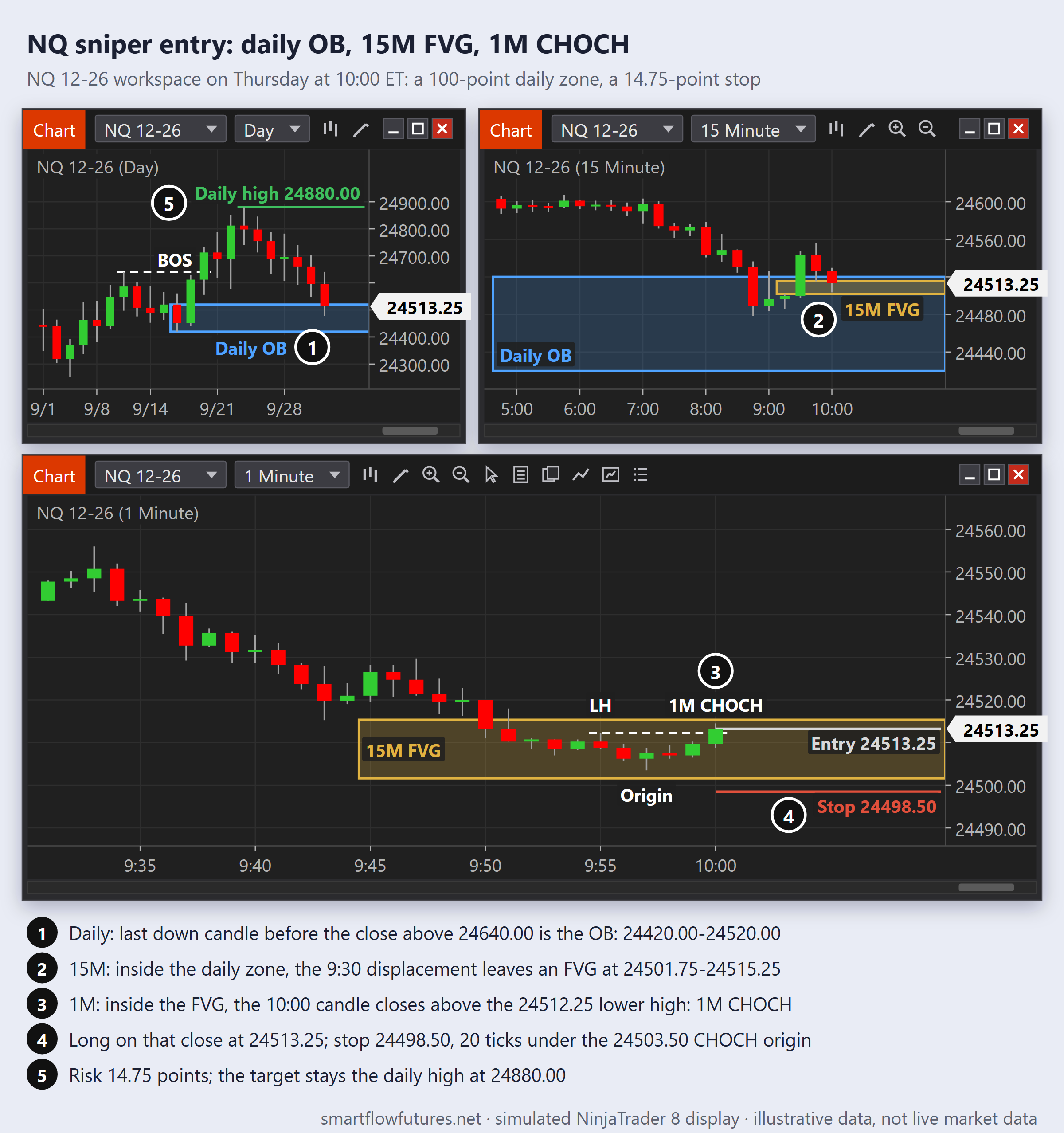
Scenario: Your daily analysis identifies a bullish order block on NQ. The 4H is bullish. You are looking to buy a pullback to this daily order block.
The Approach:
Mark the daily order block zone (perhaps 100 points in size). As price approaches, switch to the 15M chart. Within the daily zone, identify 15M order blocks or FVGs. When price enters the 15M zone, switch to the 1M chart. Look for 1M CHOCH or rejection pattern. Enter with stop just beyond the 1M structure (perhaps 10-15 points). Target remains the daily high or next major level.
Managing Sniper Trades
Because stops are tight:
Move to Breakeven Quickly: Once price moves in your favor by 1R (one times your risk), consider moving stop to breakeven.
Accept Failures: Some sniper entries will get stopped by noise. This is normal. The larger winners make up for them only while your win rate stays above the breakeven win rate.
Do Not Widen Stops: The larger R:R comes from the tight stop. Widening it after entry makes the loss bigger than planned and defeats the purpose.
Common Sniper Mistakes
Over-Refinement: Refining too much on charts below 1M where noise dominates and signals are unreliable.
Missing Trades: Waiting for the perfect 1M setup while the trade leaves without you. Balance precision with execution.
Wrong Bias: A perfect sniper entry means nothing if the higher timeframe bias is wrong. Precision cannot fix incorrect direction.
Key Takeaways
Sniper entries use multiple timeframes: direction from higher TF, execution from lower TF. Refining from 15M to 1M or 5M can dramatically reduce stop size. Techniques include lower TF CHOCH, micro order blocks, and FVG refinement. Accept higher stop-out frequency in exchange for a larger risk-reward. The larger R:R comes from maintaining tight stops while keeping the same targets; it pays only while your win rate stays above the breakeven win rate.