
The Silver Bullet is a specific intraday strategy designed to capture moves during precise one-hour windows. By combining time-based analysis with SMC concepts, the Silver Bullet provides a structured approach to finding one excellent trade per session.
What is the Silver Bullet Strategy?
The Silver Bullet strategy focuses on trading Fair Value Gaps (FVGs) that form during specific one-hour windows (not killzones: the New York AM window starts right after the New York AM killzone, 7:00-10:00 AM ET). Rather than trading all day, you wait for particular time windows when institutional activity typically creates clean, tradeable setups.
The philosophy is simple: one well-executed trade per session beats many mediocre ones.
Silver Bullet Time Windows
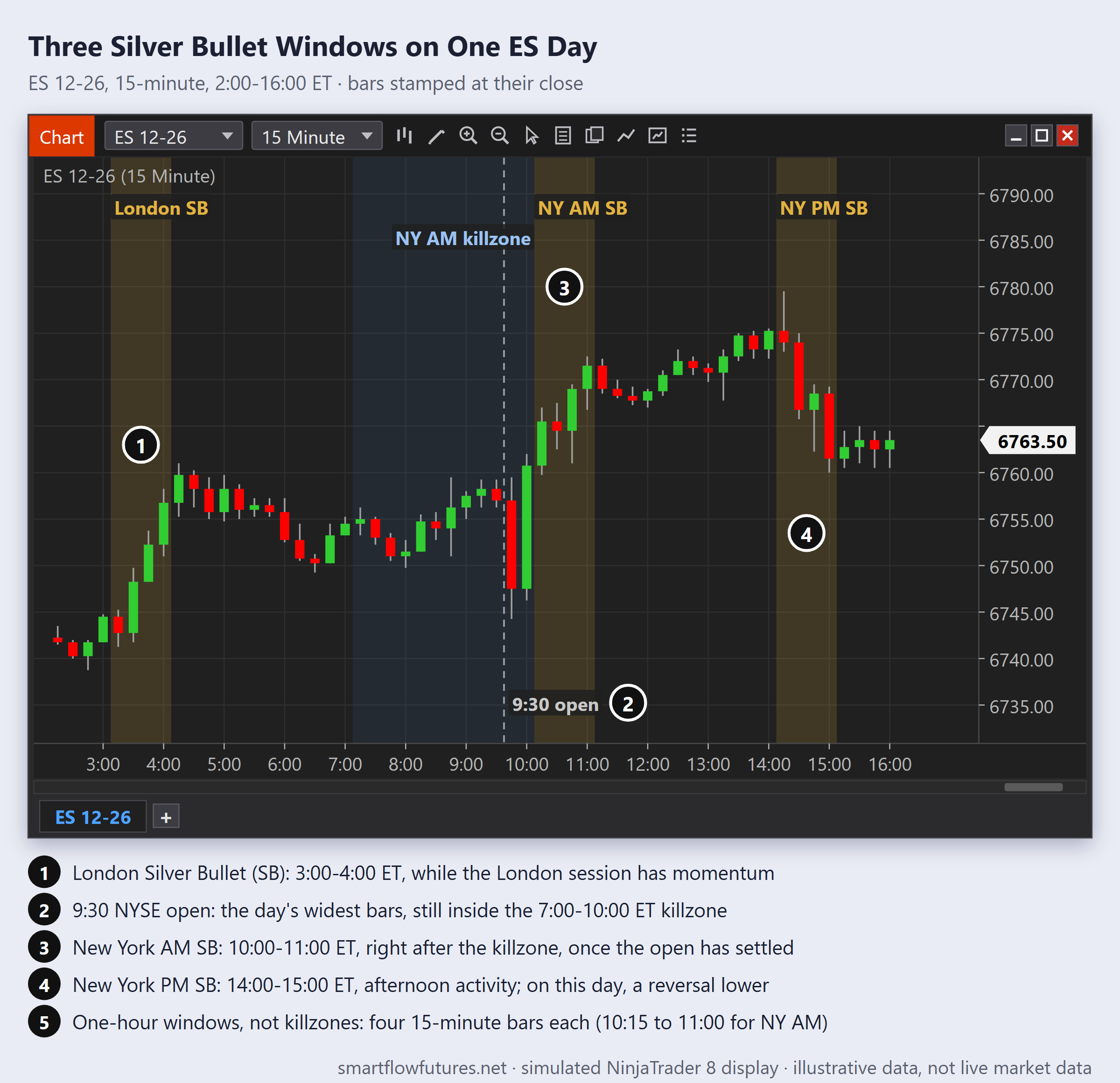
The strategy recognizes three primary Silver Bullet windows for US markets:
London Silver Bullet: 3:00 AM – 4:00 AM ET. Captures the London session momentum. Best for those able to trade European hours.
New York AM Silver Bullet: 10:00 AM – 11:00 AM ET. The primary window for most traders. Occurs after the initial NYSE volatility settles.
New York PM Silver Bullet: 2:00 PM – 3:00 PM ET. Captures afternoon institutional activity. Often sees reversals or trend continuations.
The Silver Bullet Setup
During the Silver Bullet window, look for this specific pattern:
Step 1: Establish Bias
Before the window opens, determine your directional bias using higher timeframe analysis. Are you looking for longs or shorts?
Step 2: Wait for Displacement
Within the Silver Bullet window, wait for a strong displacement move (aggressive candles in one direction). This displacement should create a Fair Value Gap.
Step 3: Identify the FVG
Mark the FVG created by the displacement. This is your potential entry zone.
Step 4: Entry on Retracement
Wait for price to retrace into the FVG. Enter with a limit order at the near edge of the gap or at its midpoint, or on confirmation once price is inside it.
Step 5: Target Previous High/Low
Target the next untaken swing high (swing low for a short), or the next liquidity pool. A swing the displacement already broke has no liquidity left to target.
Silver Bullet Entry Rules
For Long Setups:
Higher timeframe bias is bullish. During the window, price displaces upward, creating a bullish FVG. Price retraces down into the FVG. Enter long within the FVG. Stop below the FVG low. Target the swing high or external liquidity above.
For Short Setups:
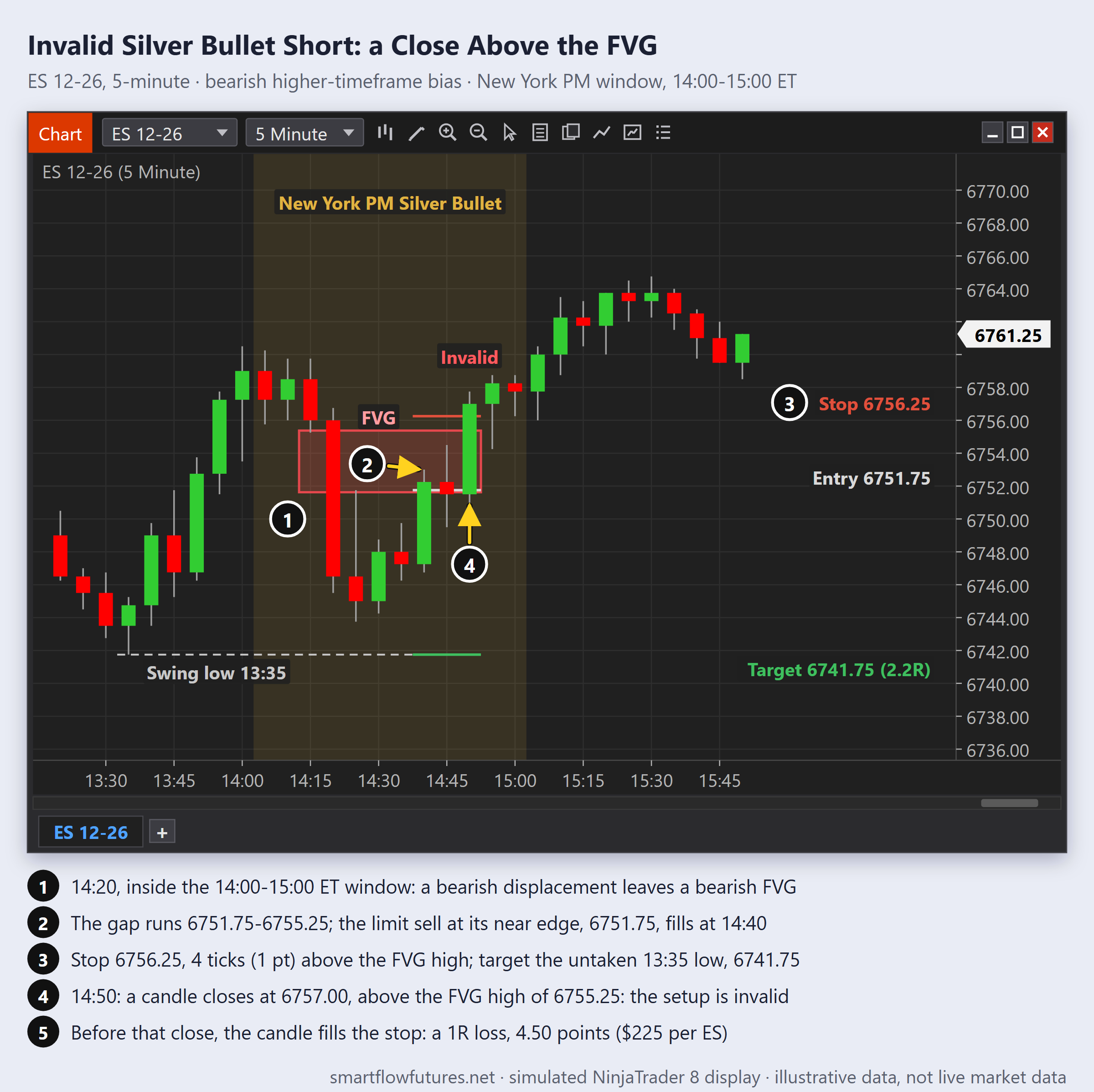
Higher timeframe bias is bearish. During the window, price displaces downward, creating a bearish FVG. Price retraces up into the FVG. Enter short within the FVG. Stop above the FVG high. Target the swing low or external liquidity below.
Qualifying Silver Bullet Setups
Not every FVG during the window is tradeable. Quality Silver Bullets have:
Clear Displacement: The move creating the FVG should be aggressive and decisive, not choppy or overlapping.
Reasonable FVG Size: The gap should be tradeable but not excessively large. Very large gaps suggest extreme volatility.
Alignment with Bias: The setup should align with your higher timeframe direction.
Not Against Major Levels: Avoid setups that run into significant higher timeframe resistance or support.
Risk Management
Silver Bullet trades should have defined risk:
Stop Placement: Beyond the FVG is standard. If a candle closes beyond the far edge of the gap (below the FVG low for a long, above the FVG high for a short), the setup is invalid.
Position Sizing: Risk a fixed percentage per trade (1-2% recommended). The strategy may only provide one trade per session.
Trade Duration: Most Silver Bullet trades should work quickly (within 30-60 minutes). If stalling, consider managing the trade.
Silver Bullet and SMC Confluence
The best Silver Bullet setups have additional confluence:
Order Block and FVG: If the order block the displacement started from sits directly below the FVG (directly above it for a bearish gap), or a lower-timeframe order block sits inside the FVG, the setup has more confluence.
OTE Zone: If the FVG falls within the OTE zone of a larger move, the setup gains strength.
Liquidity Sweep Before: If liquidity was swept before the displacement, smart money is likely positioned.
SMT Divergence: If correlated markets show divergence supporting your direction, confidence increases.
Example Silver Bullet Trade
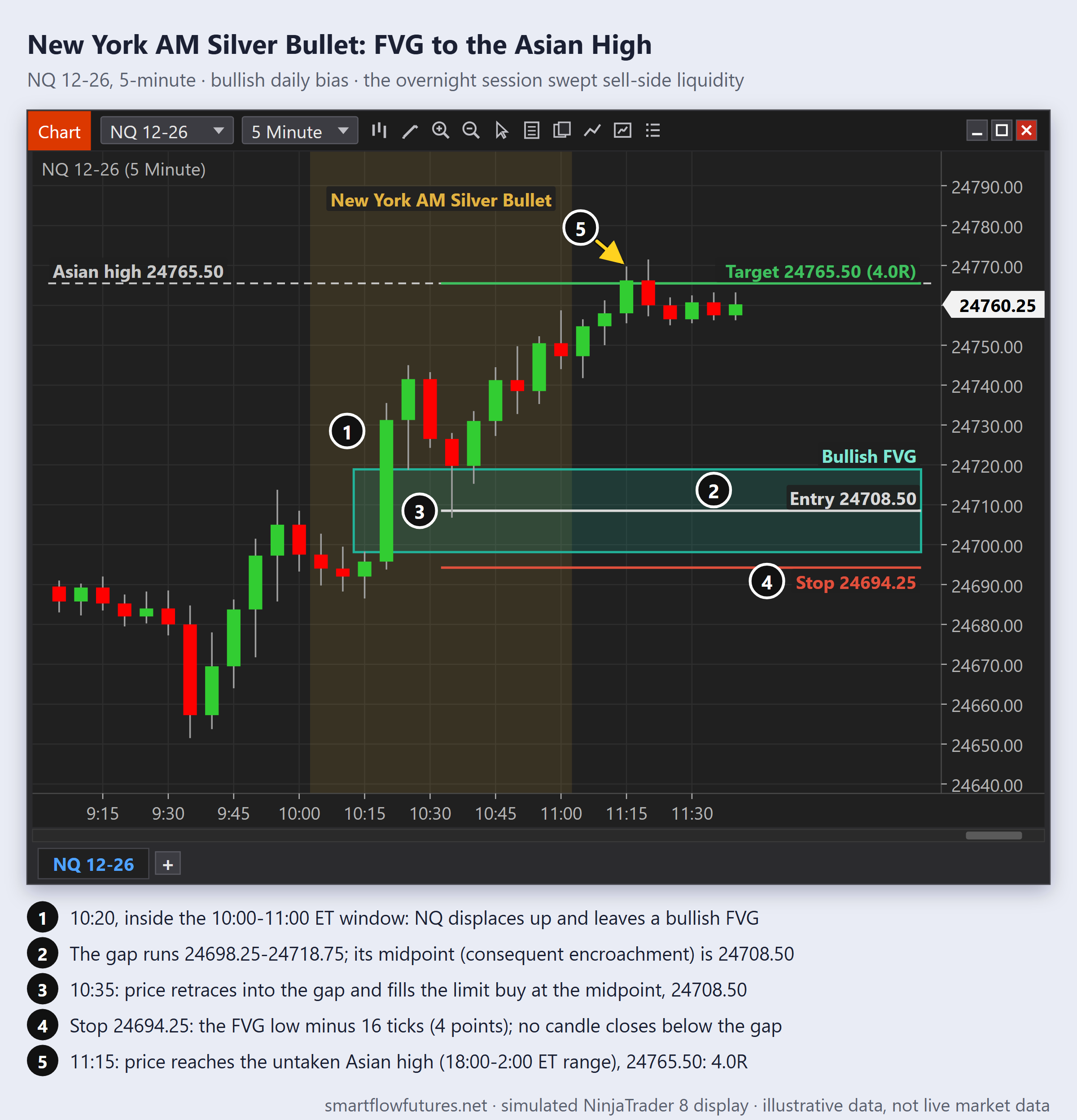
Context: It is 10:15 AM ET. Your daily analysis shows bullish bias on NQ. The overnight session swept sell-side liquidity.
The Setup: At 10:20 AM, NQ displaces sharply upward, creating a clean bullish FVG. Price then retraces toward the gap.
The Entry: At 10:35 AM, price retraces into the FVG and fills your limit buy at the midpoint of the gap (its consequent encroachment). Stop goes below the FVG. Target is the Asian high (the high of the 6:00 PM-2:00 AM ET range), still untaken above price.
The Result: Price bounces from the FVG and rallies to your target by 11:15 AM. Trade completed within the session.
Common Silver Bullet Mistakes
Trading Outside the Window: The strategy is time-specific. FVGs outside the window are different trades.
Forcing Setups: Not every session provides a Silver Bullet. No setup is better than a bad setup.
Ignoring Bias: Trading against your determined bias fails the ‘Alignment with Bias’ requirement.
Multiple Trades: The strategy is designed for one trade per window. Taking multiple trades defeats the purpose.
Key Takeaways
The Silver Bullet strategy focuses on specific time windows: 3-4 AM, 10-11 AM, or 2-3 PM ET. Look for displacement creating an FVG during these windows. Enter on retracement into the FVG with proper stop placement. One quality trade per session is the goal. Combine with other SMC confluence for stronger setups.