
Fair Value Gaps, commonly abbreviated as FVGs, are one of the core concepts in Smart Money trading. They represent moments of extreme imbalance where price moved so aggressively that it left a gap in the market structure. Understanding FVGs will change how you read price action.
What is a Fair Value Gap?
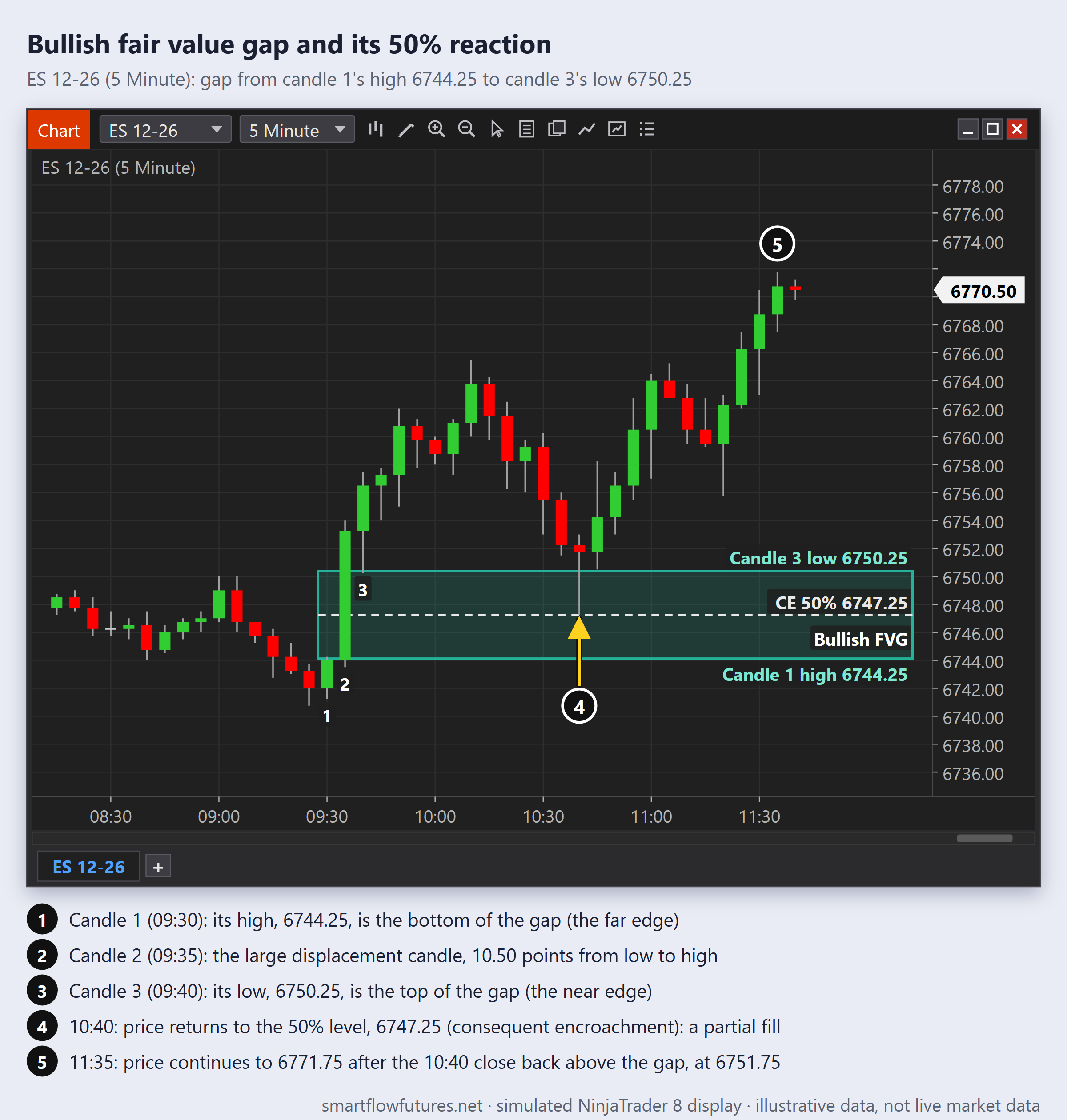
A Fair Value Gap is a three-candle pattern where the middle candle is so large that a gap exists between the wicks of the first and third candles. This gap represents a zone where price was delivered in one direction with little two-way trade, driven mostly by aggressive buying or selling.
In a Bullish FVG, the gap forms during an up move. The high of candle one doesn’t overlap with the low of candle three, creating a gap that price may return to fill.
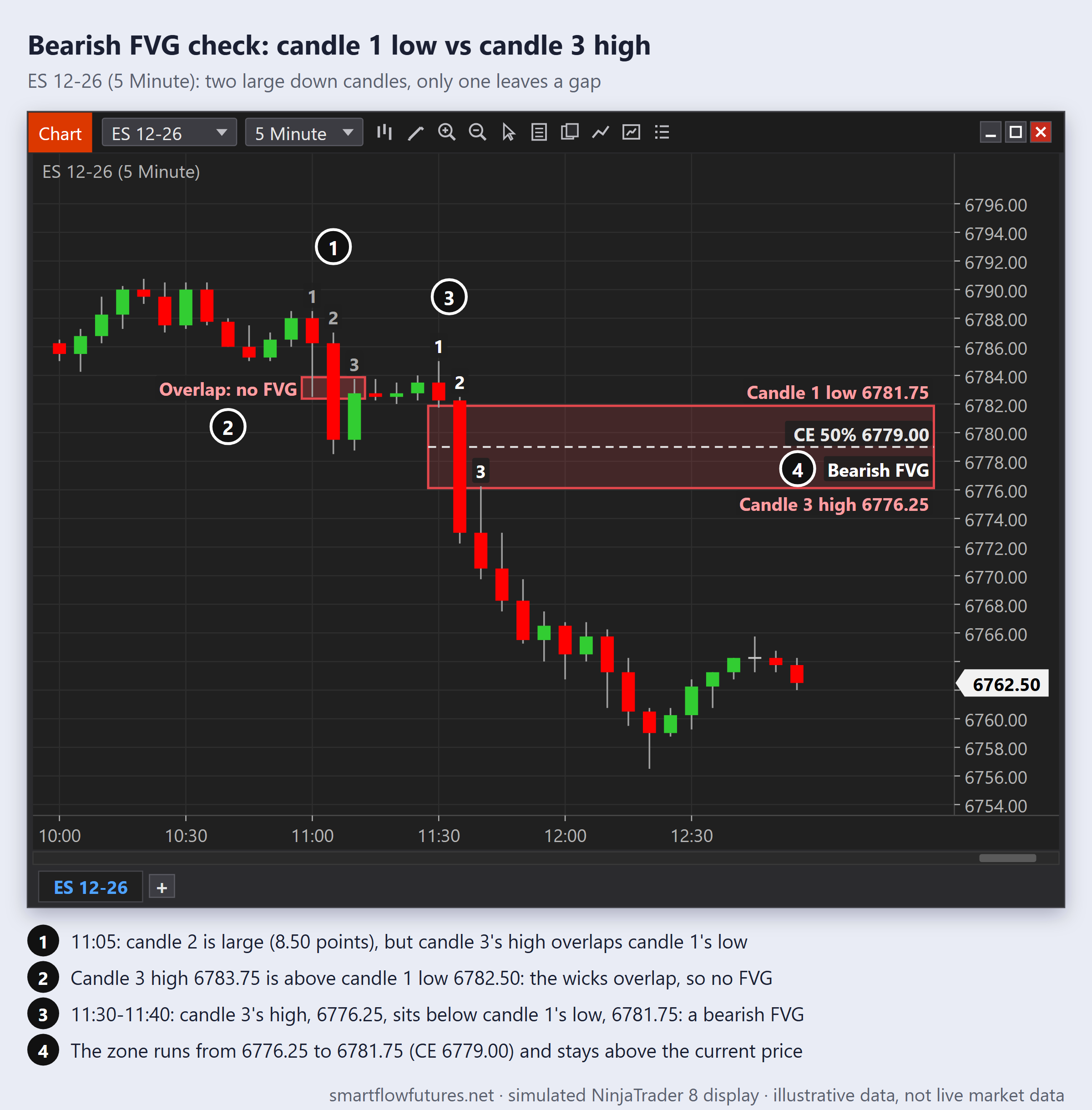
In a Bearish FVG, the gap forms during a down move. The low of candle one doesn’t overlap with the high of candle three, creating a gap above the current price.
Why Do FVGs Form?
FVGs occur when institutional order flow is so aggressive that it overwhelms normal market mechanics. Imagine a large institution needs to buy a significant position quickly. Their buying is so intense that sellers cannot keep up. Price moves before adequate selling can meet the demand.
This creates an inefficiency. Markets naturally seek balance, and these imbalanced zones often attract price back for rebalancing. The theory is simple: where trading was mostly one-sided, the market wants to return and establish fair value through two-sided trading.
Identifying Fair Value Gaps
To identify an FVG, examine any three consecutive candles:
For a Bullish FVG:
Compare the high of the first candle with the low of the third. If the third candle’s low sits above the first candle’s high, there’s a gap, and the FVG zone is the space between them.
For a Bearish FVG:
Compare the low of the first candle with the high of the third. If the third candle’s high sits below the first candle’s low, there’s a gap, and the FVG zone is the space between them.
FVG Trading Strategies
Strategy 1: FVG as Support/Resistance
The most common approach treats bullish FVGs as support and bearish FVGs as resistance. When price returns to a bullish FVG, expect buying. When price returns to a bearish FVG, expect selling.
Strategy 2: FVG Fill and Continue
Price often trades into an FVG, frequently to its 50% level and sometimes to its far edge (candle one’s high for a bullish FVG, candle one’s low for a bearish one), before continuing in the original direction. This provides entry opportunities with defined risk. Stops can go beyond that far edge, plus a small buffer.
Strategy 3: Consequent Encroachment
The 50% level of an FVG (the middle of the gap) is often the level where price reacts, rather than the market filling the entire gap. This is called consequent encroachment, a common reaction level.
FVG Quality Factors
Like order blocks, FVG quality varies:
Higher Timeframe FVGs: More significant and more likely to cause reaction. A daily FVG is more powerful than a 5-minute FVG.
Fresh vs. Tested: Untested FVGs have higher probability. Each test weakens the gap.
Size of the Gap: Larger gaps indicate more aggressive order flow and may have stronger reactions.
Context: FVGs that form with the trend and align with other SMC concepts carry higher probability.
Combining FVGs with Other Concepts
FVGs carry more weight when combined with other SMC concepts:
FVG + Order Block: When the displacement out of an order block leaves an FVG beyond it (above a bullish block, below a bearish one), you have confluence: the two zones reinforce each other. An FVG inside a block only happens across timeframes (a lower-timeframe FVG inside a higher-timeframe block).
FVG + Premium/Discount: Bullish FVGs in discount zones and bearish FVGs in premium zones offer better risk-reward than gaps on the other side of equilibrium.
FVG + Break of Structure: FVGs that form during a BOS often mark significant institutional activity and warrant attention.
Partial Fills vs. Full Fills
Not every FVG gets completely filled. Understanding the difference helps set realistic expectations:
Partial Fill: Price enters the FVG zone but reverses before completing the fill. This often happens at the consequent encroachment (50%) level.
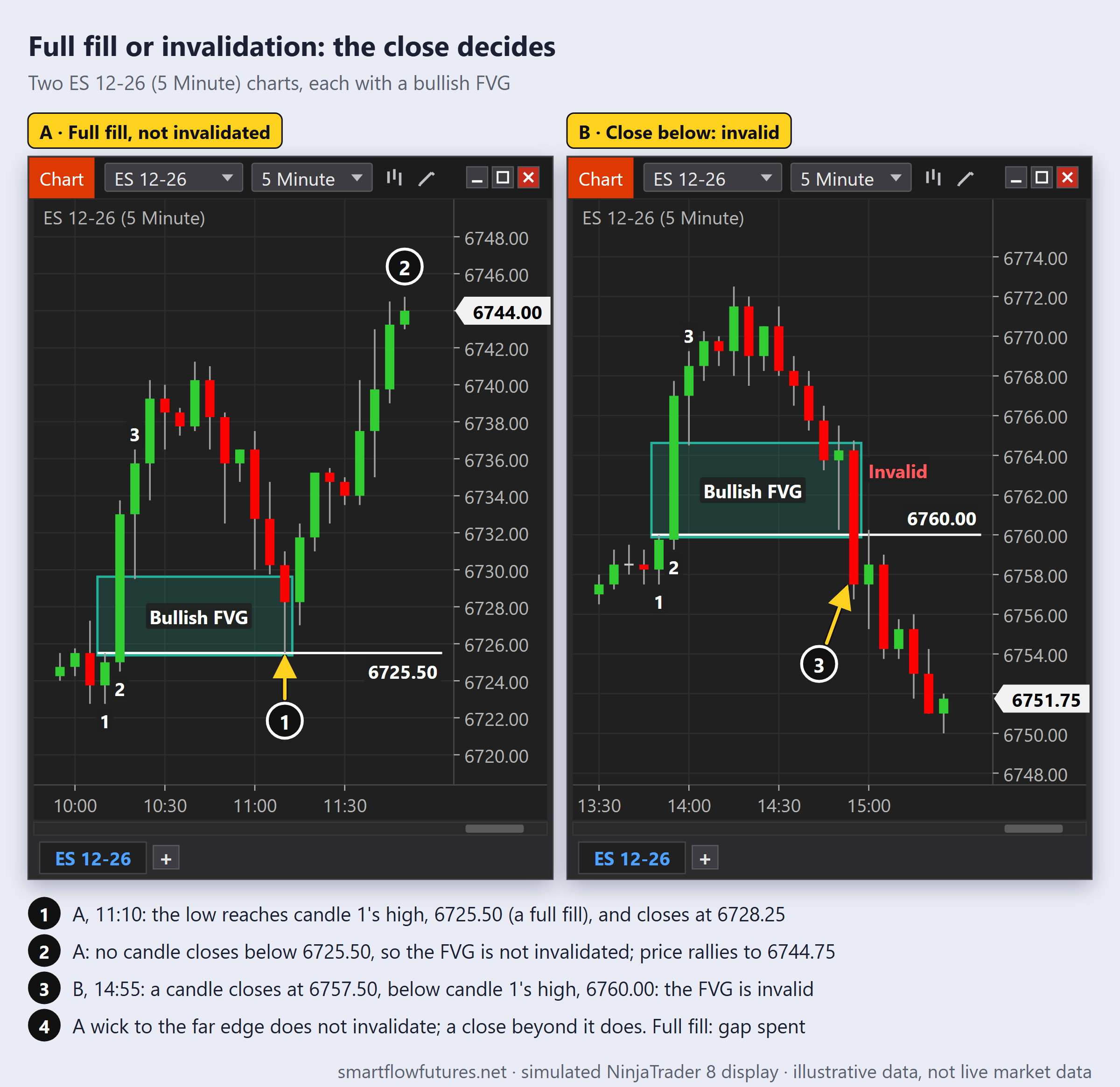
Full Fill: Price reaches the far edge of the FVG, closing the inefficiency completely. After a full fill, the gap is spent for later returns.
Rejection: Sometimes price approaches an FVG but reverses before entering it. This shows strong defense of the zone and can be a trading signal itself.
FVG Invalidation
An FVG is considered invalid when:
A candle closes beyond the far edge of the gap (below candle one’s high for a bullish FVG, above candle one’s low for a bearish one). Multiple tests have significantly weakened the zone. Higher timeframe structure has changed, making the FVG irrelevant to current price action. Very old FVGs can also lose relevance simply through time decay.
Practical Application
Here’s how to incorporate FVGs into your trading:
During Analysis: Mark significant FVGs on your higher timeframe charts (4H, Daily). These become reference levels for the day or week.
During Trade Planning: Identify FVGs that align with your bias. If bullish, look for bullish FVGs in discount as potential entry zones.
During Execution: When price approaches an FVG, enter with a limit order at its near edge (candle three’s low for a bullish FVG, candle three’s high for a bearish one) or at its 50% level, or wait for lower timeframe confirmation (see the FVG Retest lesson).
Key Takeaways
Fair Value Gaps represent aggressive institutional order flow that created market inefficiency. They form when the wicks of candles one and three don’t overlap. Markets often return to FVGs to rebalance and establish fair value. The 50% level (consequent encroachment) is often where price reacts first. Combine FVGs with other SMC concepts for higher probability setups.