
Daily Open and Midnight Open: Time-Based Trading Concepts
Time is an important but often overlooked element of trading. Institutional traders operate on schedules, and certain times of day create important reference points. Understanding the Daily Open and Midnight Open concepts helps you align with institutional activity.
Why Time Matters in SMC
Institutions don’t trade randomly. They execute during specific windows based on market participation, their clients’ needs, and strategic considerations. Certain price levels gain significance based on when they were established.
The daily open and midnight open are two such levels that often influence intraday price action.
The Daily Open
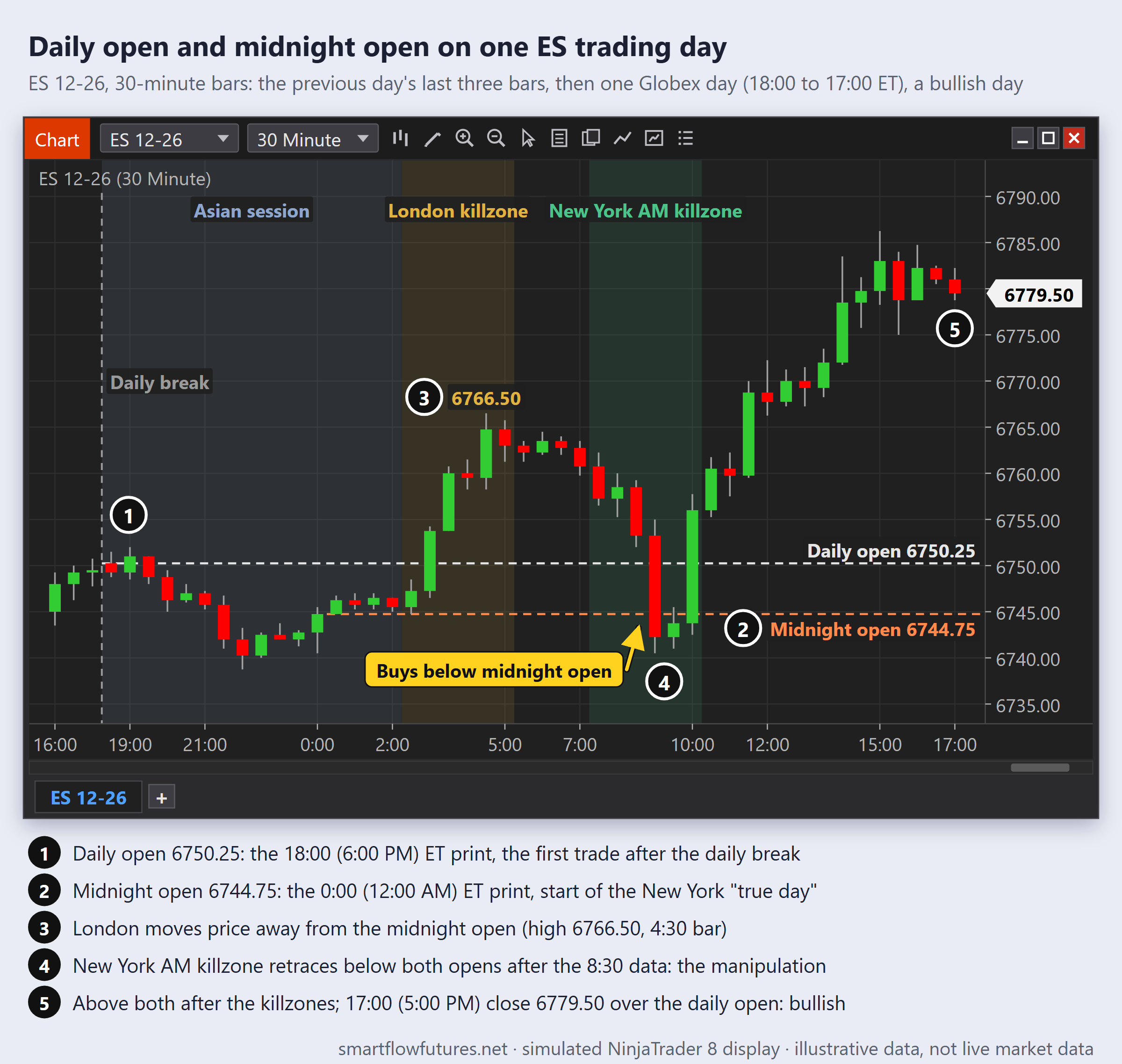
The daily open is the price at which the new trading day begins. For futures like NQ, ES, and YM, this is typically at 6:00 PM ET when the new session starts after the daily break.
Why It Matters:
The daily open represents the “starting point” for institutional positioning. A day whose 5:00 PM ET close is above its daily open is bullish, below it bearish; early moves against that bias are often the manipulation, a false move before the real one. Price often tests the daily open before making its directional move.
Trading with Daily Open
Monitor how price reacts to the daily open during the session. Use your higher-timeframe bias to judge which side of the daily open the day is likely to close on. For entries, use the midnight open (next section): on a bullish day the best buys usually come below the midnight open, after the morning manipulation; on a bearish day the best sells come above it. If price is oscillating around the daily open, the market is undecided, so wait for clarity.
The Midnight Open
The midnight open is the price at 00:00 (midnight) New York time. This marks the start of the “true day” for New York-based traders and many global institutions.
Why It Matters:
The midnight open is often an intraday pivot. Moves made after midnight, late in the Asian session and in London, set up relative to this level, and the New York session frequently retraces to or through the midnight open before making its main move.
Common Patterns
Price moves away from the midnight open in London, then retraces to or through it in the New York AM killzone (7-10 AM ET). That retracement is the manipulation; price then continues in the daily direction.
This pattern isn’t universal, but it occurs frequently enough to be worth monitoring.
Using These Levels Together
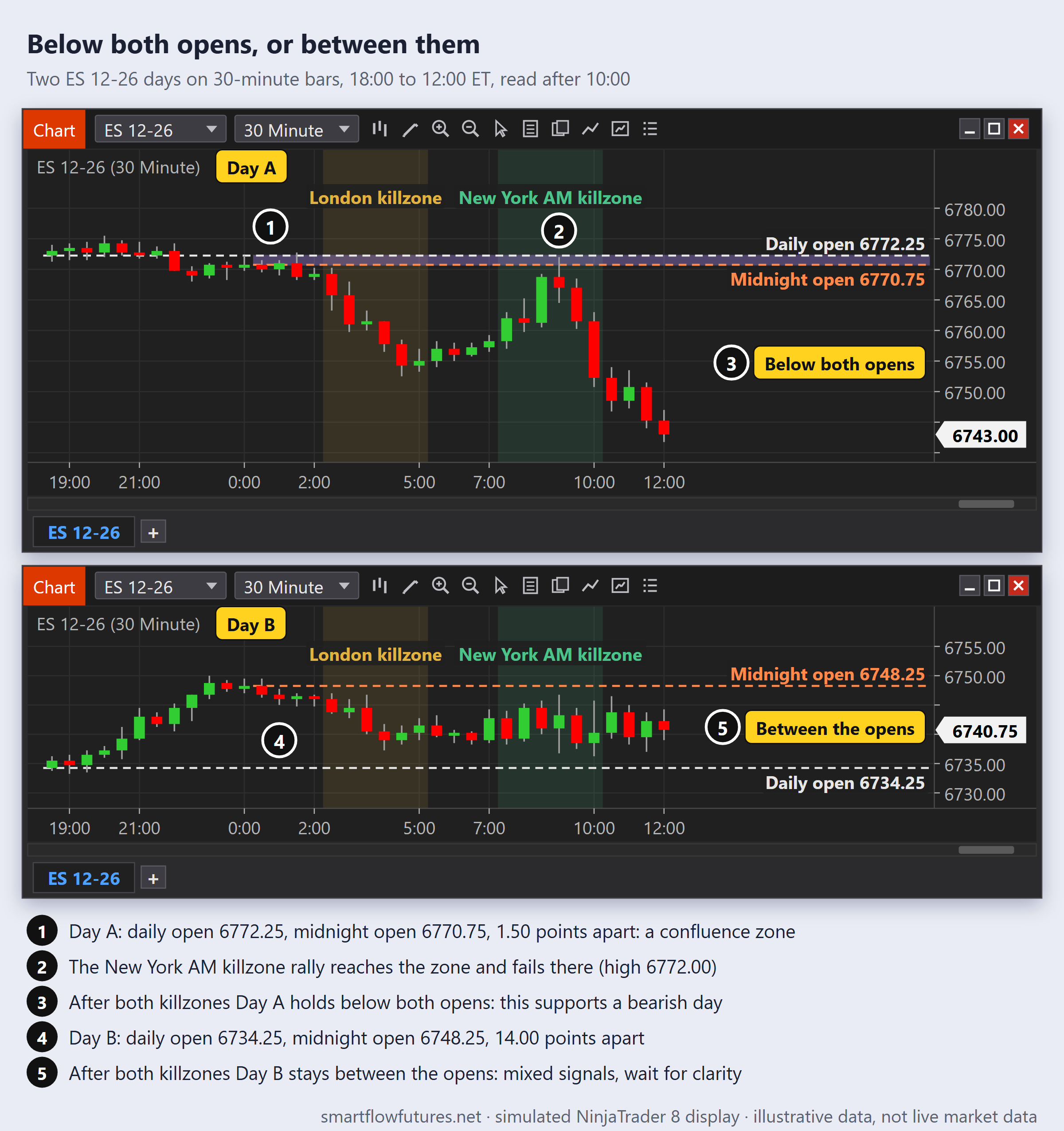
The daily open and midnight open often provide context for each other. When both sit at similar levels, that’s a strong confluence zone. Price holding above both after the London and New York AM killzones supports a bullish day; holding below both, a bearish day. When price sits between them, the signals are mixed, so wait for clarity.
Practical Application
Mark the daily open (6:00 PM ET) and the midnight open (12:00 AM ET) on your chart each day. Watch how price reacts during different sessions. Use them as reference points for bias, not as entry signals themselves. Combine with order blocks and structure for actual trade setups.
Session Timing
Understanding when different sessions operate helps contextualize these levels. The Asian session runs 6 PM to 2 AM ET, the London session 2 AM to about 12 PM ET (the London open itself is 3 AM), and the New York session 7 AM to 5 PM ET. London and New York overlap from 8 AM to 12 PM ET (the usual currency-market convention, which starts New York at 8 AM); for ES and NQ the busiest stretch is the New York AM killzone (7-10 AM ET), with its 8:30 AM data and 9:30 AM cash open.
Key Takeaways
The daily open (6 PM ET for futures) marks the new trading day. The midnight open (12 AM ET) is often an intraday pivot. Used with your higher-timeframe bias, these levels show where the day’s best entries sit: below them on a bullish day, above them on a bearish day. These are reference levels, not standalone trading signals. Combine with other SMC concepts for complete analysis.