
Order Blocks Explained: Where Institutions Enter
Order blocks are a core concept in SMC trading. They represent zones where institutional traders have placed significant orders, leaving footprints that often influence future price action. Understanding order blocks transforms how you see charts.
What is an Order Block?
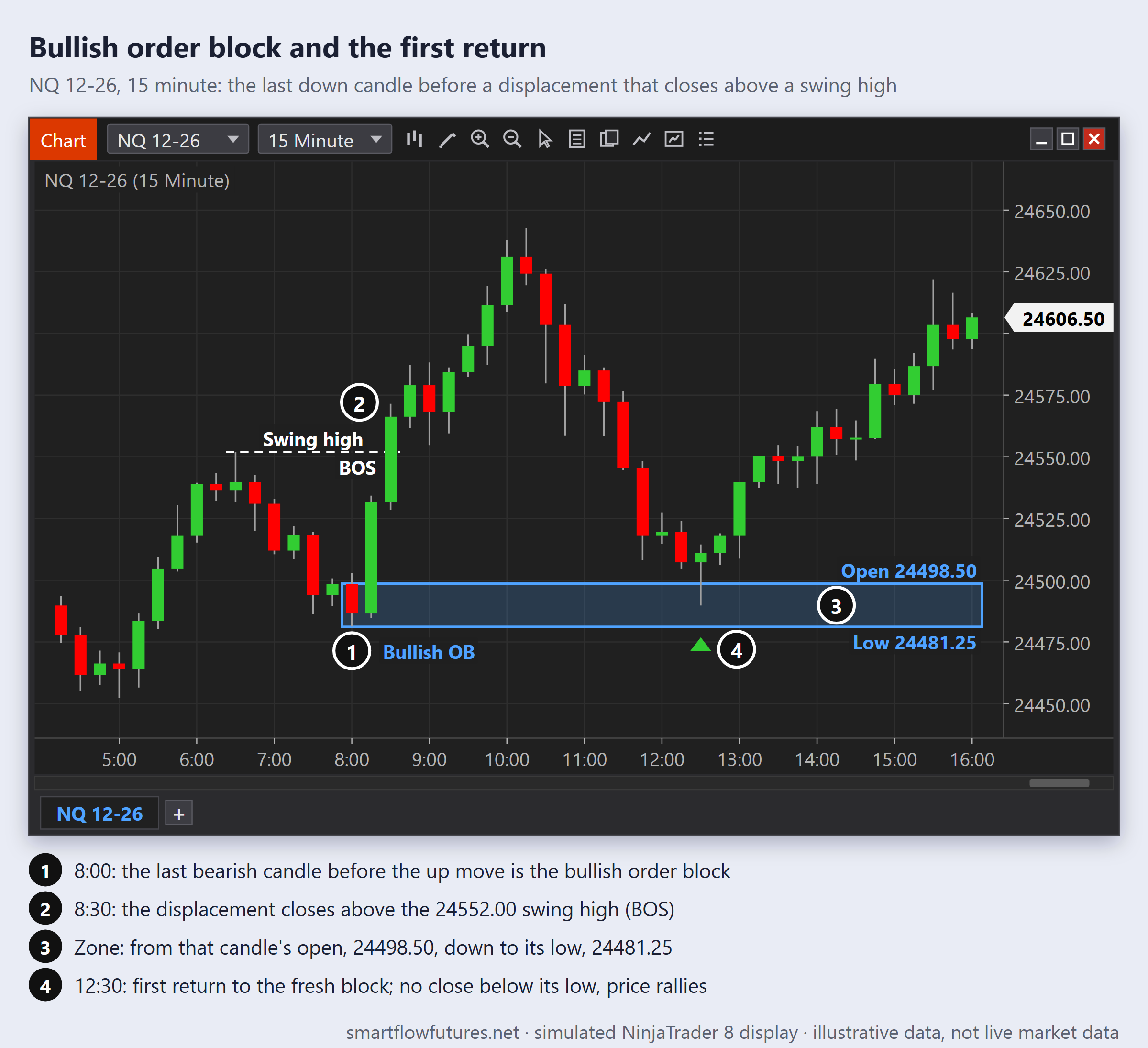
An order block is the last candle (or series of candles) of one color before a significant move in the opposite direction. It represents the zone where institutions accumulated or distributed positions before price moved.
Bullish Order Block: The last bearish candle before a significant up move. Institutions were buying in this zone.
Bearish Order Block: The last bullish candle before a significant down move. Institutions were selling in this zone.
Why Order Blocks Work
Institutions can’t fill large orders instantly. If a fund needs to buy several hundred NQ contracts (one contract is worth about $490,000 at 24,500), a single market order would push price through several levels before it was filled.
Instead, they accumulate gradually. Sometimes they buy while price is falling (catching other traders’ stop losses). The zone where this accumulation occurs often shows as the last down candle before the move up.
When price returns to these zones later, several things may happen. The institutions may add to positions if they want more exposure. Other traders recognize the level and enter, creating demand. Unfilled orders from the original accumulation may still be sitting there.
This confluence often causes price to react when revisiting order blocks.
Identifying Order Blocks
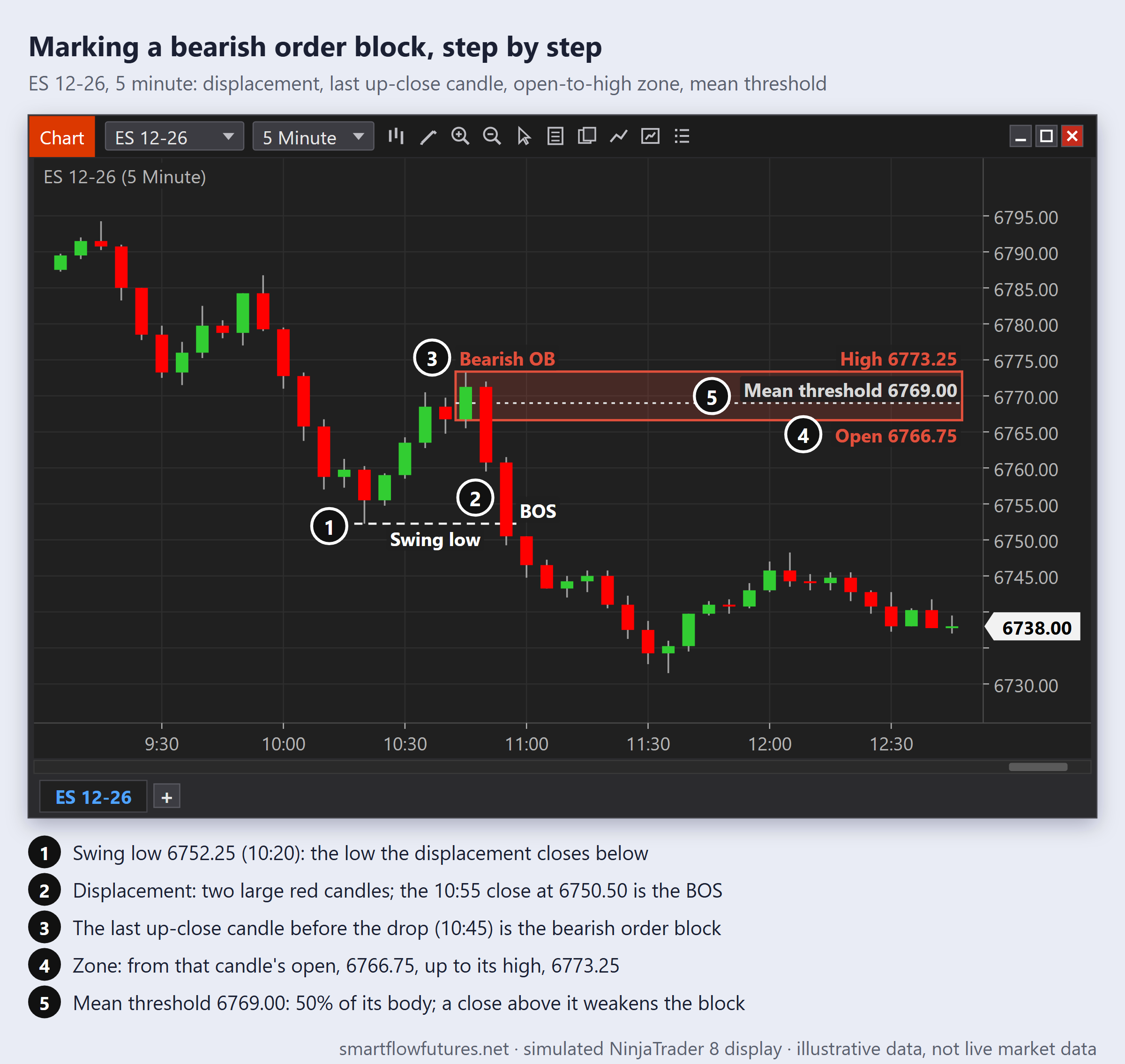
The basic process involves finding a displacement (a decisive move of large-bodied candles, ideally one that closes beyond a swing), looking back to find the last opposite-color candle before the move, and marking the zone from that candle’s open to its low for a bullish block (open to its high for a bearish block). The block’s mean threshold is the midpoint of that candle’s body (50% between its open and close); a candle close beyond it (below it, for a bullish block) weakens the block.
Quality Filters
Not all order blocks are equal. Stronger order blocks cause a break of structure, are on higher timeframes, have a strong move away (showing conviction), are in premium/discount zones (depending on direction), and haven’t been tested yet (fresh order blocks).
Order Blocks vs. Support/Resistance
Order blocks might look like traditional support and resistance, but the two work differently. Traditional S/R focuses on horizontal levels where price has bounced. These zones focus on the cause (institutional positioning) rather than just the effect (price bounce), which makes them more precise. Understanding why they work also improves your ability to filter good levels from bad ones.
Order Block Mitigation
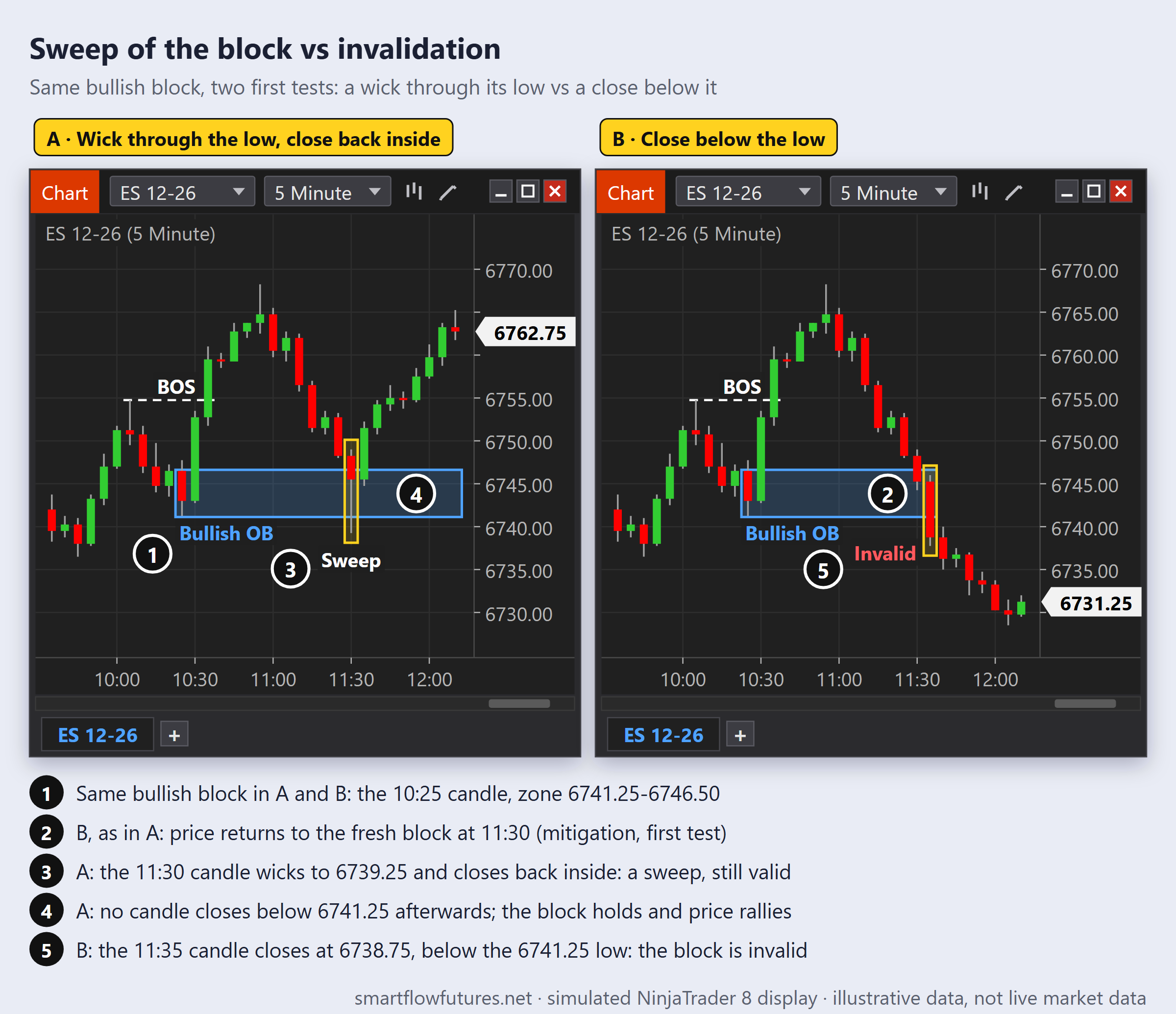
“Mitigation” refers to price returning to an order block. When an order block is mitigated, unfilled orders may be filled. Traders who entered at that level may be exiting. The order block’s “energy” may be used up.
Order blocks that have been mitigated (tested) are generally weaker than fresh (untested) order blocks. A block is invalid once a candle closes beyond its far edge (below a bullish block’s low, above a bearish block’s high); a wick through it that closes back inside is a sweep of the block, not an invalidation.
Types of Order Blocks
SMC names several types. This course trades the standard type; the other three are defined here and not traded separately. Standard Order Blocks are the basic type described above. Breaker Blocks are order blocks that fail after price has first taken a prior swing high or low. A bullish breaker is the bearish order block (the last up-close candle at the high) left before a down-move that took a prior low; once a candle closes above its high, it is used as support on the return (a bearish breaker mirrors this). Mitigation Blocks are the same failure without the prior liquidity grab: for a bullish mitigation block, the down-move made a higher low instead of taking the prior low (a bearish mitigation block mirrors this with a lower high). Rejection Blocks are zones from the candle bodies to the tips of the long wicks at a swing high or low.
Trading Order Blocks
A basic order block trading approach involves identifying the trend using higher timeframe structure, waiting for a pullback to an order block in the direction of the trend, looking for confirmation at the order block (lower timeframe CHOCH or reaction), entering with stops beyond the order block, and targeting the next significant level or order block.
Common Mistakes
Traders often fall into traps like marking every small candle as an order block (be selective—quality over quantity), trading order blocks against the trend (always prioritize higher timeframe direction), ignoring the quality of the move that created the order block (weak moves create weak order blocks), and not waiting for confirmation when your plan calls for it (order blocks are zones for setups, not automatic entry signals).
Key Takeaways
Order blocks mark zones of institutional positioning. Bullish OB is the last down candle before an up move. Bearish OB is the last up candle before a down move. Price often reacts when returning to order blocks. Quality filters are essential—not all order blocks are tradeable. Combine with structure, premium/discount, and confirmation for best results.