
Bullish Order Blocks: Finding Institutional Buying Zones
Bullish order blocks are the footprints of institutional buying. When you can identify where large players have accumulated positions, you can position yourself to ride the same wave. This article provides a complete guide to finding and trading bullish order blocks.
Defining the Bullish Order Block
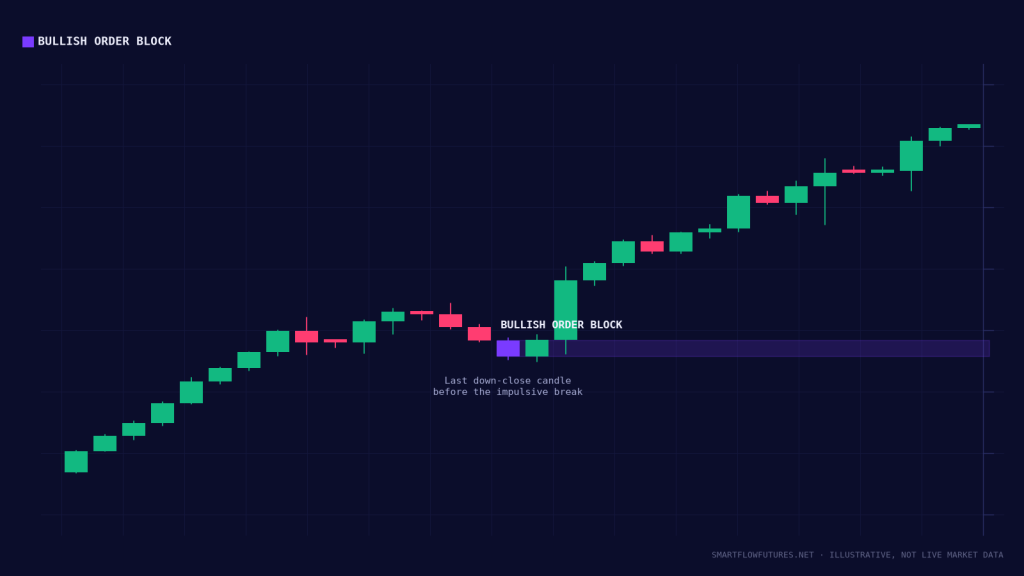
A bullish order block is formed when price makes a down move (creating a bearish candle or series of candles), followed by a significant up move that breaks structure or shows strong momentum. The last bearish candle before the up move becomes the bullish order block.
This zone represents where institutional buying overcame selling pressure. When price returns, institutions may still have interest in buying at these levels.
Identification Process
Step 1: Identify bullish market structure (uptrend) on your trading timeframe.
Step 2: Find significant up moves that broke structure (BOS) or showed strong impulse.
Step 3: Look back to find the last bearish candle before the up move began.
Step 4: Mark the zone from the candle’s open to the candle’s low (this is your order block zone).
Quality Assessment
High-quality bullish order blocks share several traits. A strong one causes a break of structure, which shows institutions had real conviction behind it. It also sits in the discount zone, below 50% of the range, where buyers get good value. Higher timeframe order blocks carry more weight than lower timeframe ones. An untested (fresh) block hasn’t been revisited yet, so it hasn’t absorbed any opposing orders. And after it forms, price should move away decisively, not just drift off.
Weaker Order Blocks
Be cautious with bullish order blocks that didn’t break structure, are located in premium zones, are on very low timeframes only, have been tested multiple times, or had a weak move away.
The Trading Setup
Entry Approach 1: Limit Order
Place a buy limit order at the top of the order block zone. Set stop loss below the order block low. This catches the first touch but may miss if price only briefly enters the zone.
Entry Approach 2: Confirmation Entry
Wait for price to enter the order block zone. Drop to a lower timeframe (e.g., 5M if trading 1H order blocks). Look for bullish structure shift or rejection. Enter on confirmation with stop below recent low.
The confirmation approach offers higher probability but may result in missing some trades.
Stop Loss Placement
Stops should go below the order block. Options include below the order block low (tighter), below the order block with buffer (moderate), and below the next structural low (wider but safer). Tighter stops offer better risk/reward but higher chance of getting stopped out on volatility.
Target Selection
Common targets for bullish order block trades include the previous swing high, the next bearish order block above, premium zones (above 50%), opposing order blocks, and measured moves (equal to the impulse that created the order block).
Multi-Timeframe Approach
The most powerful approach combines timeframes. Use a higher timeframe like daily or 4H to establish bias by identifying the overall bullish structure. On a medium timeframe like 1H or 15M, look for bullish order blocks within that trend. Then drop to a lower timeframe like 5M or 1M for entry, watching for confirmation once price reaches the order block.
Example Walkthrough
The daily chart shows bullish structure with recent BOS. The 1-hour shows price pulling back toward a bullish order block in discount. The order block is fresh (untested) and caused the previous BOS. Price enters the order block zone.
On the 5-minute chart, you see price form a lower low, then a CHOCH (higher high), indicating bullish shift. Enter long after the CHOCH with stop below the order block and target at the previous high.
Common Mistakes
Common mistakes include trading against the higher timeframe trend (always align with the bigger picture), entering without confirmation (order blocks are zones, not automatic entries), and ignoring context (order blocks work best with multiple confluences). Oversizing positions is another one: respect your risk management regardless of how good the setup looks. And don’t give up after a few failures. Not every order block works, and that’s normal.
Key Takeaways
Bullish order blocks mark institutional buying zones. They’re the last bearish candle before a significant up move. Quality matters. Use filters to identify high-probability setups. Combine with structure, premium/discount, and lower timeframe confirmation. Always trade in the direction of higher timeframe structure. Proper stop placement protects your capital.