
ICT Concepts Integration: A Top-Down Trade Sequence
Master the complete ICT framework by understanding how all concepts work together as a unified trading system.
Throughout this course, you have learned individual ICT (Inner Circle Trader) concepts: market structure, order blocks, fair value gaps, liquidity, and time-based analysis. Now it is time to integrate these concepts into a cohesive trading framework. Understanding how these elements interact and confirm each other is what turns isolated setups into a complete trading plan.
The ICT Framework Hierarchy
ICT concepts work in a hierarchical structure where higher timeframe analysis provides context for lower timeframe execution:
Determine overall market direction using market structure, premium/discount zones, and major liquidity pools.
Identify order blocks, fair value gaps, and liquidity targets that align with your bias.
Wait for killzone timing and price reaching your identified levels before considering entry.
Use lower timeframe confirmation such as a CHOCH on the 5M or 1M (also called a market structure shift) or order flow signals for entry.
How Concepts Work Together
Market Structure + Liquidity
Market structure breaks (BOS/CHOCH) often occur after liquidity sweeps. Smart money needs to grab liquidity before reversing or continuing a trend. When you see a sweep of a swing high or low followed by a structure break in the opposite direction, you have strong confluence for a trade.
Order Blocks + Fair Value Gaps
Order blocks that create fair value gaps are stronger than those that do not. When price leaves an order block aggressively, creating an imbalance, that order block gains significance. Price returning to fill the FVG while entering the order block provides optimal entry locations.
Premium/Discount + Time
Trading in premium zones during bearish bias or discount zones during bullish bias makes the setup stronger. Combine this with killzone timing: look for sells in premium during the London or New York AM killzones, and buys in discount during these active periods.
Inducement + Entry Models
Inducement levels confirm your setup. When price takes inducement (minor liquidity) before reaching your order block, it signals that smart money has collected enough liquidity to move price. This adds confidence to your entry.
The Complete Trade Sequence
| Phase | ICT Concepts Used | Purpose |
|---|---|---|
| Narrative | HTF Market Structure, Daily/4H Bias | Understand what smart money is likely doing |
| Target Identification | Liquidity Pools, Premium/Discount | Know where price is likely heading |
| Entry Zone | Order Blocks, FVGs, OTE | Define where you want to enter |
| Timing | Killzones, Power of Three | Wait for optimal session timing |
| Confirmation | LTF CHOCH, Inducement | Validate entry with lower timeframe |
| Execution | Entry Models (Silver Bullet, etc.) | Precise entry with defined risk |
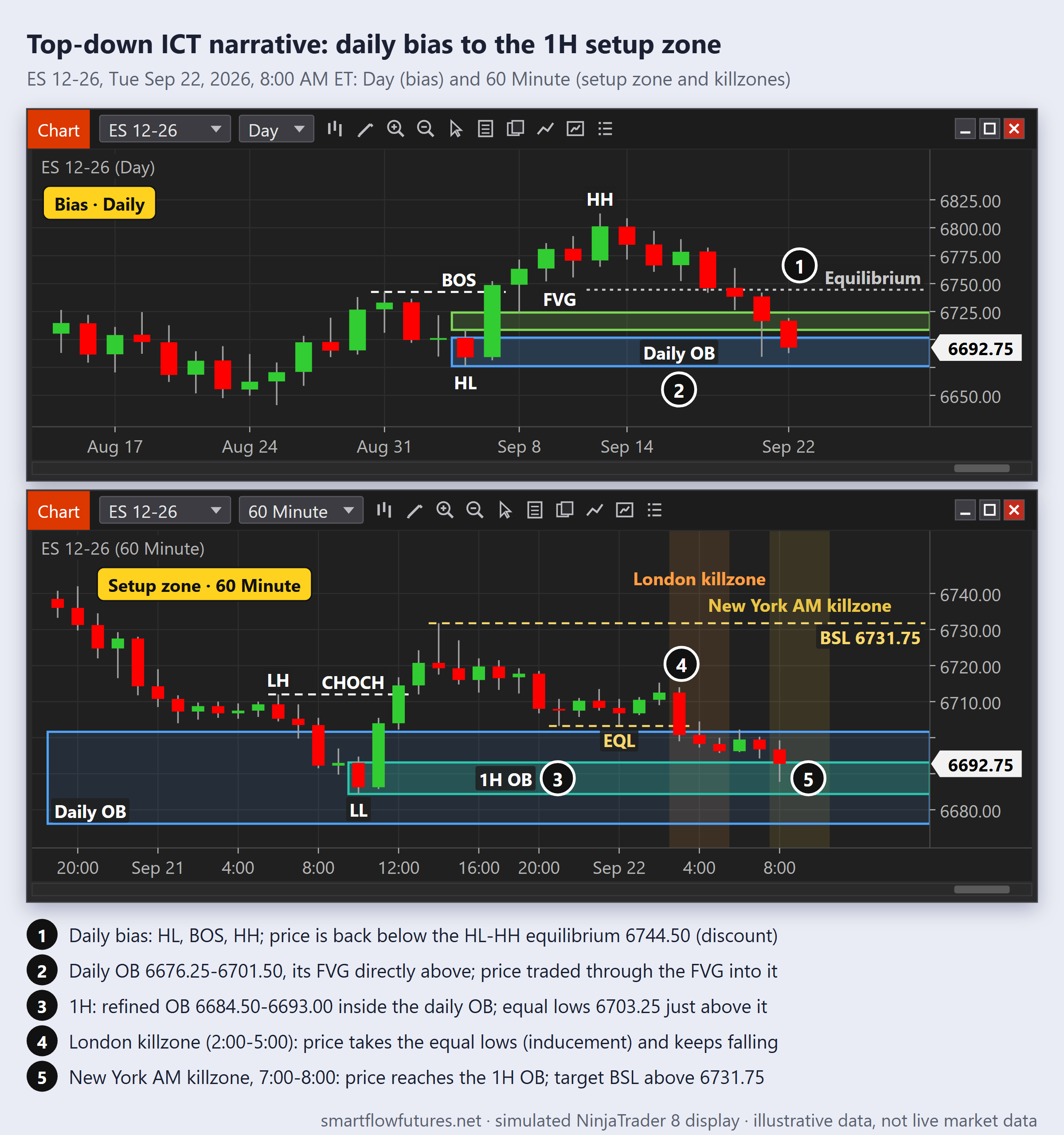
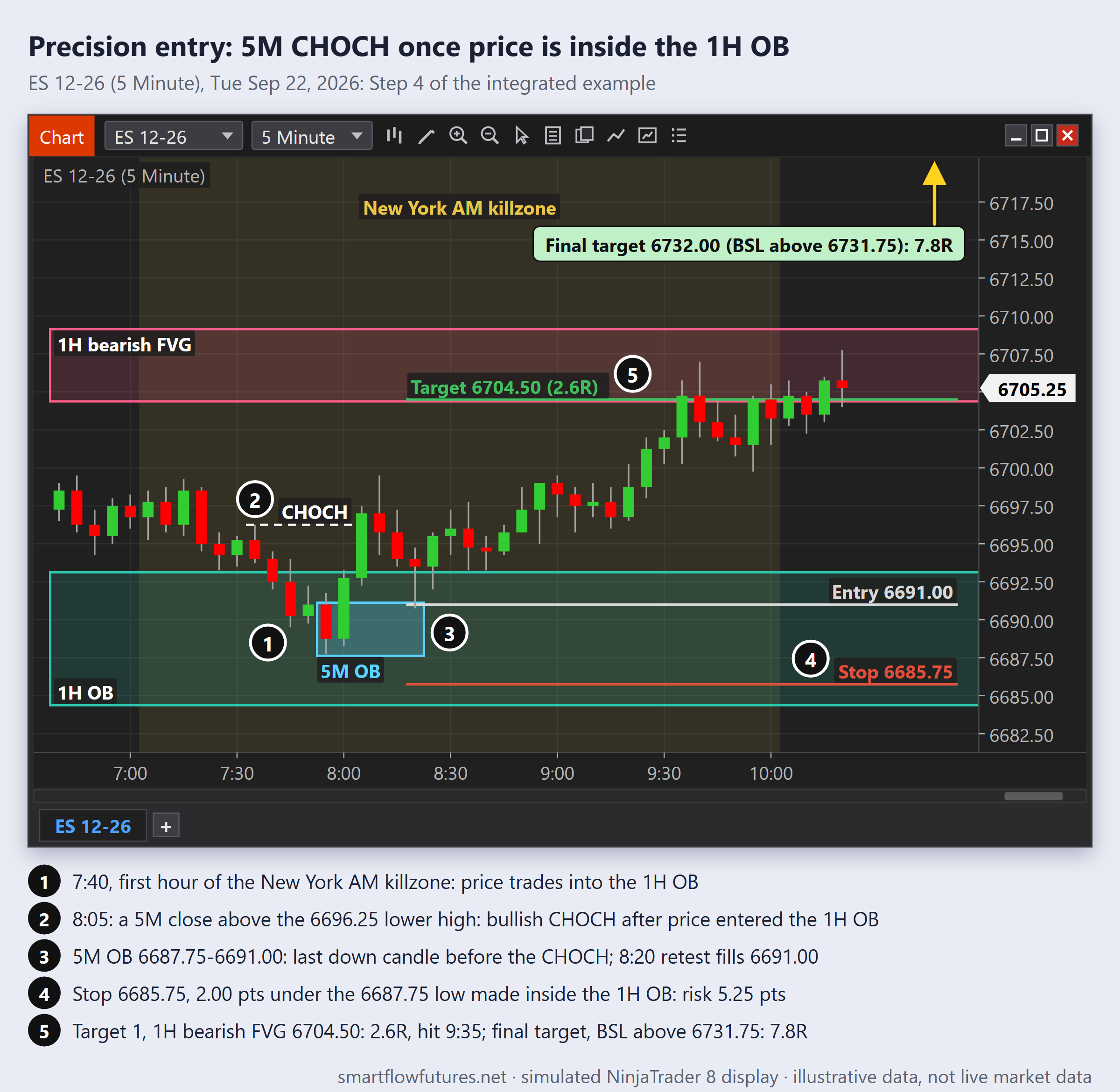
Integrated Analysis Example
HTF Bias
Entry Zone
Killzone
Trigger
ICT Confluence Checklist
Structure Confluence
- HTF bias is clear (bullish or bearish)
- Trading with the HTF trend
- LTF structure aligns with HTF
- Recent BOS/CHOCH supports direction
Liquidity Confluence
- Liquidity target identified
- Entry is after liquidity sweep
- Inducement has been taken
- Clear path to target liquidity
PD Array Confluence
- Trading from valid order block
- FVG present at entry zone
- In premium (sells) or discount (buys)
- OTE level alignment
Time Confluence
- Within active killzone
- Day of week is favorable
- Not during high-impact news
- Power of Three phase identified
Integration Mistakes to Avoid
No matter how perfect your LTF setup looks, trading against your higher timeframe bias (Daily/4H) weakens the trade. Always ensure your trade direction aligns with the bigger picture.
The best PD arrays mean nothing during dead market hours. A perfect order block during the New York lunch hour (12:00-1:00 PM ET) will likely not produce results. Wait for killzones.
You do not need every single concept to align, nor all sixteen items of the checklist above: a score of 4 or more on the six-factor confluence checklist from the High vs Low Probability Setups lesson is enough. Waiting for perfection means missing good trades.
Jumping to entry without understanding what smart money is doing leads to confusion when trades do not work. Always build your narrative first.
ICT concepts are not meant to be used in isolation. The power comes from integration: structure provides direction, liquidity provides targets and entry triggers, PD arrays provide entry zones, and time provides the when. Master the hierarchy, build your narrative, and execute with precision during optimal times.