
You have now learned the individual components of a sophisticated trading approach. This final article integrates everything into a complete, cohesive framework that you can apply consistently to your trading.
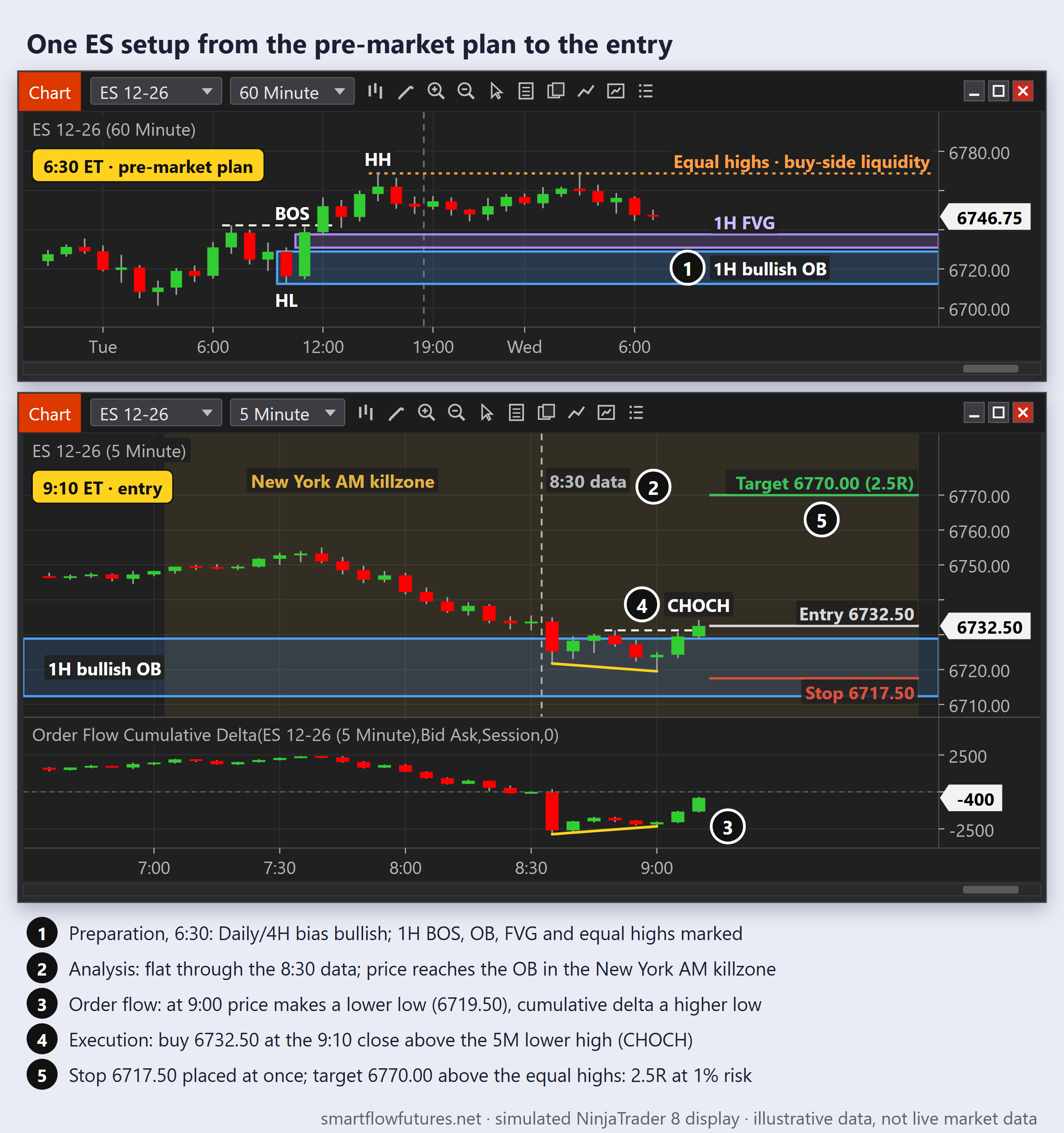
The Framework Overview
The complete trading framework consists of four phases:
Phase 1: Preparation – Before the session, establish context and identify opportunities.
Phase 2: Analysis – Multi-timeframe analysis using SMC and Order Flow.
Phase 3: Execution – Precise entry, management, and exit.
Phase 4: Review – Post-trade analysis for continuous improvement.
Phase 1: Preparation
Before each trading session:
Higher Timeframe Analysis:
Review daily and 4H charts. Identify overall market structure (trending or ranging). Mark major order blocks, FVGs, and liquidity pools. Establish directional bias.
Intermarket Context:
Check correlated markets (ES/NQ relationship). Note dollar direction (DXY). Check VIX level. Identify any intermarket divergences.
Event Awareness:
Review economic calendar. Note any high-impact events during session. Plan around scheduled volatility.
Level Identification:
Mark key levels on trading timeframe. Identify potential entry zones. Note where liquidity sits (equal highs/lows).
Session Plan:
Write down your bias and key levels. Define what setups you are looking for. Set risk parameters for the session.
Phase 2: Analysis
When the session begins:
Multi-Timeframe Flow:
Step 1: Daily/4H confirms bias (what direction?). Step 2: 15M/1H identifies setups (where to trade?). Step 3: 5M/1M refines entry (when to enter?).
SMC Analysis:
On your trading timeframe: Identify current structure (HH/HL or LH/LL). Mark active order blocks. Identify unfilled FVGs. Note liquidity pools that may be targeted.
Order Flow Analysis:
Monitor cumulative delta for directional pressure. Watch footprint for imbalances at key levels. Note absorption or exhaustion patterns. Check DOM for significant orders.
Confluence Identification:
Best setups have multiple factors aligning. HTF bias + SMC level + Order Flow confirmation = the core of a valid setup; grade it with the six-factor confluence checklist from the setup-quality lesson (5-6 factors = A+, 4 = good, 3 = marginal).
Phase 3: Execution
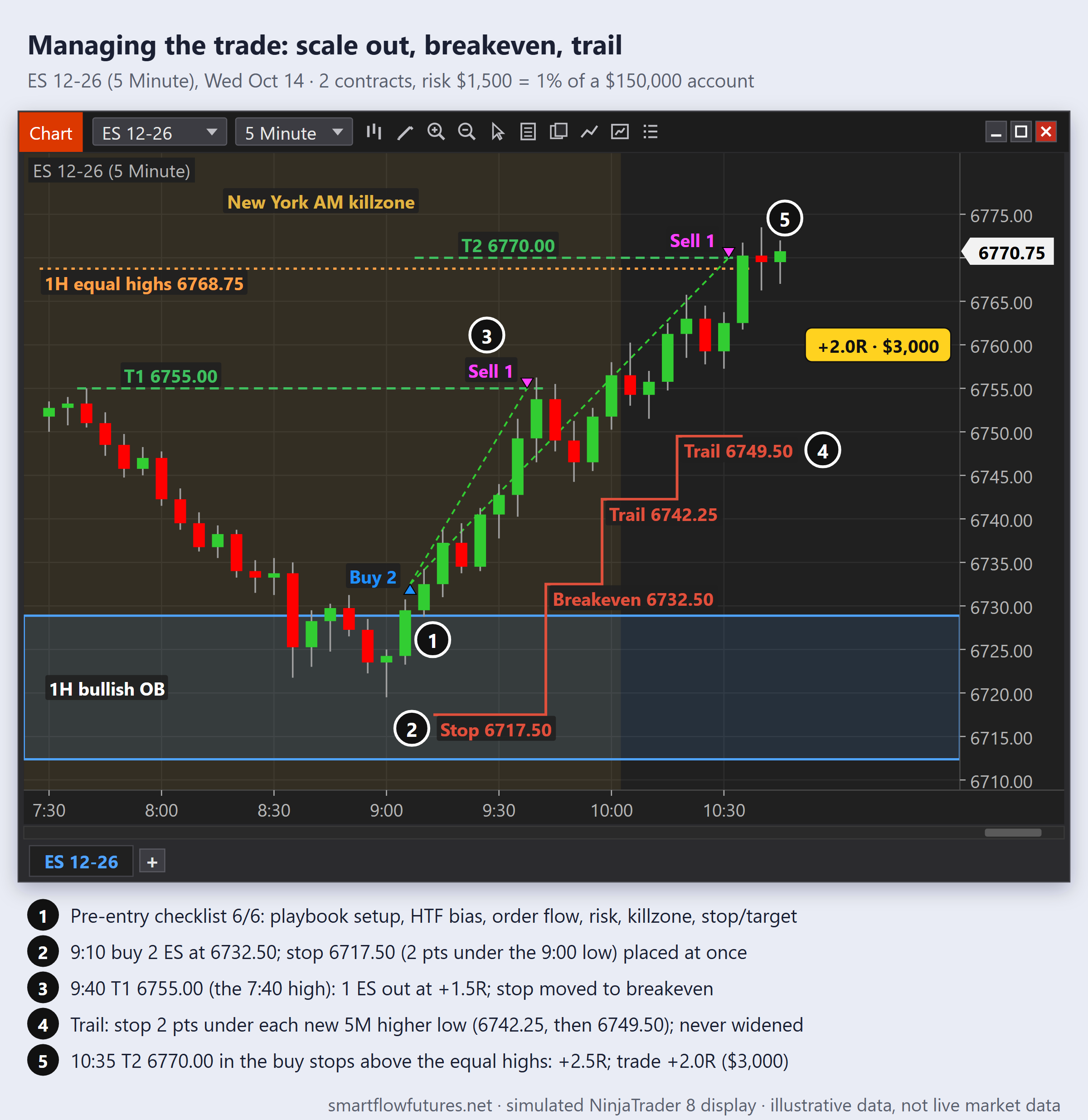
When a setup materializes:
Pre-Entry Checklist:
Is this a playbook setup? ☐
Does HTF bias align? ☐
Is there Order Flow confirmation? ☐
Am I within risk limits? ☐
Is timing appropriate (killzone)? ☐
Do I have a clear stop and target? ☐
Entry Execution:
Enter with defined position size. Place stop immediately. Set initial target order if appropriate. Record entry in journal.
Trade Management:
Follow your management rules consistently. Scale out at predetermined levels. Move stop to breakeven after first target. Trail stop on remaining position. Do not deviate from your plan.
Exit Execution:
Exit at targets or when setup invalidates. Accept stops when hit. Do not widen them. Record exit details.
Phase 4: Review
After each trade and session:
Immediate Post-Trade:
Record the trade in your journal. Note emotional state. Take screenshot. Initial assessment: Was it a good trade?
Session Review:
Review all trades at session end. Calculate session statistics. Identify any rule violations. Note observations and lessons.
Weekly Review:
Analyze the week aggregate performance. Look for patterns in winners and losers. Identify improvement areas. Set goals for next week.
Continuous Improvement:
Update playbook based on learnings. Refine rules that are not working. Keep doing what is working, at the same fixed risk per trade.
The Daily Routine
Pre-Market (30-60 minutes before):
Complete Phase 1 preparation. Write session plan. Mental preparation.
Market Hours:
Execute Phase 2 and 3. Follow your plan. Stay disciplined.
Post-Market (30 minutes after):
Begin Phase 4 review. Journal trades. Process the session.
Evening:
Complete detailed review. Prepare for next session if applicable.
Risk Management Integration
Throughout all phases, risk management is paramount:
Position Sizing: Fixed percentage per trade (1-2%). Never exceed based on “conviction.”
Daily Limits: Maximum daily drawdown (2-3%). Stop trading if hit.
Correlation Risk: Account for correlated positions. Do not double up on risk.
Event Risk: Reduce exposure before major events. Accept that some risk cannot be managed.
Psychology Integration
Maintain psychological discipline:
Before Trading: Check your state. If not optimal, reduce size or skip.
During Trading: Follow the plan. Trust your preparation. Accept uncertainty.
After Losses: Follow loss recovery protocol. Do not revenge trade. Process emotions before continuing.
The Path Forward
You now have a complete framework. Success requires:
Practice: Apply the framework consistently. Repetition builds competence.
Patience: Results take time. Trust the process through drawdowns.
Persistence: Keep learning and improving. Markets evolve; you must too.
Perspective: No single trade matters. Any edge plays out only over many trades.
Key Takeaways
The complete framework has four phases: preparation, analysis, execution, and review. Preparation establishes context and identifies opportunities before the session. Analysis uses multi-timeframe SMC and Order Flow for trade identification. Execution follows defined rules with proper risk management. Review enables continuous improvement through systematic learning. Daily routine structures these phases for consistent application. Risk management and psychology are integrated throughout. Success requires practice, patience, persistence, and perspective.
Congratulations! You have completed the entire Smart Order Flow Trading curriculum. You now have a comprehensive education in Smart Money Concepts, Order Flow analysis, market microstructure, and professional trading practices. The knowledge is yours—now apply it with discipline and patience. Your next trade is the next chance to put the framework to work. Trade well.