
The London killzone represents the waking of European markets and often sets the tone for the entire trading day. While US futures traders may find these hours challenging, understanding London session dynamics still matters for complete market analysis.
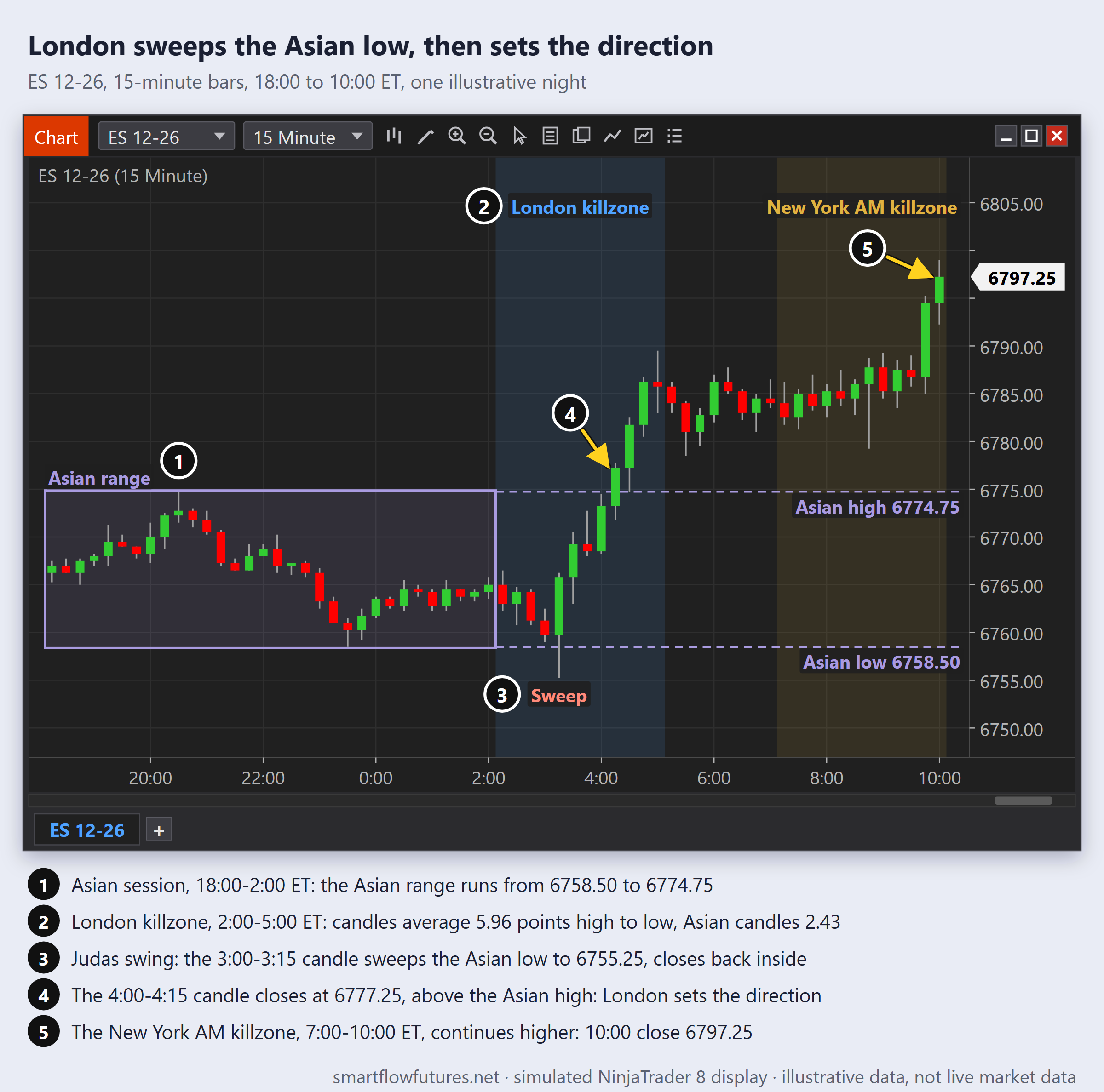
London Killzone Timing
The London killzone spans approximately 2:00 AM to 5:00 AM Eastern Time. This captures: London banking institutions coming online, European equity market preparations, and the reaction to Asian session price action.
The full London session runs from 2:00 AM to about noon ET (the London open itself is 3:00 AM) and overlaps New York from 8 AM (the usual currency-market convention, which starts New York at 8 AM).
Why London Matters
Global Financial Hub: London is the world’s largest forex trading center and a major hub for institutional trading. When London wakes up, significant order flow begins.
Reaction to Asia: London traders react to overnight Asian price action. They often sweep Asian session levels before establishing their own direction.
Sets Daily Bias: The direction established during London often continues into New York. Understanding London price action helps predict NY movement.
Fresh Participation: European markets bring fresh participants and higher volume, leading to more significant moves than in the Asian session.
London Session Characteristics
Asian Range Sweep: One of the most common London patterns is sweeping the Asian session high or low. London traders target this Asian-range liquidity to build positions.
Increased Volatility: Expect volatility to increase significantly compared to Asian session. Moves become more decisive and trending.
Pre-NY Setup: London often establishes the setup that New York will trigger. Price may build into a pattern that completes during NY hours.
Trading London Session
For those able to trade London hours:
Setup 1: Asian Range Sweep
Identify the Asian session high and low. Watch for London to sweep one side. Enter on reversal confirmation. Target the opposite side of the Asian range or beyond.
Setup 2: London Breakout
After sweeping Asian liquidity, London often breaks out in a trending direction. Trade with the trend using pullbacks to order blocks or FVGs. Target external liquidity or next key levels.
Setup 3: Midnight Open Reaction
The midnight open (00:00 New York time) is a level London often reacts to, either trading through it and reversing, or using it as support or resistance.
London for US Traders
Most US traders can’t actively trade at 2-5 AM. However, you can still use London analysis:
Pre-Session Analysis: Before your trading day, review what happened during London. What levels were swept? What direction was established? What FVGs or order blocks were created?
Context for NY: London’s direction often continues into NY. If London established a bullish bias by sweeping lows and rallying, expect NY to continue higher (or target London highs for reversal).
Key Levels: London high, London low, and any significant order blocks created during London become important reference points for NY trading.
London Session Price Patterns
The London Judas Swing: Price initially moves in one direction to sweep liquidity, then reverses for the real move. This “false” move early in London traps traders before the trend begins.
The Continuation: Sometimes London simply continues the Asian direction without reversal. This happens when larger timeframe momentum is strong.
The Range Expansion: London expands the Asian range in both directions before choosing a side. This creates new liquidity pools for later targeting.
London and Economic Data
European economic releases impact London session:
UK Data: Bank of England decisions, GDP, CPI, and employment data move GBP pairs and can impact index futures.
Eurozone Data: ECB decisions and Eurozone economic releases affect EUR and European indices.
Timing: Most UK data and German statistics-office releases print at 2:00 AM ET, the Eurozone PMIs at 4:00 AM ET and Eurozone (Eurostat) data at 5:00 AM ET; preliminary German CPI comes around 8:00 AM ET. Bank of England decisions come at 7:00 AM ET and ECB decisions at 8:15 AM ET, inside the New York AM killzone. All are one hour later in the weeks between the US and European clock changes (March, and late October to early November). Be aware of the calendar if trading these hours.
London to New York Transition
The transition from London to New York (7-8 AM ET) is significant:
London traders start adjusting positions as New York comes in. Early New York participants enter. Price often consolidates before the NY open brings fresh volatility. This hour, the first of the New York AM killzone, can set up trades that trigger on the 8:30 AM data or the 9:30 AM open.
Marking London Levels
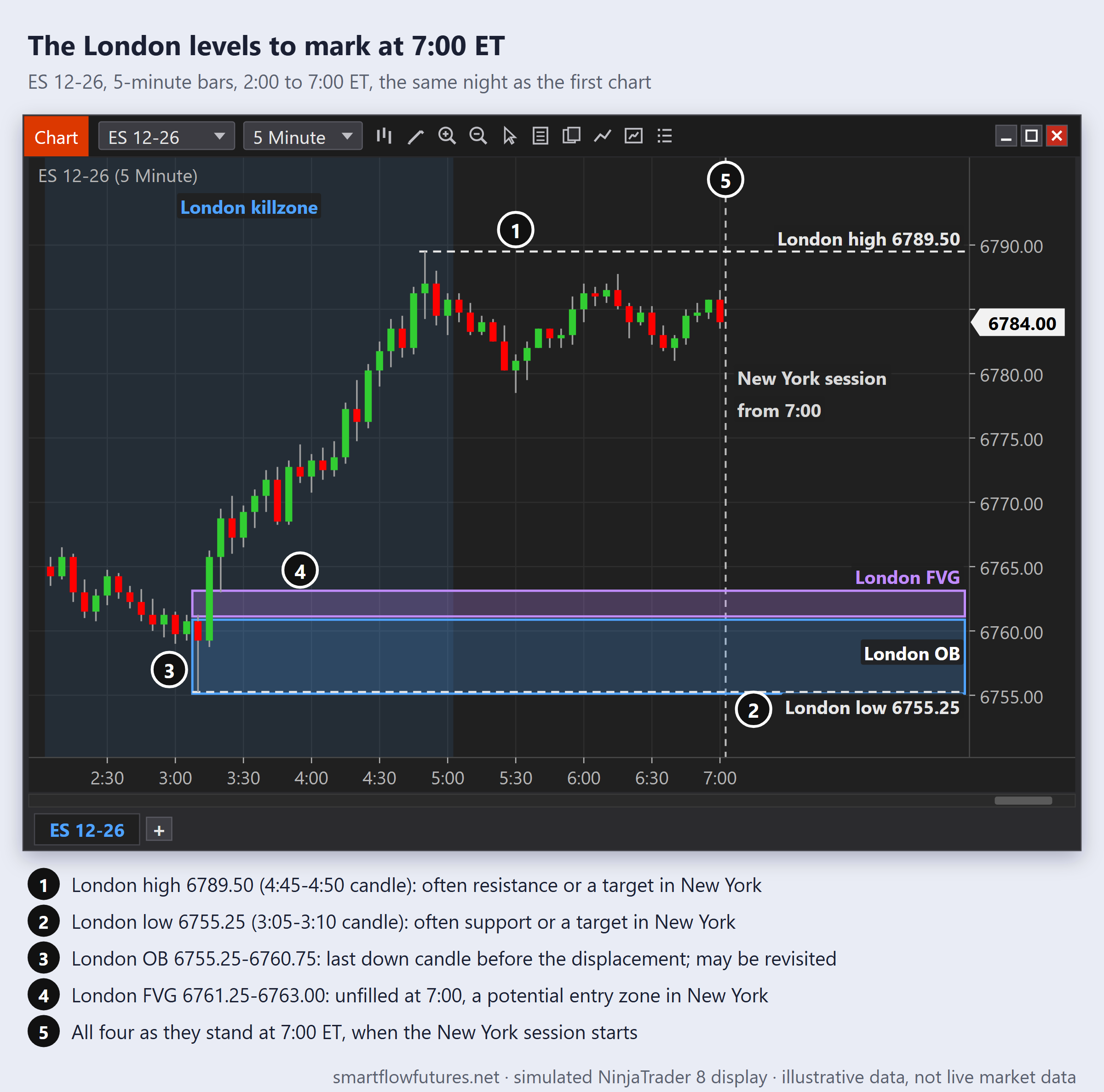
At minimum, mark these London session levels (as they stand when the New York session starts at 7:00 AM ET) on your charts:
London High: Often becomes resistance or a target during NY session.
London Low: Often becomes support or a target during NY session.
London Order Blocks: Significant order blocks created during London may be revisited during NY.
London FVGs: Unfilled gaps from London moves are potential entry zones during NY.
Key Takeaways
The London killzone (2-5 AM ET) often sets the daily directional bias. London typically sweeps Asian session highs or lows to grab liquidity. Even if you can’t trade London, analyze it for context before NY session. Mark London high, low, order blocks, and FVGs as reference points. The London-NY transition (7-8 AM ET, the first hour of the New York AM killzone) often sets up the morning trades.