
What Is Smart Money? SMC Explained
Smart Money Concepts (SMC) is a trading methodology built on how large institutional traders actually operate. Instead of relying on lagging indicators, SMC traders learn to read the footprints major players leave on price charts, so they can align with institutional order flow rather than trade against it.
Defining “Smart Money”
The term “smart money” refers to capital controlled by informed, well-resourced market participants — mainly institutional traders like banks, hedge funds, and large trading firms. These entities have advantages most retail traders simply don’t have.
They run their own research teams and have access to proprietary analysis. They move enough capital that their own trades can shift market prices. Their execution technology and trading infrastructure are more advanced than what retail platforms offer. They see economic data and order flow faster than the public does. And they understand market mechanics — the order book, microstructure, how fills actually happen — at a level most retail traders never study.
Why “Smart” Money?
“Smart” here doesn’t mean smarter people — it means better-informed, better-resourced ones. Institutional participants tend to have longer track records, tighter risk management, and institutional-grade analysis behind their decisions. Their collective behavior is what creates the market movements everyone else reacts to.
The Problem for Retail Traders
Traditional technical analysis often fails retail traders for a simple reason: most of it is lagging. It shows what already happened, not what’s about to. Patterns like head and shoulders or double tops are commonly taught, which means institutions know retail traders are watching for them and can use that against you. Most retail traders end up trading reactively, entering only after a move has already started.
That’s how you end up buying tops, selling bottoms, and getting stopped out right before price finally moves the way you originally expected.
The SMC Solution
SMC is a framework for understanding how institutions actually trade. Instead of fighting smart money, you learn to spot where they’re accumulating and distributing, trade in the same direction as institutional order flow, and use retail behavior — the very thing working against most traders — as your edge instead.
Core SMC Principles
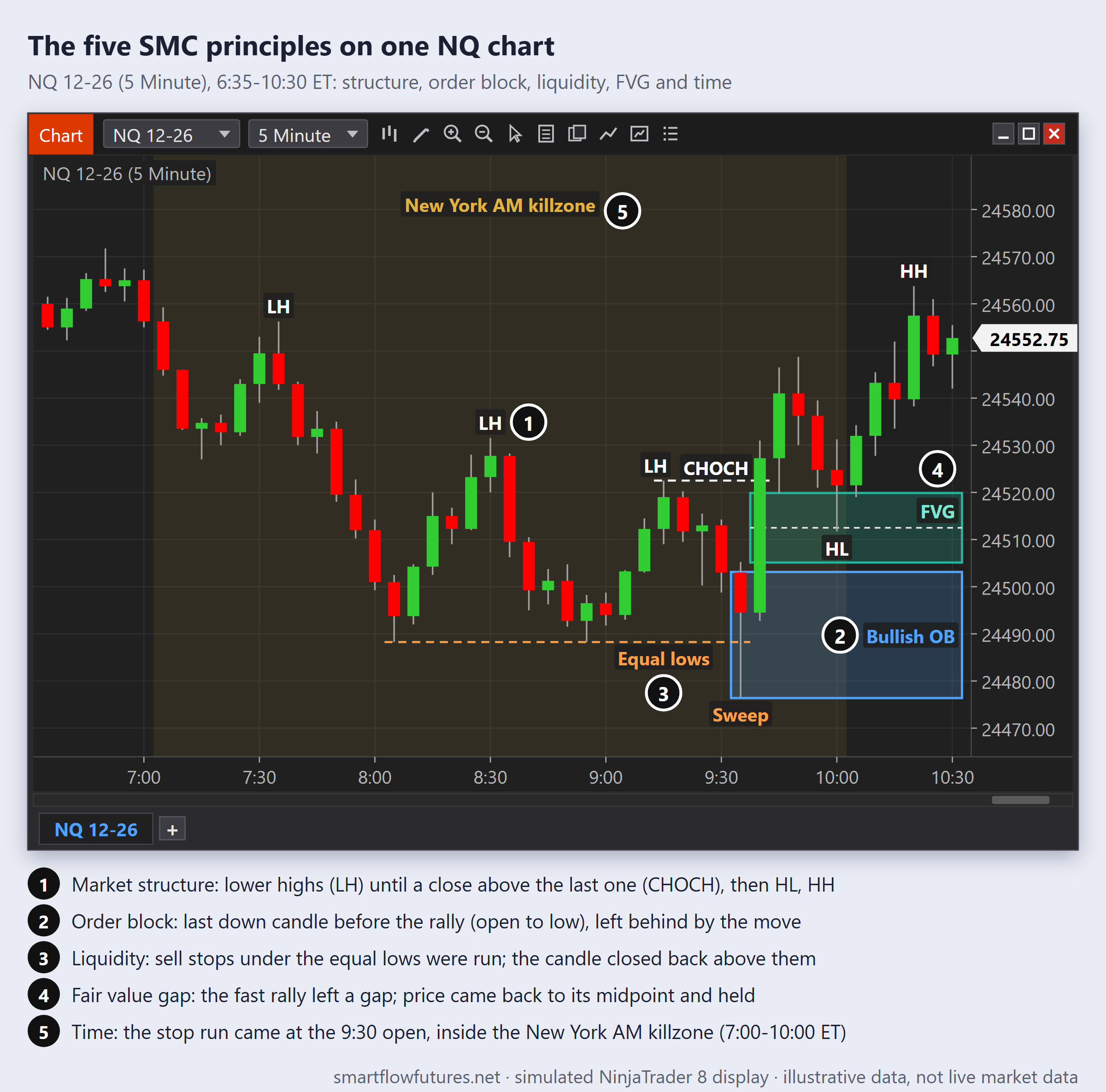
1. Market Structure
Markets move in a structured way: higher highs and higher lows in an uptrend, lower highs and lower lows in a downtrend. Reading structure correctly tells you the current bias and where a reversal is more likely to happen.
2. Order Blocks
Before a significant move, institutions often leave “order blocks” behind — zones where they built or unwound a position. When price returns to these zones, they frequently act as support or resistance again.
3. Liquidity
Institutions need liquidity to fill large orders, and large orders seeking liquidity often run retail stop losses, by design or as a by-product. Knowing where liquidity pools sit helps you anticipate where price is likely to go next.
4. Imbalance and Fair Value
Fast price moves create imbalances, or fair value gaps: zones where price was delivered in one direction with little two-way trade. Price often comes back into these gaps later, frequently to their midpoint and sometimes filling them completely, which is where a lot of SMC trade opportunities come from.
5. Time-Based Analysis
Institutions trade on a schedule. Market opens, session overlaps, and major economic releases all see concentrated institutional activity. Timing your trades around these windows tends to improve your results, but time is a filter for your setups, not a setup on its own.
How Institutions Actually Trade
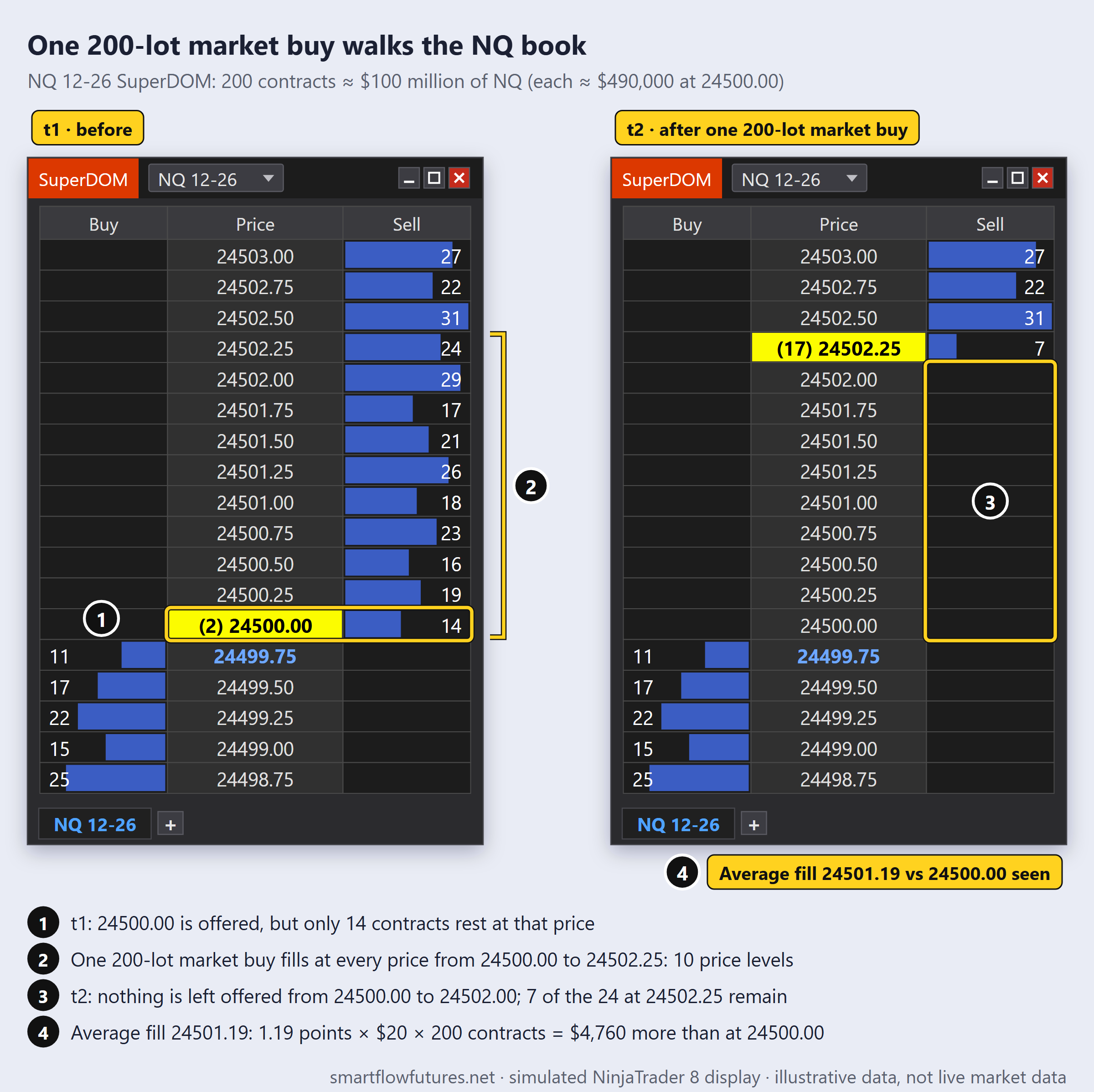
Here’s the challenge that explains most of SMC: imagine you need to buy $100 million worth of NQ futures, about 200 contracts (one contract is worth about $490,000 at 24,500). You can’t just fire off a single market order: it would push price through several levels before it was filled, and your average entry would be worse than the price you saw.
So instead, institutions build positions gradually, often in areas where price looks weak and retail traders are selling. Sometimes they let price fall into retail stops and buy the selling those stops create. Sometimes they position ahead of a news event they expect to move price in their favor.
SMC exists to help you recognize these patterns, so you can trade alongside institutions instead of becoming their exit liquidity.
SMC vs. Traditional Technical Analysis
Traditional TA leans on lagging indicators like moving averages and RSI, patterns that are public knowledge institutions can exploit, and interpretations that vary from one trader to the next.
SMC instead focuses on market structure and on liquidity (the levels where orders rest and where price tends to be drawn) rather than pattern-matching after the fact, using ideas you can identify consistently instead of guessing.
None of this makes traditional TA useless; some of it pairs well with SMC. But the core shift is from reacting to patterns to positioning yourself ahead of institutional flow.
The Learning Journey
Learning SMC works best in order. In the lessons ahead, you’ll cover market structure, how to identify and trade order blocks, how liquidity builds and gets taken, time-based concepts like killzones and sessions, and finally how to combine all of it into one strategy.
Each concept builds on the last, so take the time to actually understand one before moving to the next. Skipping ahead here just means re-learning the fundamentals later, at a worse time.
A Note on Origins
SMC ideas have been popularized by several educators, most notably “ICT” (Inner Circle Trader). We teach our own interpretation and application of these concepts, but we want to be upfront that we didn’t invent this framework — we’re building on work others developed and shared first.
What we focus on here is application: not theory for its own sake, but strategies you can actually use in real markets.