
Inducement is one of the most cunning concepts in Smart Money trading. It describes the minor liquidity price takes just before reaching its real point of interest, luring early traders into a trap before the real move begins. Understanding inducement helps you avoid these traps, and can help you profit from them.
What is Inducement?
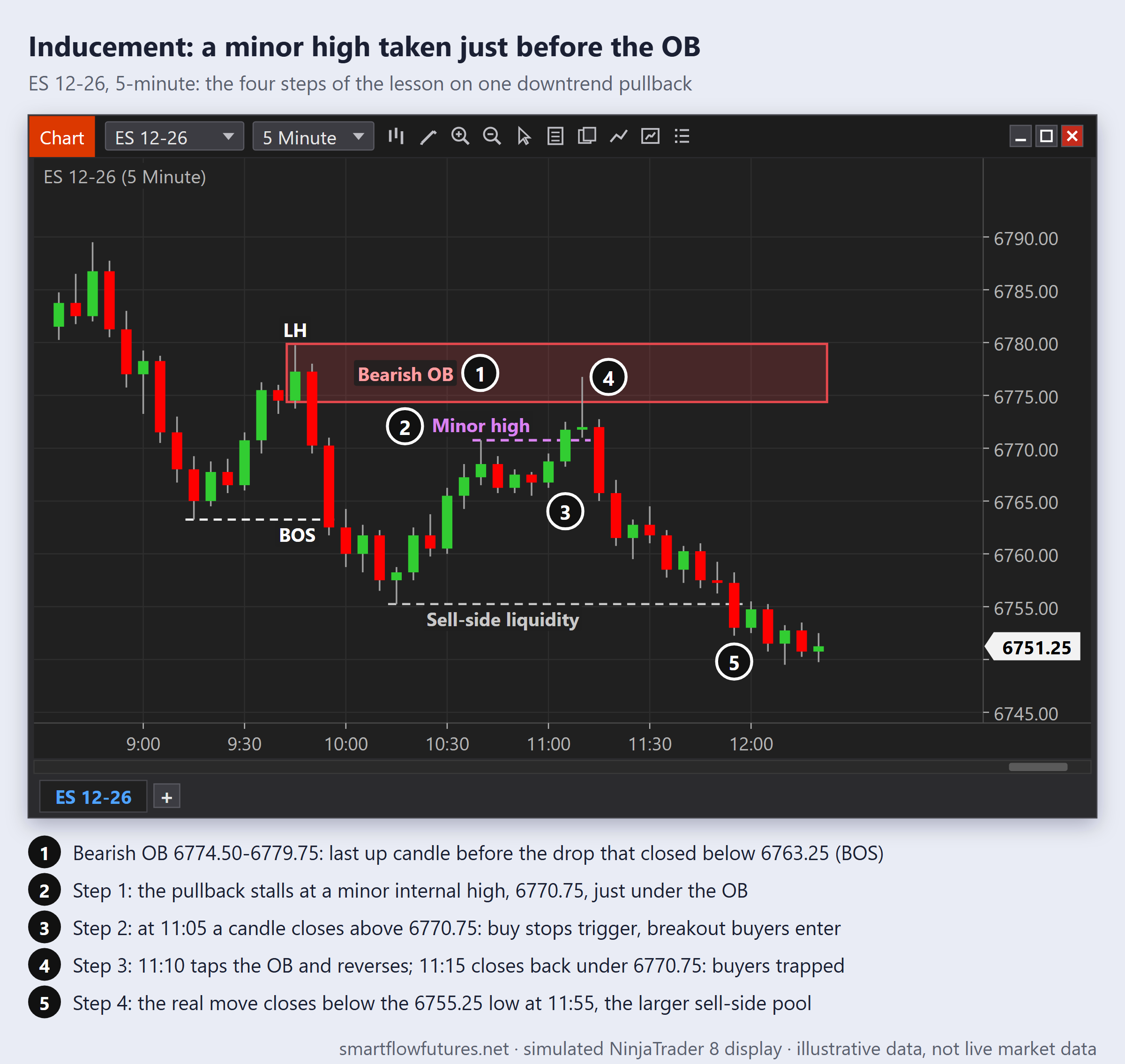
Inducement is the minor liquidity price takes just before it reaches its real point of interest: a small internal swing high or low whose break lures early traders in, and whose stops then feed the move into the order block or FVG. It’s the bait before the trap. Smart money uses the liquidity taken there for their actual intended positions.
The concept is simple: if institutions want to sell a large position, they need buyers. Retail traders who buy the break of a minor high (a false bullish signal) supply the buying liquidity needed to absorb the institutions’ sells, along with the buy stops resting above it.
How Inducement Works
Step 1: The Setup
Price approaches a minor internal high (or low) just ahead of an order block or FVG, where retail traders expect a breakout or continuation.
Step 2: The Inducement
Price takes that minor level, triggering entries from retail traders who see a breakout. Buy stops are triggered and breakout buyers enter with market or stop orders. Retail is now positioned.
Step 3: The Trap
Shortly after retail enters, price reaches the order block or FVG and reverses sharply. The breakout was false. Retail traders are now trapped in losing positions.
Step 4: The Real Move
With retail trapped and their stops now providing liquidity, the real move begins in the opposite direction.
Recognizing Inducement Patterns
Common inducement setups include:
Minor Breakouts: Price breaks above a minor high (or below a minor low) sitting just ahead of an order block or FVG, enough to trigger entries, then reverses from the zone. The break lacked conviction. It was inducement. A failed break of a range boundary is a false breakout, not inducement (see Trapped Traders).
Minor Internal Highs/Lows: In a downtrend, a small rally takes out a minor internal high (below the last lower high), inducing longs; then the downtrend resumes. The minor high was inducement. A candle close above the last lower high would be a CHOCH, not inducement.
Pattern Completions: Technical patterns (triangles, flags, etc.) appear to complete just ahead of an order block or FVG, triggering pattern-based entries. The pattern then fails at the zone. It was inducement. A pattern that fails away from a point of interest is a failed pattern (a trap), not inducement.
Liquidity Pool Taps: Price briefly takes out a minor liquidity pool without conviction on the way to an order block or FVG, then reverses from the zone. Taking that pool was inducement for positions in the opposite direction. When the pool bounds the range, call it a sweep, not inducement.
Inducement vs. a Real Break
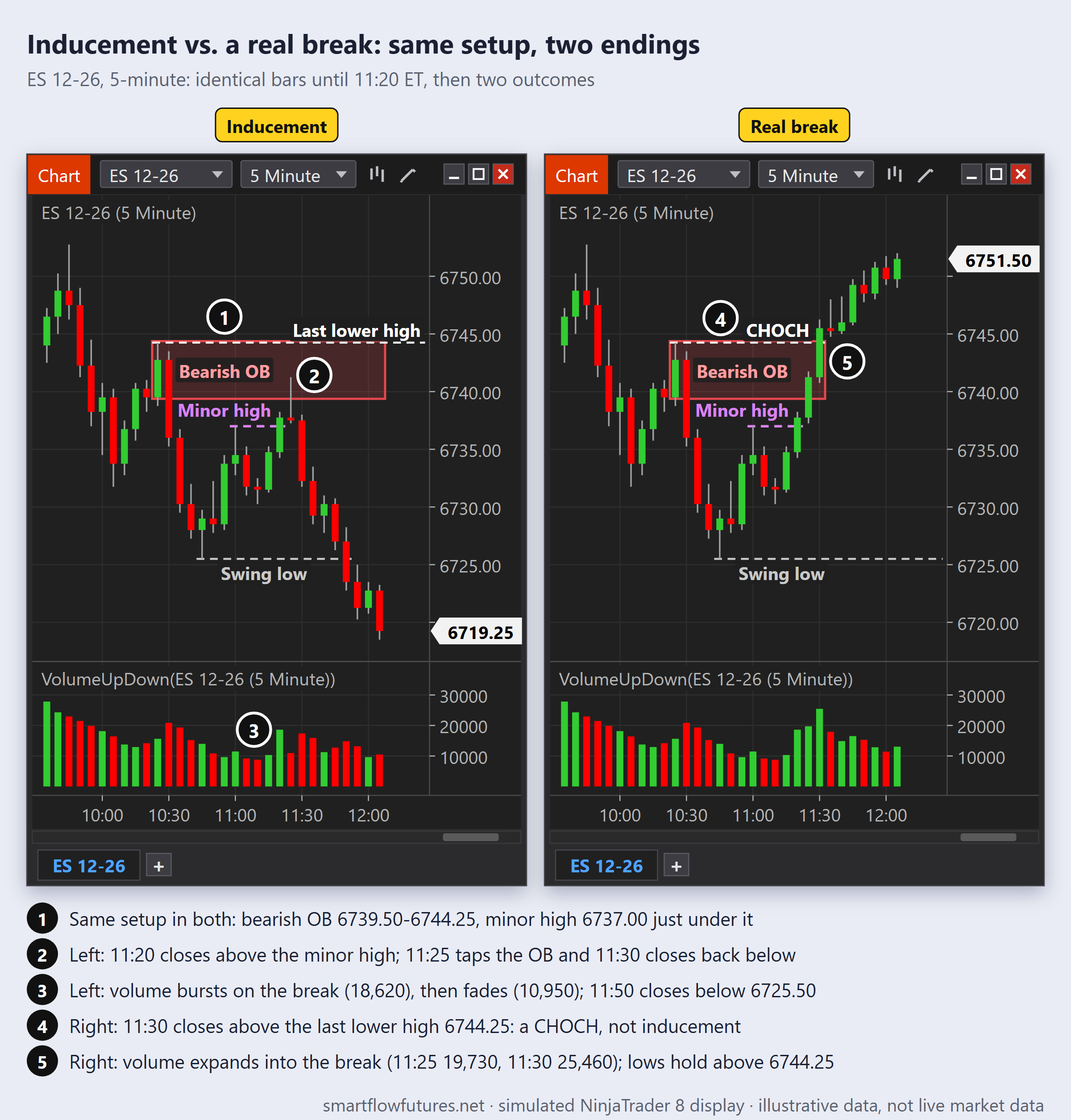
How do you distinguish inducement from real moves? Look for:
Conviction: Real breakouts have follow-through. Price breaks, closes beyond the level, and continues. Inducement fails quickly: even when a candle closes beyond the minor level, price reverses at the order block or FVG just beyond.
Volume: Legitimate moves often have volume confirmation. Inducement shows no follow-through: volume fades or diverges after the initial burst.
Higher Timeframe Context: Does the breakout align with higher timeframe structure? If you’re seeing a bullish breakout on the 5-minute while the 4-hour is clearly bearish, be suspicious.
Speed of Reversal: Inducement reversals happen quickly, often within candles. If price takes a minor level and fails as soon as it reaches the order block or FVG beyond, it was likely inducement.
Trading Inducement
You can trade inducement in two ways:
Avoid Being Trapped: Recognize inducement patterns and don’t take the bait. Wait for confirmation beyond the initial break before entering.
Trade the Reversal: If you identify inducement occurring, position yourself with smart money. Wait for the trap to spring, then enter in the direction of the real move.
Inducement and Liquidity
Inducement is intimately connected to liquidity:
The inducement move often targets a small liquidity pool, just enough to attract retail and generate the necessary opposing orders. After inducement, price typically targets a larger liquidity pool in the real direction. Inducement creates new liquidity (the trapped traders’ stops) which fuels the real move.
Inducement on Different Timeframes
Inducement occurs on all timeframes:
Higher Timeframes: Weekly or daily inducement can trap position traders for days before the reversal.
Intraday: Session inducement traps day traders, often occurring near session opens or during killzones.
Scalping Timeframes: Minute-level inducement traps scalpers, often preceding quick reversals.
Generally, higher timeframe inducement is more significant and leads to larger moves.
Combining Inducement with SMC Concepts
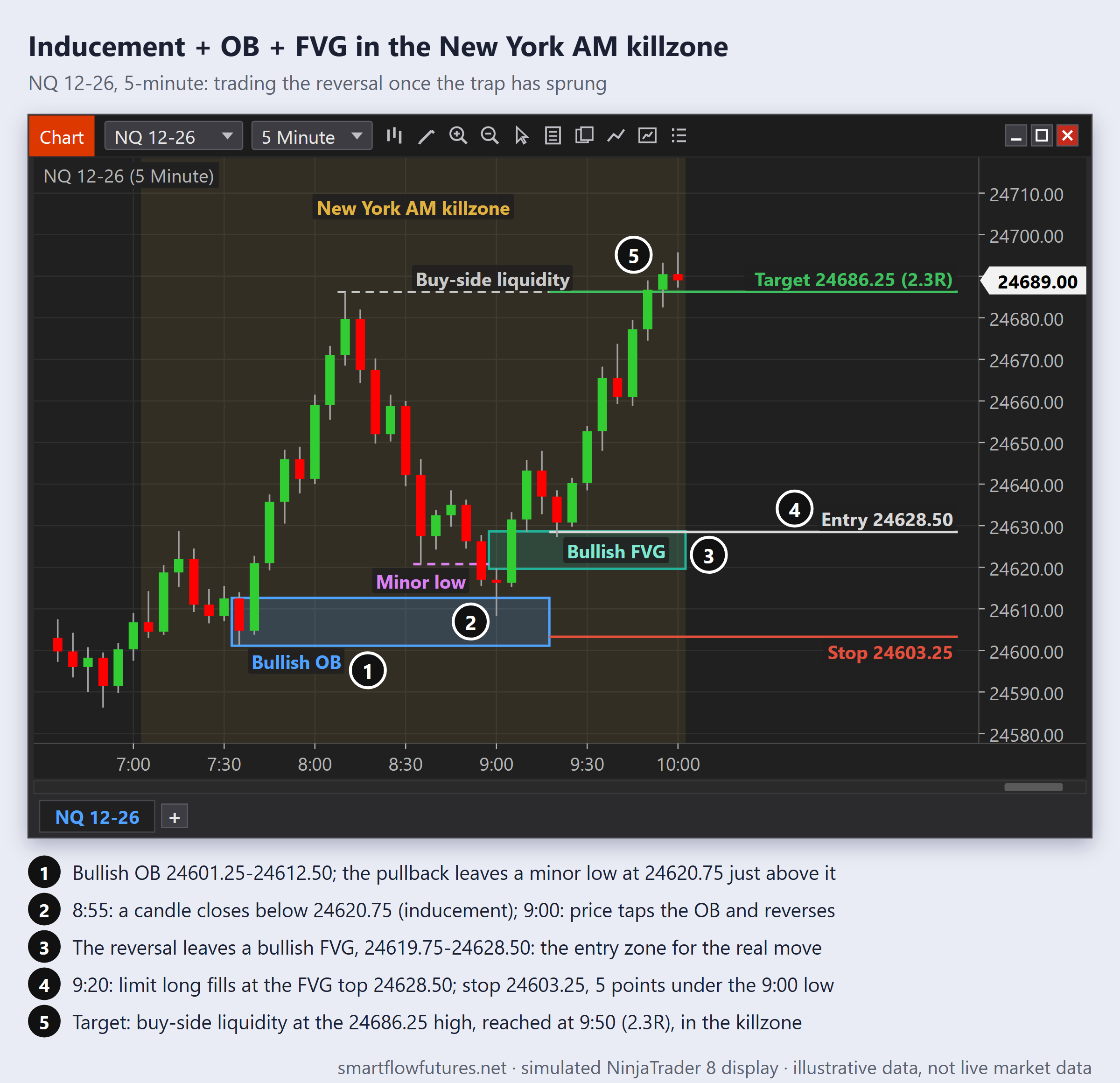
Inducement works well with other SMC concepts:
Inducement + Order Block: Look for inducement taken just before price runs into an order block. The order block provides confluence for the reversal.
Inducement + FVG: The reversal after inducement often creates new FVGs as price moves quickly. These FVGs can be entry zones for the real move.
Inducement + Killzone: Inducement frequently occurs during killzones, when institutions are most active.
Protecting Yourself from Inducement
Practical steps to avoid inducement traps:
Wait for candle closes beyond levels. Don’t trade the break of the wick. A close beyond a minor level is not enough on its own: look for confirmation on lower timeframes before entering. Consider the higher timeframe context always. Be especially cautious during high-volatility periods. If a breakout seems too obvious, it might be inducement.
Key Takeaways
Inducement is the minor liquidity price takes just before it reaches its real point of interest, trapping early traders. It creates liquidity for institutional positions in the opposite direction. Recognize inducement by weak conviction, quick reversals, and higher timeframe conflict. Either avoid inducement traps or trade the reversal with smart money. Combine inducement awareness with other SMC concepts for best results.