
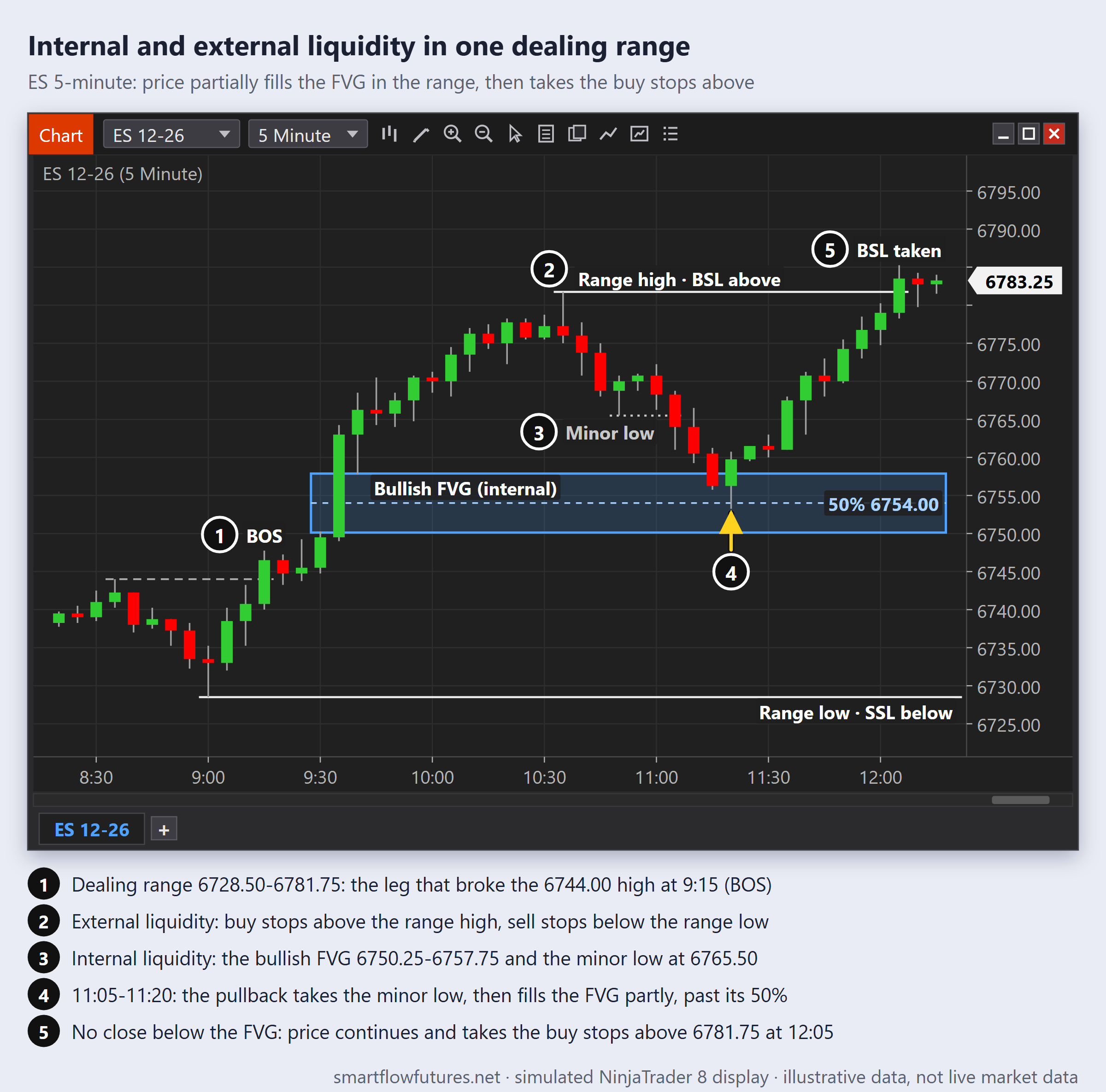
While external liquidity exists beyond the current range, internal liquidity lives within it. Internal liquidity is mainly Fair Value Gaps, imbalances and minor swing points, and it gives you intermediate targets while explaining much of the intraday price movement.
What is Internal Liquidity?
Internal liquidity refers to the unfilled orders and inefficiencies within the current trading range (the dealing range: the swing low to swing high of the leg that last broke structure). Unlike external liquidity (stops beyond the range’s swing high and low), internal liquidity sits inside the range: FVGs and the minor swing highs and lows. The gaps, imbalances, and unfilled areas are where price moved too quickly for efficient trading; the minor swings have small pools of stops beyond them.
The primary forms of internal liquidity are Fair Value Gaps (FVGs), volume imbalances (a gap between two consecutive candle bodies whose wicks overlap), opening gaps (at the 6:00 PM ET daily reopen, the Sunday 6:00 PM ET open, or the 9:30 AM ET cash open), and the stops beyond the minor swing highs and lows within the range.
FVGs as Internal Liquidity
Fair Value Gaps are the most common form of internal liquidity. When price moves aggressively, it can leave a gap between the wicks of the first and third candles of a three-candle move. These gaps represent zones where:
Little two-sided trading occurred. Unfilled orders may rest. Price often returns to rebalance.
Think of FVGs as unfinished business within the range. Price tends to return to these zones to complete the price discovery that was skipped during the aggressive move. Calling a gap liquidity is an analogy: like a pool of stops, it tends to draw price toward it, here to rebalance the one-sided move.
Internal vs. External Liquidity
The difference matters for how you manage a trade:
External Liquidity (the range’s swing high and low, and older levels beyond): Final destinations for larger moves. Price draws toward these pools to trigger stops and find counterparty orders.
Internal Liquidity (FVGs, imbalances, minor swings): Intermediate stops along the way. Price often pauses, retraces, or consolidates at internal liquidity before continuing toward external targets.
How Price Interacts with Internal Liquidity
Price behavior at internal liquidity tends to follow a few recurring patterns:
Fill and Continue: Price retraces to an FVG, fills it partially or fully (a full fill reaches its far edge, candle 1’s high or low), then continues in the original direction toward external liquidity.
Bounce and Continue: Price touches the near edge of internal liquidity and bounces without full fill, continuing its journey.
Consolidate: Price spends time within the internal liquidity zone, building energy before the next move.
Using Internal Liquidity for Entries
Internal liquidity provides entry opportunities:
Scenario: You’ve identified a bullish bias and want to enter long. Rather than chasing price, wait for a retrace to internal liquidity (a bullish FVG). Enter as price reaches this zone with a limit order, or on confirmation (as in the FVG Retest lesson), with stops below the FVG.
This approach provides:
Better entry price (buying the dip within the trend). Defined risk (stop below the internal liquidity zone). Clear target (the external liquidity above).
Internal Liquidity as Profit Targets
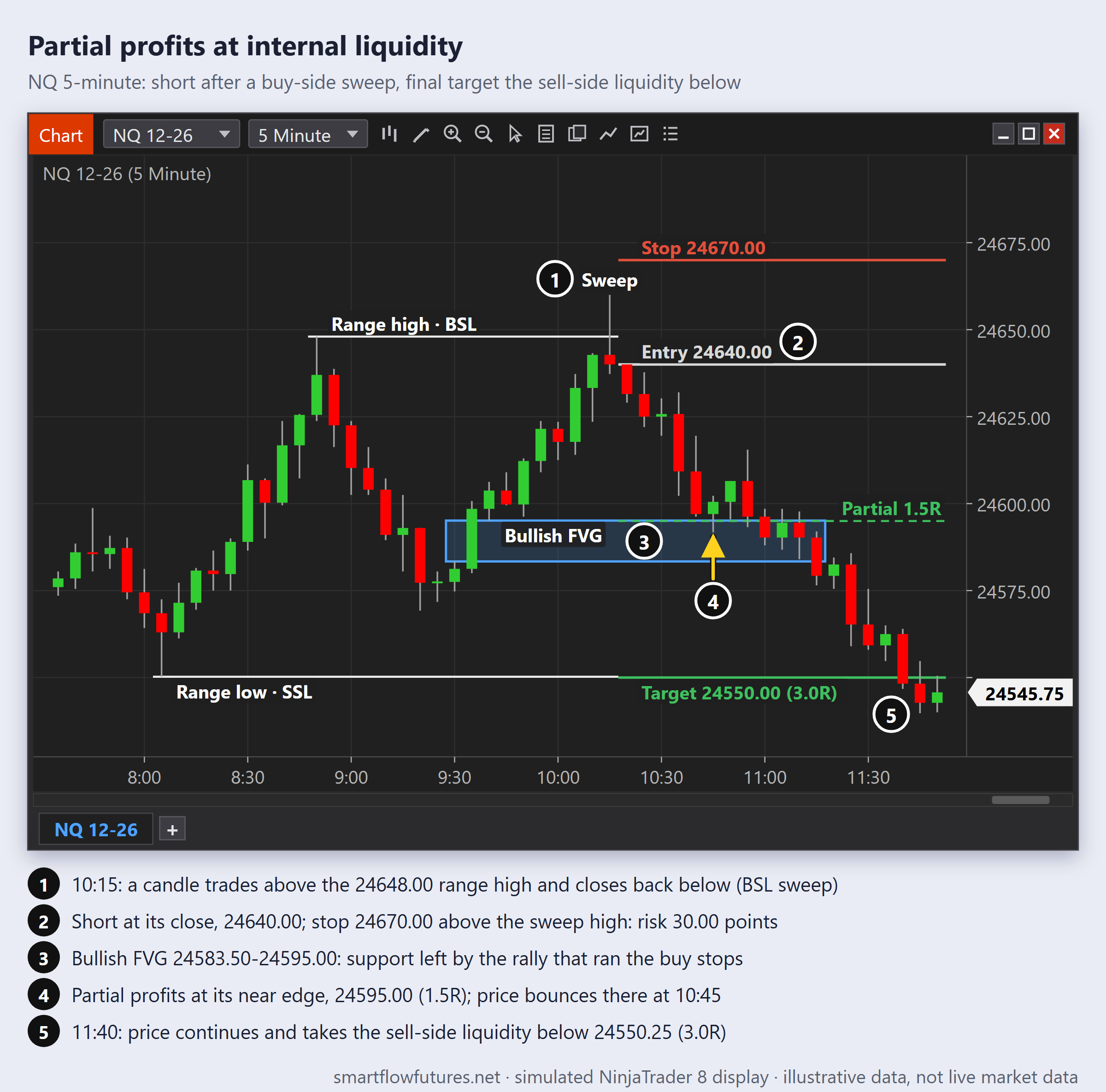
If external liquidity is your final target, internal liquidity provides intermediate targets for partial profits:
Example: You enter short after a BSL sweep. Your final target is SSL below. But there’s a bullish FVG between entry and target (support left by the rally that ran the buy stops). Consider taking partial profits at this internal liquidity zone, as price may bounce there before continuing.
Stacked Internal Liquidity
Sometimes multiple internal liquidity zones exist between price and external targets:
FVG 1 closer to current price. FVG 2 further away. An order block in between (not internal liquidity itself, but another reaction zone).
In these cases, price often fills internal liquidity sequentially, moving from zone to zone. This creates a roadmap for your trades. Each internal liquidity zone is a potential reaction point.
Internal Liquidity and Order Blocks
Order blocks often contain or create internal liquidity:
An order block may have an FVG directly beyond it, or a lower-timeframe FVG inside it. Price may retrace to fill an FVG and stop at an order block. The combination of OB + FVG adds confluence to the zone.
Trading the Internal to External Flow
A common SMC trade setup:
Step 1: Identify the external liquidity target (the range’s swing high or low).
Step 2: Wait for price to retrace to internal liquidity (FVG).
Step 3: Enter at internal liquidity with confirmation.
Step 4: Target the external liquidity.
This framework uses internal liquidity for entry and external liquidity for exit, a logical flow that aligns with how price moves.
Invalidation of Internal Liquidity
Internal liquidity loses significance when:
A candle closes beyond its far edge, or it was fully filled on an earlier return (for a minor swing, its stops have been taken). Price structure changes significantly. Too much time passes and context shifts. Higher timeframe direction invalidates the zone.
Keep your charts clean by removing or de-emphasizing internal liquidity that’s no longer relevant.
Key Takeaways
Internal liquidity (FVGs, imbalances, minor swing highs and lows) exists within the current trading range. Price often retraces to fill internal liquidity before continuing to external targets. Use internal liquidity for entries and intermediate profit targets. Combine internal liquidity with order blocks for confluence. Think of trading as a flow from internal liquidity entries to external liquidity targets.