
Liquidity sweeps, also known as stop hunts, are a core tradeable pattern in Smart Money trading. Learning to identify them in real time lets you enter trades right as smart money is positioning. This article covers how to spot and trade these setups.
What is a Liquidity Sweep?
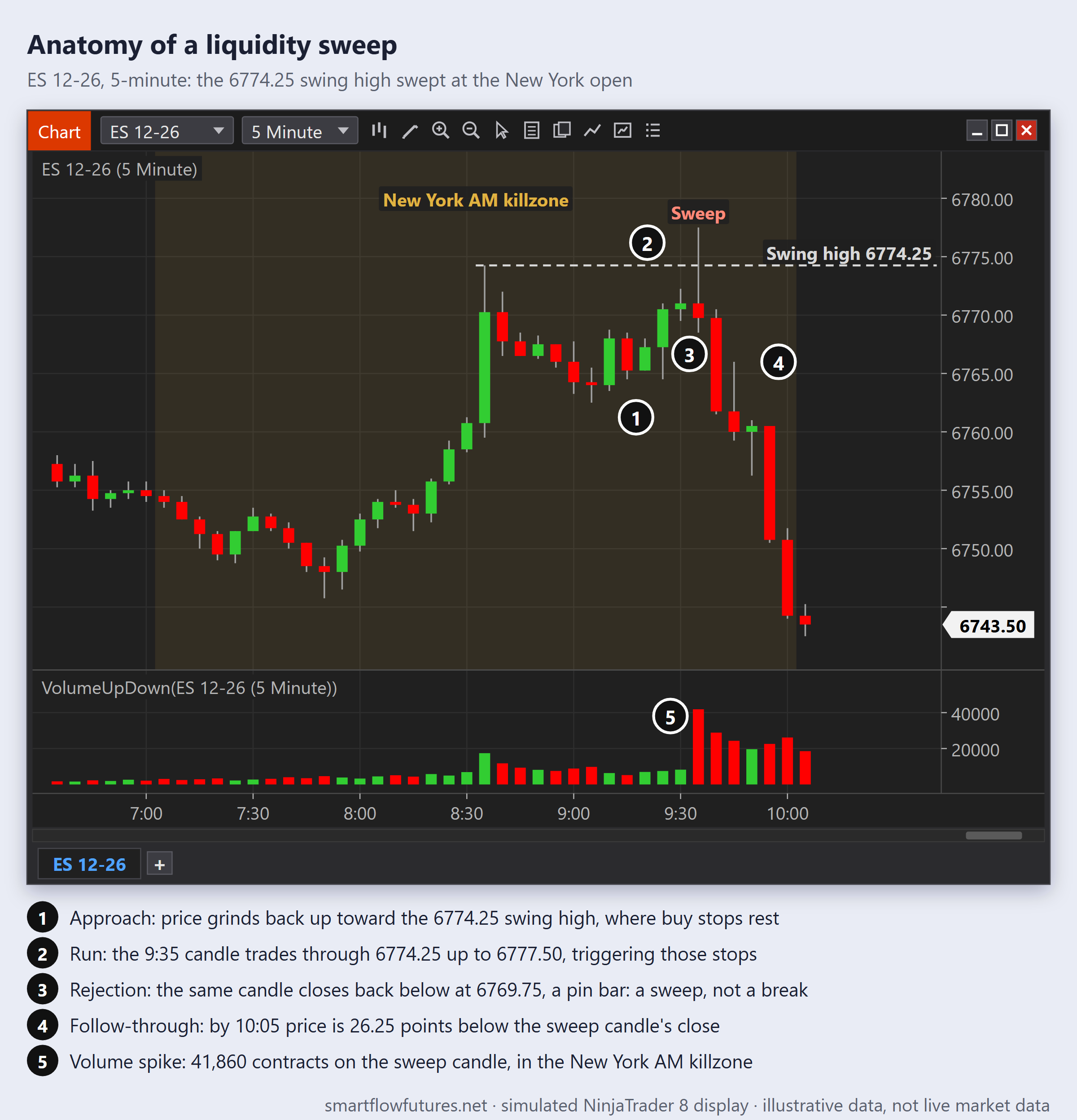
A liquidity sweep occurs when price trades beyond a liquidity pool (a swing high or low), triggering the resting stops, and the candle closes back inside the level. A close beyond the level is a break, not a sweep. The “sweep” describes that stop-order flush: those triggered orders clear out just before price moves in the opposite direction.
Sweeps are significant because they reveal institutional activity. When price sweeps liquidity, large traders are often using those triggered orders to build their positions. The sweep often marks their entry zone.
Anatomy of a Liquidity Sweep
The Approach: Price moves toward a swing high or low where liquidity is resting. This may happen gradually or quickly.
The Run: Price trades through the swing level. This triggers the stop orders: buy stops above highs, sell stops below lows.
The Rejection: Within the same candle, price reverses and the candle closes back inside the level, leaving a wick beyond it (often a pin bar or an engulfing candle).
The Follow-Through: Price continues in the reversal direction, often aggressively, as trapped breakout traders exit and no resting stops remain beyond the level.
Identifying Sweeps in Real-Time
The challenge is recognizing a sweep while it’s happening, not after the move is over. Key indicators:
Quick Rejection: The run beyond the swing level is brief. Price pokes through then immediately pulls back. If you see a wick developing beyond a swing point, a sweep may be occurring.
Candle Behavior: Watch the candle that trades beyond the level: a pin bar or engulfing candle that closes back inside is the sweep; a candle that closes beyond the level is a break.
Volume Spike: Sweeps often show volume spikes as stops trigger. If you see unusual volume as price trades through a swing point, pay attention to what happens next.
Time of Day: Sweeps are more common during killzones when institutional activity peaks. Be especially alert during London and New York opens.
Trading the Sweep
Entry Method 1: Immediate Reversal
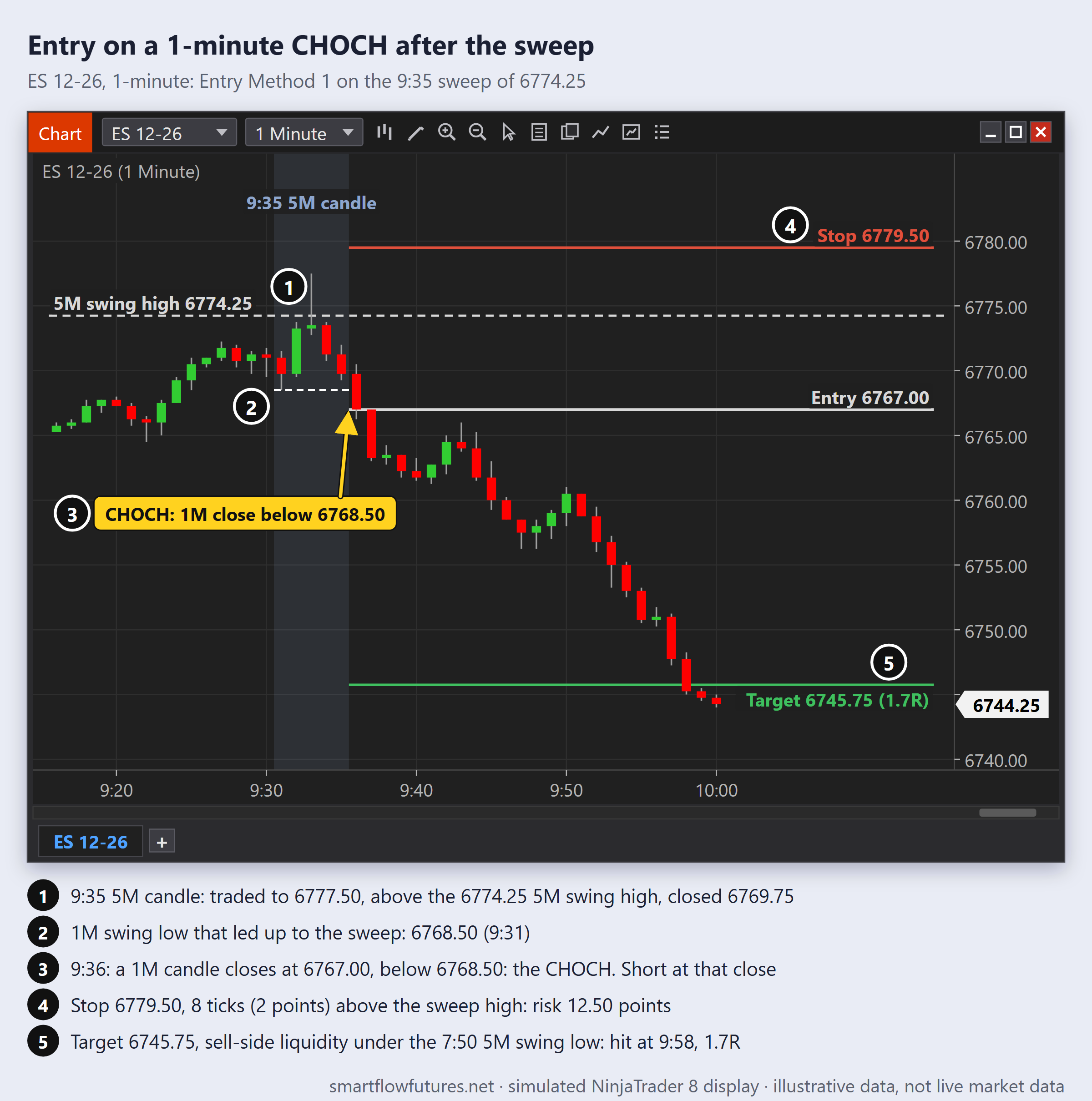
Enter as soon as you see confirmation of reversal, typically after a rejection candle completes or on a lower timeframe CHOCH opposite the sweep direction (after a sweep of highs, a candle close below the lower timeframe swing low that led up to the sweep).
Entry Method 2: Retrace Entry
Wait for the initial reversal, then enter on a retrace back toward the sweep point. This provides a better entry price but risks missing the trade if price doesn’t retrace.
Stop Loss Placement
Stop placement for sweep trades:
Beyond the Sweep High/Low: The safest placement is beyond the point price reached during the sweep. If a later candle closes beyond this level, the sweep has failed and the setup is invalid.
Using ATR Buffer: Add a buffer based on ATR to account for normal market noise; beyond a sweep extreme, a typical buffer is 8-20 ticks (2-5 points) on ES and 20-80 ticks (5-20 points) on NQ.
Aggressive Placement: Some traders use tighter stops just beyond the liquidity level, accepting a higher chance of stop-out for better risk-reward.
Target Setting for Sweep Trades
Common targets include:
If the sweep was above highs, target the liquidity resting below the lows on the opposite side. Other options are the most recent FVG or order block in the trade’s direction, the 50% level of the range being swept, or the next significant swing point.
Sweep Quality Factors
Not all sweeps are equal. Higher quality sweeps:
Higher Timeframe: A sweep of a daily swing high is more significant than a 5-minute swing high.
Multiple Levels: Sweeps that take out several swing points at once (stacked liquidity) are more powerful.
Killzone Timing: Sweeps during institutional activity windows carry more weight.
Clean Rejection: Quick, decisive rejection (not gradual) suggests strong institutional presence.
Alignment: Sweeps whose reversal runs with the higher timeframe bias (a sweep of lows in a bullish bias, a sweep of highs in a bearish bias) are more reliable.
Failed Sweeps
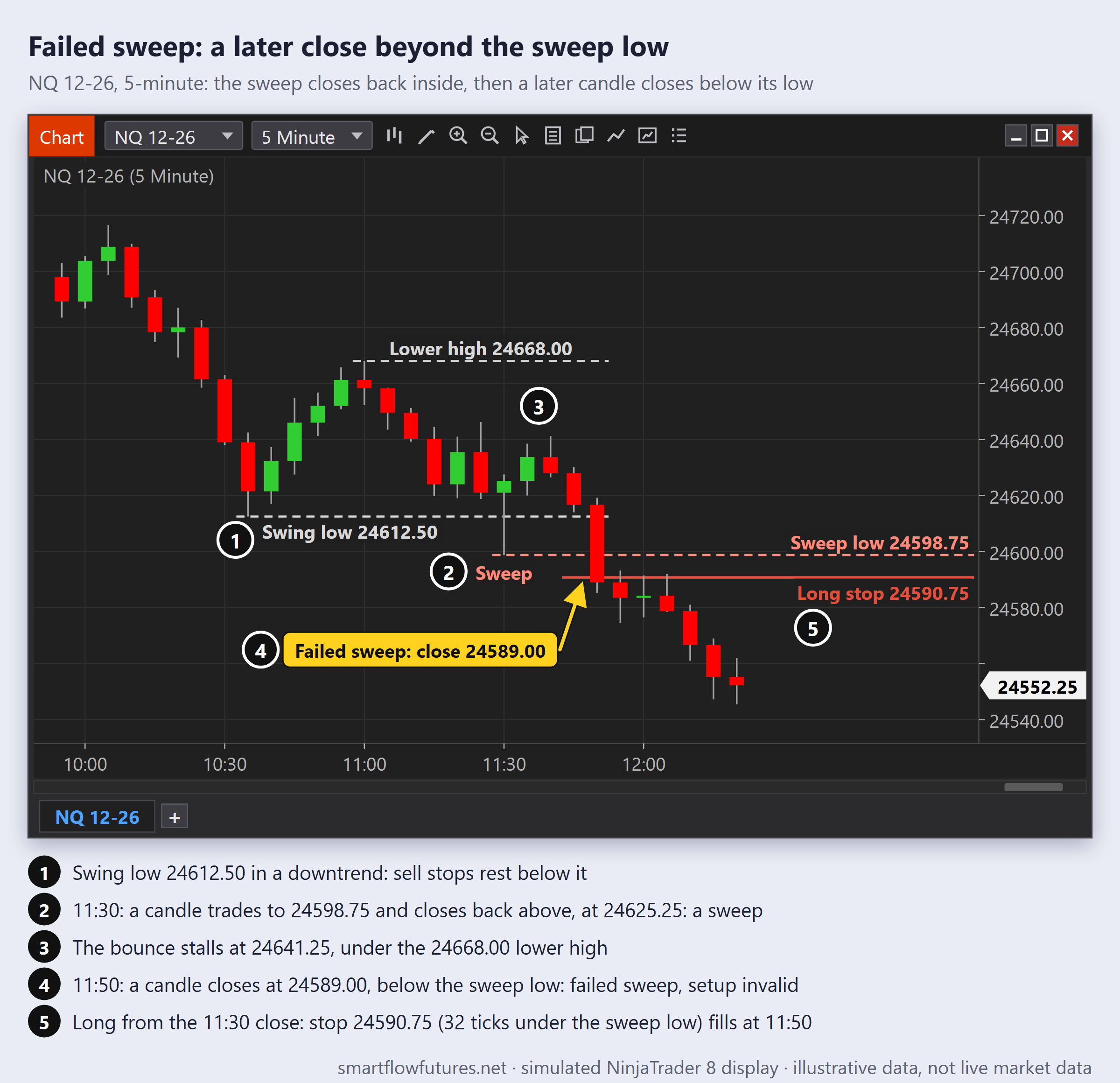
Sometimes price closes back inside, then a later candle closes beyond the sweep extreme and continues (a failed sweep). This happens when:
The liquidity taken fuels continuation rather than reversal. Higher timeframe momentum overwhelms the reversal attempt. The move beyond the level was genuine buying or selling, not just stop hunting.
Manage this risk by: waiting for confirmation before entry, using appropriate stop losses, accepting that not every sweep reverses.
Combining Sweeps with Other Concepts
Sweep + Order Block: If a sweep reverses into an order block, you have confluence. The order block provides additional confidence in the trade.
Sweep + FVG: Sweeps often create new FVGs due to aggressive movement. These FVGs can be retrace entry points.
Sweep + CHOCH: A sweep followed by a Change of Character on a lower timeframe is a stronger setup than a sweep alone.
Practice Identifying Sweeps
Develop your sweep-reading skills:
Study historical charts to identify past sweeps and note their characteristics. Then practice calling sweeps in real time on replay, as they form. Starting on higher timeframes helps, since sweeps are slower there and easier to read. Keep notes on which sweeps you called correctly and which you didn’t, so you can track your accuracy over time.
Key Takeaways
Liquidity sweeps occur when price trades beyond a swing point and the candle closes back inside. They reveal institutional activity and mark potential entry zones. Look for quick rejections, reversal candles, and volume spikes to identify sweeps in real-time. Trade with confirmation. Enter after the reversal is evident. Combine sweeps with order blocks, FVGs, and CHOCH for stronger setups.