
Time is one of the most overlooked variables in trading. While most retail traders focus solely on price, professional traders know that when you trade matters as much as what you trade. Killzones are specific time windows when institutional activity peaks and the best trading opportunities emerge.
What Are Killzones?
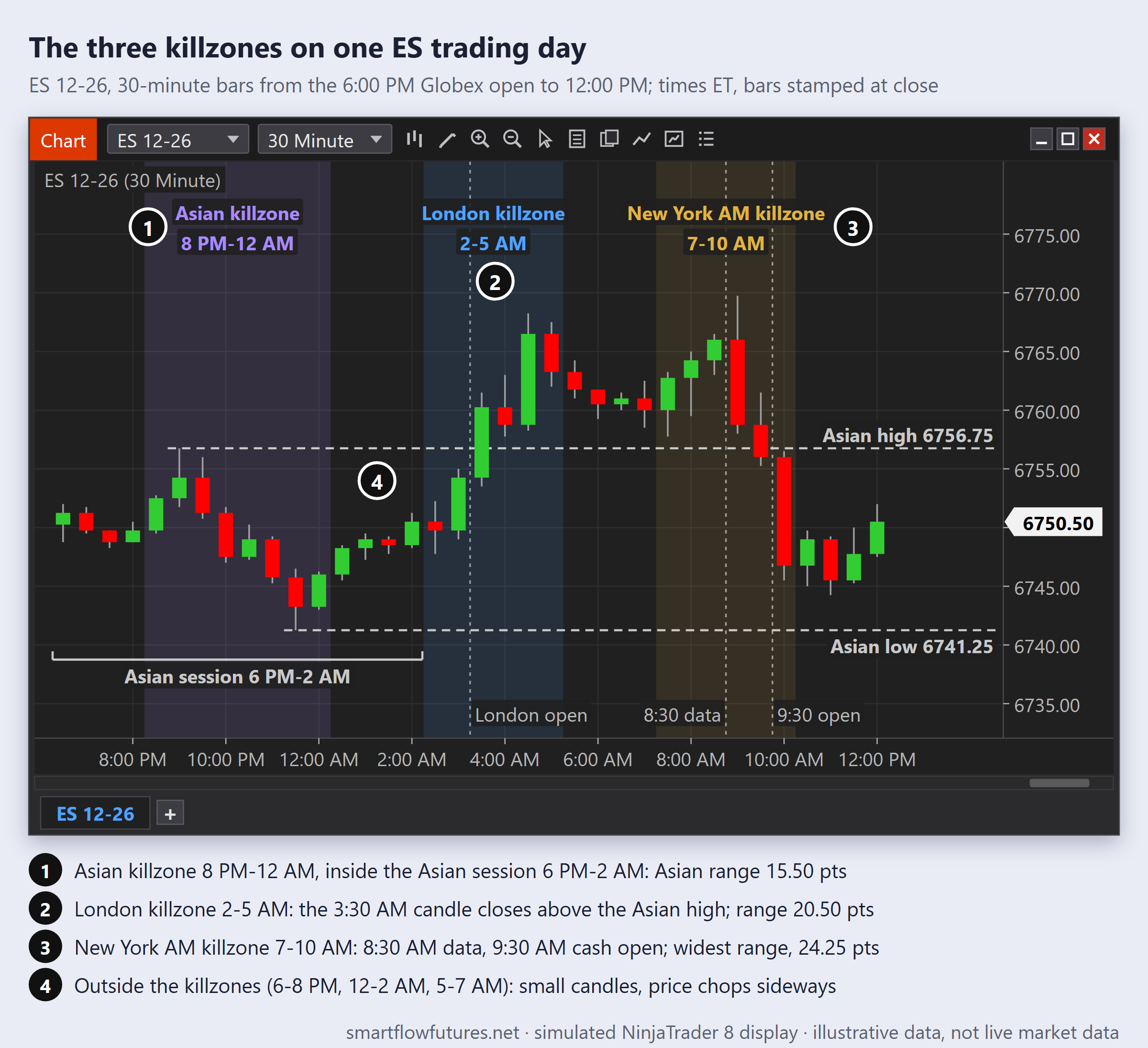
Killzones are specific periods during the trading day when smart money is most active. These windows typically coincide with major market opens and overlaps between sessions. During killzones, you see increased volatility and volume, more significant price moves and reversals, stronger setups, and clearer institutional footprints.
Outside of killzones, markets often chop sideways and produce noise and false signals. Focusing your trading on killzones tends to improve your results.
The Three Major Killzones
Asian Killzone: Approximately 8:00 PM – 12:00 AM ET (all times on this site are New York time, all year). This is when Tokyo and Asian markets are active, and it is the core of the Asian session (6:00 PM – 2:00 AM ET), whose high and low form the Asian range that London and New York react to. For ES and NQ it is the least reliable of the three killzones.
London Killzone: Approximately 2:00 AM – 5:00 AM ET. London opens at 3:00 AM ET, inside this window, and European traders become active. Often sees significant moves as it reacts to the Asian range. Very important for forex and index futures. The US and the UK change clocks on different Sundays: during the gap weeks (from the second Sunday of March to the last Sunday of March, and from the last Sunday of October to the first Sunday of November) the London open falls at 4:00 AM ET instead of 3:00 AM, still inside the killzone. For a reader in Paris, ET is 6 hours behind (5 during the gap weeks).
New York Killzone: Approximately 7:00 AM – 10:00 AM ET. The most volatile period for US futures. Overlaps the London session (London trades until about 12:00 PM ET) and holds the 8:30 AM economic releases and the 9:30 AM cash open. Typically sees the biggest moves of the day. The Indices Killzones ribbon at the top of this site shows the windows used for index futures such as ES and NQ: its Asia and London blocks match the killzones above, while its New York blocks are the index killzones, NY AM 9:30-11:00 AM ET (from the cash open) and NY PM 1:30-4:00 PM ET. The general New York killzone remains 7:00-10:00 AM ET.
Why Killzones Matter
Institutional traders work during the business hours of their own financial center (2:00 AM ET is 7:00 AM in London most of the year), not at random hours from home. They arrive at their desks, analyze overnight activity, and execute their strategies during specific windows. This creates recurring tendencies:
Maximum Participation: More participants means deeper order books, more volume, and more significant moves.
Price Discovery: Major price levels are established during killzones. Breakouts and reversals are more meaningful.
Stop Hunts: Smart money often sweeps liquidity pools during killzone volatility (by design or as a by-product of its large orders) and uses the triggered stops to establish positions.
Trend Days: Major trending moves typically begin during killzones, not during quiet periods.
Killzone Trading Strategy
Before the Killzone:
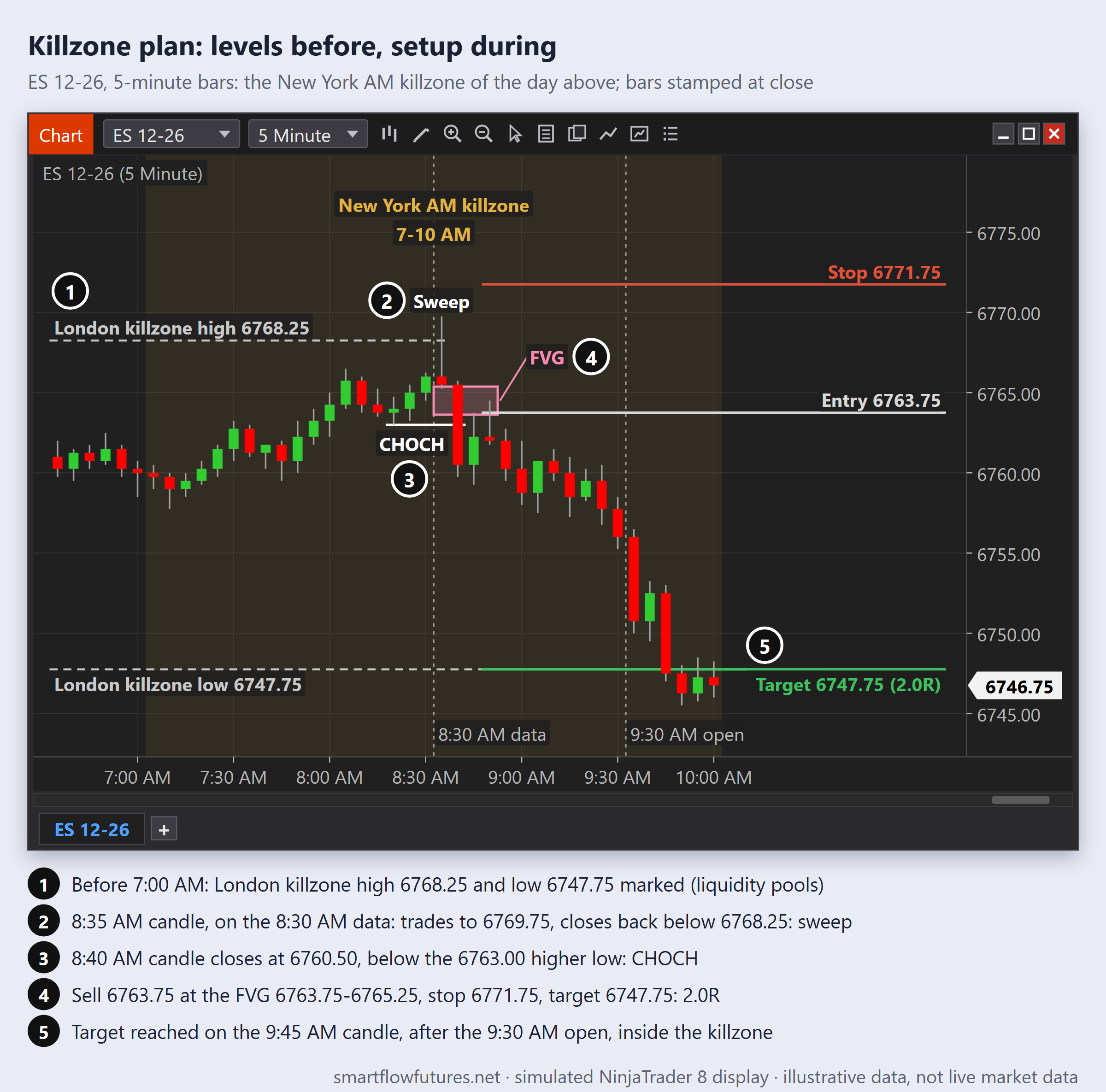
Analyze overnight price action and mark key levels (swing highs/lows, FVGs, order blocks). Identify liquidity pools that may be targeted. Form your bias based on higher timeframe analysis. Plan your trades. Know what setups you want to see.
During the Killzone:
Watch for sweeps of the Asian high/low in the London killzone and, in the New York killzone, of the Asian high/low and the London killzone high/low or, after the 9:30 AM open, of the overnight high/low (6:00 PM – 9:30 AM ET). Look for Break of Structure or Change of Character. Identify entry opportunities at order blocks or FVGs. Execute your planned setups with proper risk management.
After the Killzone:
Evaluate your trades. Update your analysis based on what occurred. Plan for the next killzone if applicable.
The London-New York Overlap
From approximately 8:00 AM to 12:00 PM ET (the usual currency-market convention, which starts New York at 8 AM), London and New York sessions overlap. This is the most liquid window for currency markets (for ES and NQ, volume peaks at the 9:30 AM cash open and into the 4:00 PM close) and often sees:
The most significant currency moves of the day. Major reversals as London positions unwind. Maximum institutional participation.
Many SMC traders focus exclusively on this overlap period for their trading.
Killzones and SMC Concepts
Time and price work together. SMC concepts are more reliable during killzones:
Order Blocks: Price reacting to order blocks during killzones is more significant than reactions during quiet periods.
Liquidity Sweeps: Sweeps during killzones often lead to bigger moves since there’s participation to fuel the reversal.
Break of Structure: BOS during killzones is more reliable as a directional signal.
FVG Fills: Price returning to FVGs during killzones often shows cleaner reactions.
Adapting to Your Timezone
Convert killzone times to your local timezone:
Use a world clock or trading platform with timezone features. Set alerts for the start of each killzone. Consider which killzones are practical for your lifestyle. The London killzone (2-5 AM ET) is challenging for US-based traders.
Trading Outside Killzones
A few guidelines apply to trading outside killzones:
Avoid: Low-volume chop between killzones. Random movements in the Asian session outside its killzone, for US futures traders (unless Asia is your focus). The New York lunch hour (12:00-1:00 PM ET), when activity wanes.
Consider: Managing existing positions from killzone entries. Identifying setups for the next killzone. Higher timeframe analysis and planning.
Key Takeaways
Killzones are specific time windows of peak institutional activity. The three major killzones are Asian (8 PM – 12 AM ET), London (2-5 AM ET), and New York (7-10 AM ET). The London-New York overlap (8 AM – 12 PM ET) is the most liquid window for currencies. SMC concepts are more reliable when combined with killzone timing. Focus your active trading during killzones for best results.