
You have now learned a comprehensive set of trading concepts: Smart Money Concepts, Order Flow analysis, time-based strategies, and advanced techniques. But knowledge alone does not make a profitable trader. What separates successful traders from struggling ones is the systematic application of knowledge with discipline and consistency.
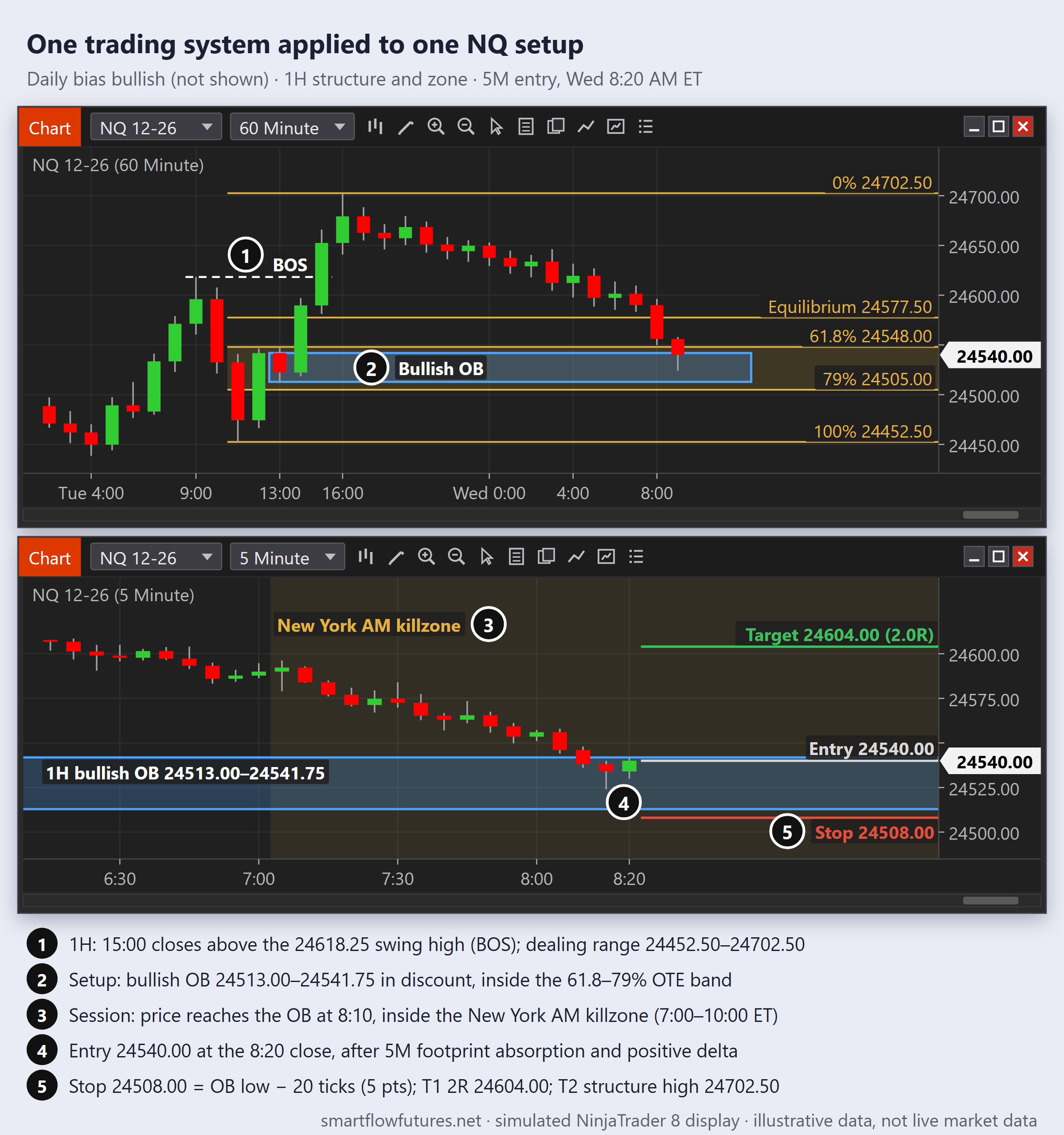
What is a Trading System?
A trading system is your personal framework for approaching markets. It includes: what you look for (setups), when you look (time windows), how you execute (entry rules), how you manage (trade management), and how you review (continuous improvement).
A system transforms discretionary decision-making into a repeatable process. This reduces emotional interference and creates consistency.
Components of Your Trading System
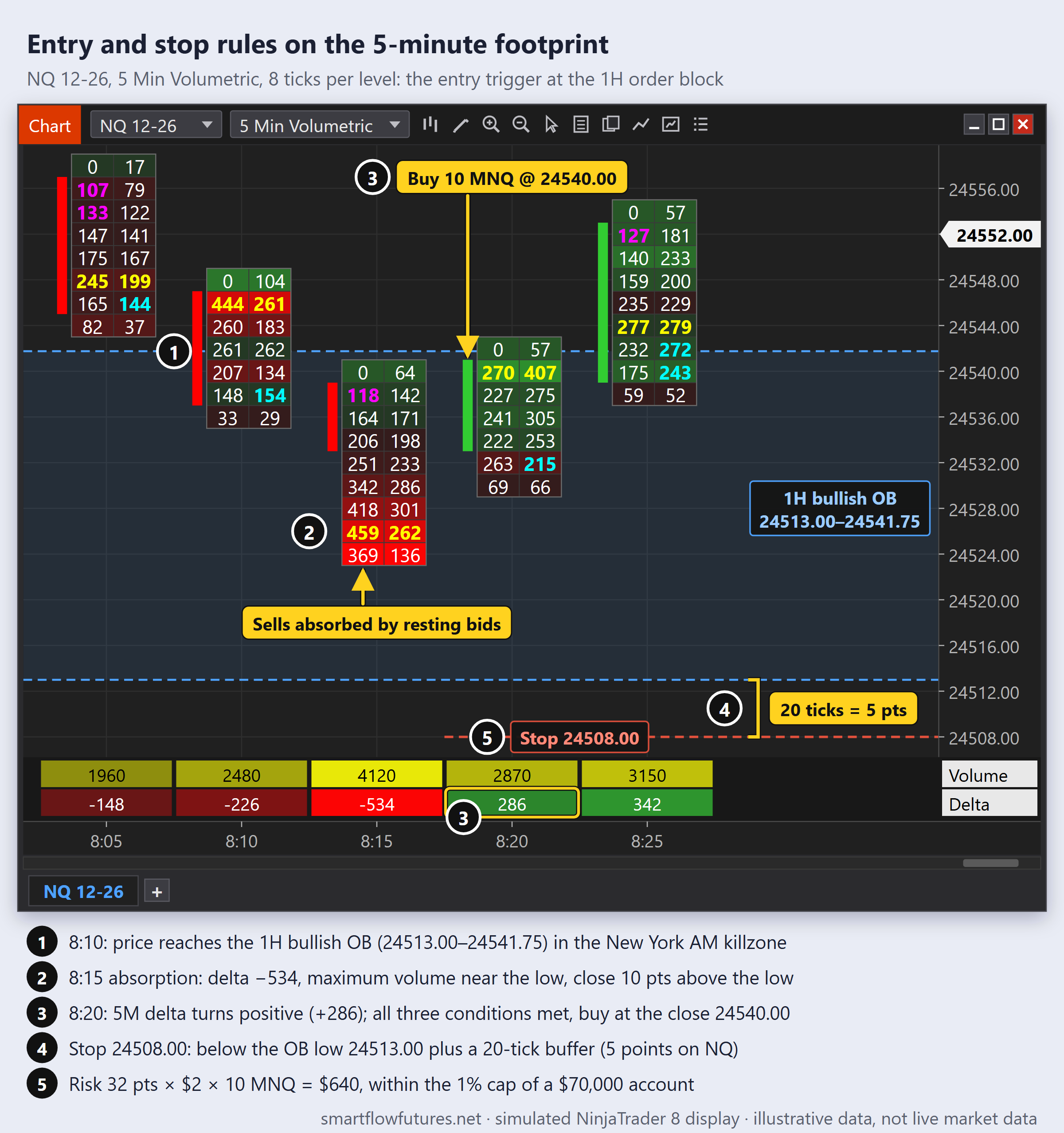
1. Market Selection
Which markets will you trade? Focus on what you know. For this course: NQ, ES, YM, Gold, Bitcoin futures. Specializing in one or two markets initially is recommended.
2. Timeframe Structure
Define your three timeframes: Bias timeframe (direction), Structure timeframe (setup), Entry timeframe (execution). Example: Daily / 1H / 5M. Stick to your chosen structure consistently.
3. Session Selection
Which sessions and killzones will you trade? Be realistic about your schedule. If you cannot trade London, do not build a system that requires it. Define your exact trading hours.
4. Setup Definition
What specific setups will you trade? Not every SMC concept needs to be in your system. Choose 2-3 primary setups and master them. Example: Order block entries with footprint absorption confirmation.
5. Entry Rules
Define exactly what triggers an entry. Vague criteria lead to inconsistent execution. Example: Enter when price reaches a 1H bullish order block during the NY AM killzone AND 5M footprint shows absorption (sells absorbed by resting bids) AND 5M delta turns positive.
6. Stop Loss Rules
Define where your stop goes for each setup. No ambiguity. Example: Stop goes below the order block low plus a 20-tick buffer (5 points on NQ). Maximum risk per trade: 1% of account.
7. Target Rules
Define your profit-taking approach. First target, second target, runner management. Example: First target at 2R (take 50%), second target at swing high (take 40%), runner to next liquidity (10%). This split needs 10 contracts or a multiple, e.g. 10 MNQ (Micro Nasdaq-100): 5 / 4 / 1.
8. Trade Management
Define how you manage open positions. When to move stop to breakeven. When to take partials. When to close early.
Creating Your Trading Rules
Write out your rules explicitly. They should be:
Specific: “I enter at the order block” is not specific enough. “I enter at the order block’s mean threshold (50% of the candle’s body) when delta is positive on the 5M” is specific.
Objective: Rules should be clear enough that someone else could follow them. If a rule requires “feeling,” it is too subjective.
Complete: Cover all scenarios: what if price gaps past your entry? What if the setup does not trigger before killzone ends? What if two setups trigger simultaneously?
Building Your Daily Routine
Pre-Market (30-60 minutes before trading):
Review overnight price action. Mark key SMC levels on your charts. Check economic calendar. Identify potential setups for the day. Form your daily bias. Mentally prepare. Clear your head.
Trading Session:
Focus during your defined hours. Follow your rules without deviation. Note trade opportunities, whether taken or not. Avoid distractions. No social media, no unrelated tasks.
Post-Session (15-30 minutes after trading):
Log all trades in your journal. Note your emotional state. Review what worked and what did not. Step away from charts after review.
Trade Journaling
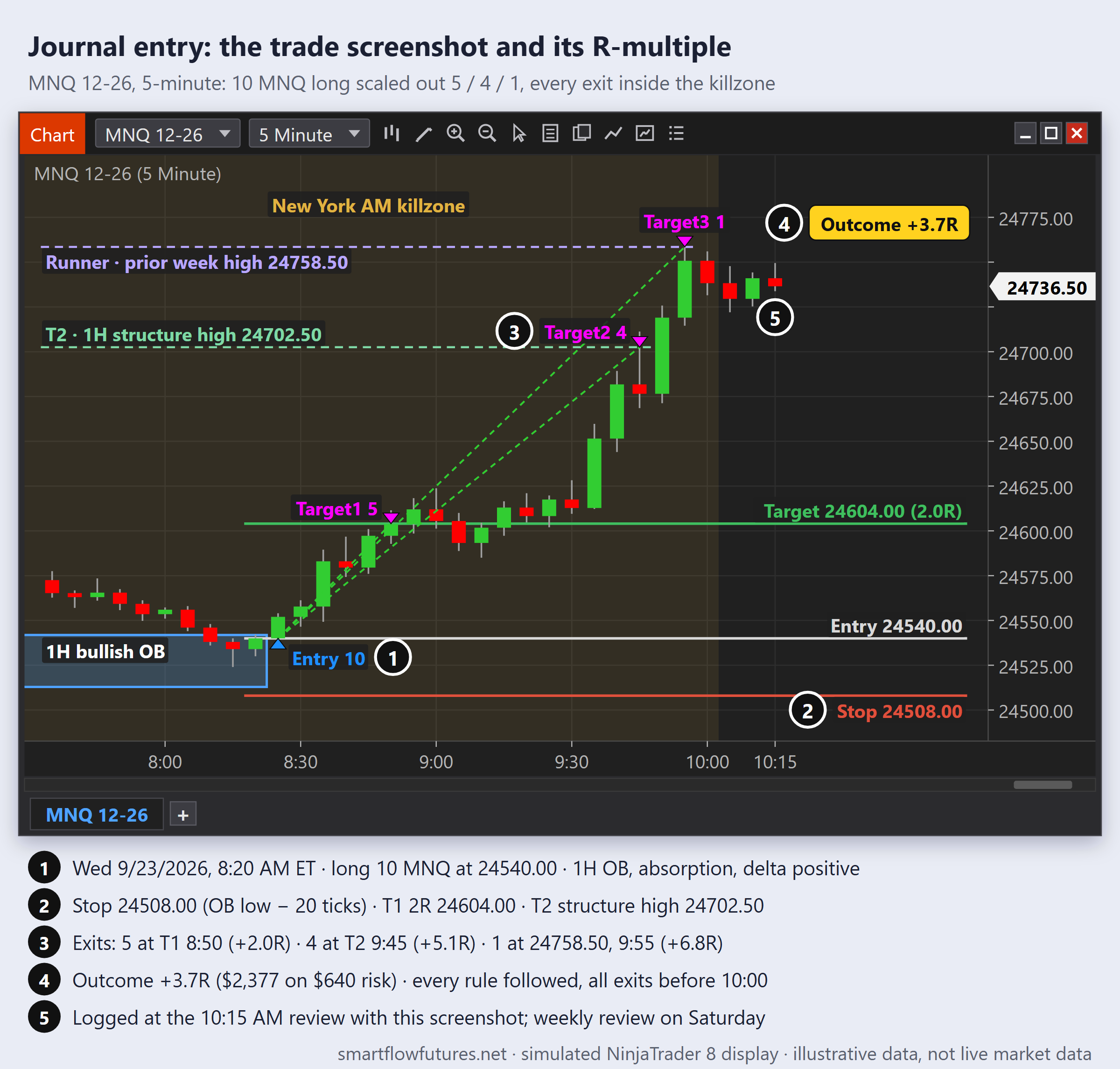
A trading journal is essential for improvement:
Minimum Journal Entry:
Date and time. Market and direction. Entry price and reasoning. Stop loss and target levels. Exit price and reasoning. Outcome (R-multiple). Notes on execution quality. Screenshot of the trade.
Review Cadence:
Daily: Brief review of that day. Weekly: Comprehensive review of all trades, patterns in wins and losses. Monthly: Statistics and system adjustments.
Performance Metrics
Track these metrics to assess your system:
Win Rate: Percentage of winning trades. Acceptable range varies by risk-reward.
Average Win / Average Loss: Your reward-to-risk in practice. Should align with your targets.
Expectancy: (Win Rate x Average Win) – (Loss Rate x Average Loss). Must be positive for profitability.
Maximum Drawdown: Largest peak-to-trough decline; shows how deep losing streaks get.
Profit Factor: Gross Profits / Gross Losses. Above 1.5 is solid.
Continuous Improvement
Your system should evolve:
1. Identify Weaknesses: Journal review reveals patterns. Which setups underperform? Which mistakes repeat?
2. Hypothesize Solutions: Based on your data, what adjustments might help? Adding a filter? Changing target approach?
3. Test Changes: Implement one change at a time. Trade small or demo while testing. Track results separately.
4. Adopt or Discard: If the change improves performance, adopt it into your system. If not, discard and try something else.
Psychology and Discipline
The best system fails without discipline:
Accept Losses: Every system has losing trades. The edge emerges over many trades, not each trade.
Avoid Revenge Trading: After a loss, do not immediately try to “make it back.” Follow your system.
Manage Ego: Winning streaks can create overconfidence. Losing streaks create doubt. Neither should change your execution.
Respect Risk: Never exceed your maximum risk per trade. Never revenge-size after losses.
Putting It All Together
Your complete system might look like this:
Market: NQ Futures (sized in MNQ micros)
Session: New York AM Killzone (7 AM – 10 AM ET)
Timeframes: Daily (bias) / 1H (structure) / 5M (entry)
Setup: Bullish Order Block in discount with OTE alignment
Entry: Price enters OB + 5M footprint shows absorption + delta positive
Stop: Below OB low + 20 ticks, i.e. 5 points on NQ (max 1% risk)
Target: T1 at 2R (50%), T2 at structure high (40%), Runner to external liquidity (10%), with 10 MNQ: 5 / 4 / 1
Daily Routine: 6:30 AM prep, 7 AM – 10 AM active, 10:15 AM review
Journaling: Every trade logged, weekly review on Saturday
Final Thoughts
Building a trading system is a journey, not a destination. Your first version will not be perfect. No system ever is. What matters is the commitment to systematic trading, honest assessment of results, and continuous refinement.
The concepts you have learned in this course give you a strong foundation. Many traders already know these concepts. The edge is in applying them with discipline, consistency, and continuous improvement.
Trade small while developing your system. Prioritize survival. The market will always be there. Your job is to develop the skills and system that allow you to extract value from it over the long term.
Key Takeaways
A trading system transforms discretionary decisions into a repeatable process. Define all components: markets, timeframes, setups, entries, stops, targets, management. Write explicit, specific, objective rules that anyone could follow. Build daily routines that include preparation, focused trading, and review. Journal every trade and review regularly to identify improvement opportunities. Discipline is the difference between knowing and profiting. Your system will evolve. Commit to continuous improvement.
Congratulations! You have completed the core concepts of the Smart Order Flow Trading curriculum. You now have a comprehensive understanding of Smart Money Concepts and Order Flow analysis. The next step is practice, execution, and development of your personal trading system. Trade well.