
Premium vs Discount Zones: Where Smart Money Buys and Sells
Every successful trader understands value. Smart money doesn’t buy at any price—they buy at discount prices and sell at premium prices. Understanding this simple concept improves your trade placement.
The Value Concept
Imagine you’re shopping for a car worth $30,000. Would you buy it for $40,000? Probably not — that’s a premium to its value. Would you buy it for $20,000? Absolutely, that’s a discount.
Markets work the same way. Within any price range, some prices represent good value (discount) and some represent poor value (premium). Smart money consistently buys at discount and sells at premium.
Defining the Range
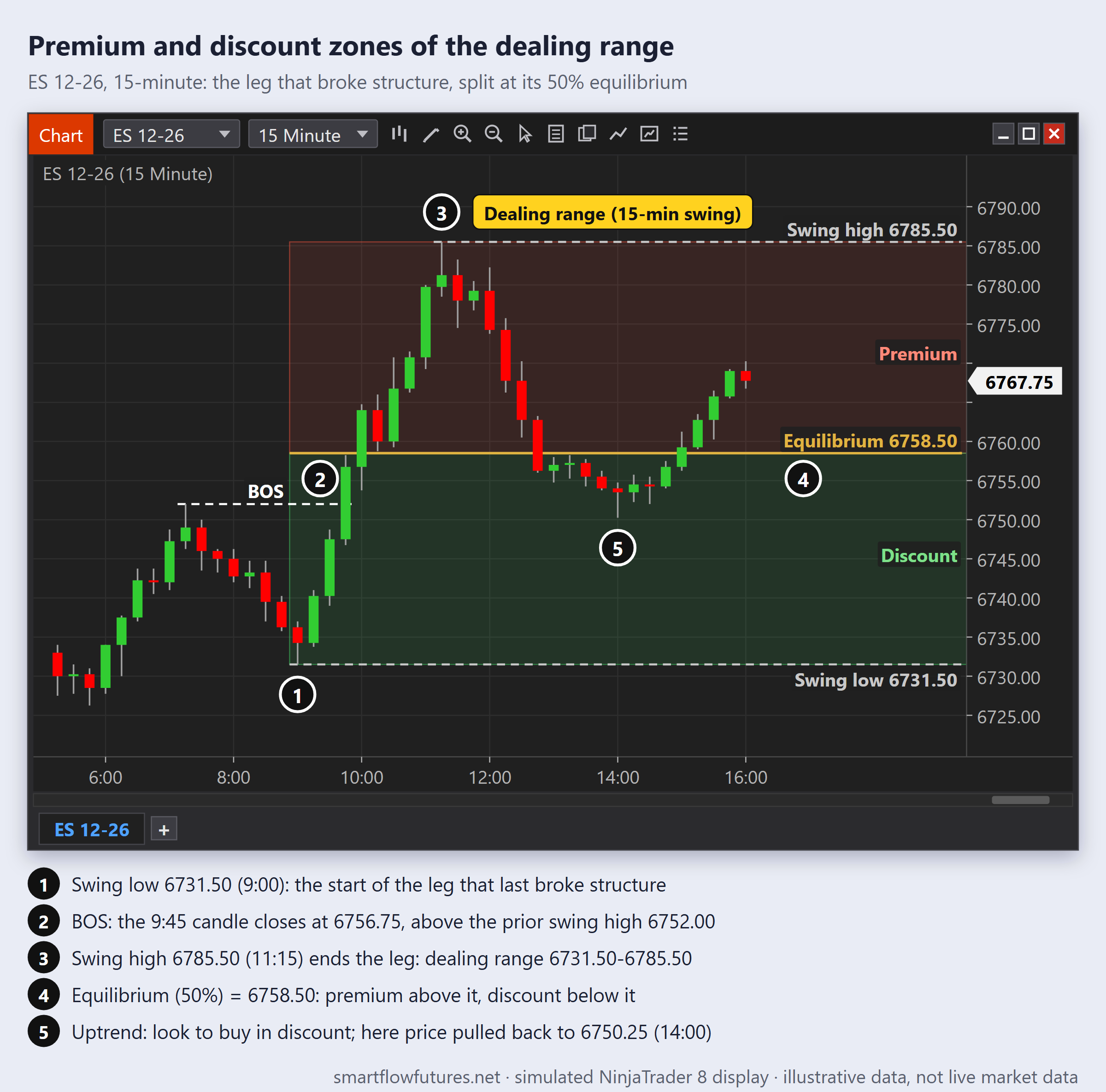
To identify premium and discount, we first need to define a range. On this site the default range is the current swing on your trading timeframe, called the dealing range: the swing low and swing high of the leg that last broke structure (it updates at every new BOS or CHOCH). A session or daily range can be used when you name it.
Once you have a range, you can calculate equilibrium—the midpoint—and divide it into zones.
Equilibrium (50% Level)
Equilibrium is the 50% point of any range. Above equilibrium is premium territory. Below equilibrium is discount territory.
In an uptrend, we want to buy in the discount zone (below equilibrium) and target premium zones. In a downtrend, we want to sell in the premium zone (above equilibrium) and target discount zones.
Premium Zone
The premium zone is the upper portion of the range (above the 50% level). In the premium zone, prices are relatively expensive. Buyers get less value for their money. Sellers get better prices.
In an uptrend, reaching the premium zone suggests the move may be extended and due for a pullback. In a downtrend, the premium zone is where we look for selling opportunities.
Discount Zone
The discount zone is the lower portion of the range (below the 50% level). In the discount zone, prices are relatively cheap. Buyers get better value. Sellers get worse prices.
In an uptrend, the discount zone is where we look for buying opportunities. In a downtrend, reaching the discount zone suggests the move may be extended.
Fibonacci Connection
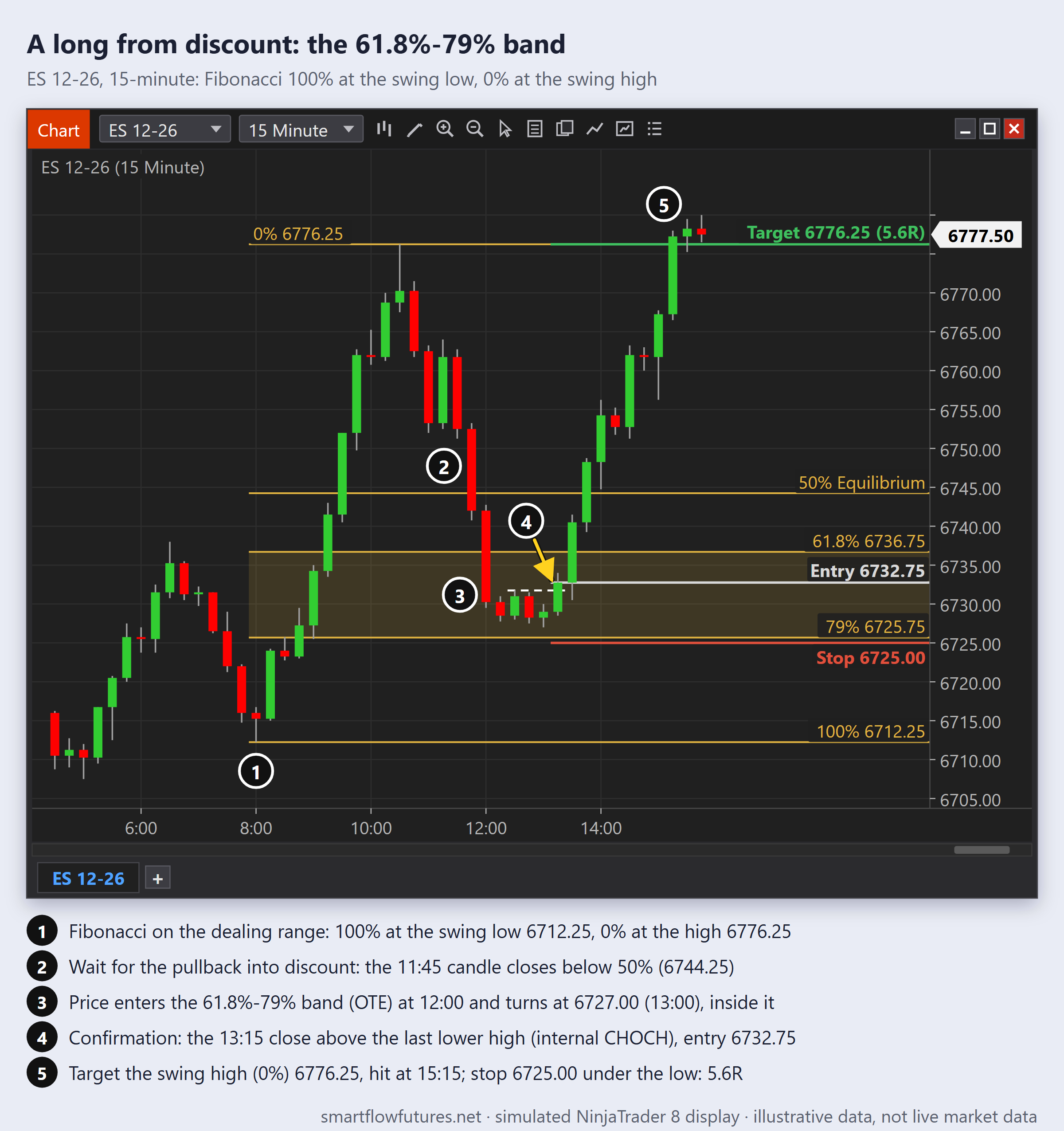
Many traders overlay Fibonacci retracement levels on this concept, drawn wick to wick across the same swing: 0% at the end of the leg (the swing high in an uptrend) and 100% at its start. The 50% level is equilibrium. The 61.8%-79% band (the optimal trade entry, or OTE, zone) is deep discount for buyers or deep premium for sellers. The 38.2% level is shallow retracement.
This is why the two tools are often used together: the 61.8%-79% band sits beyond equilibrium, in discount for a long and in premium for a short.
Practical Application
For Long Trades (in uptrends)
Wait for price to pull back into discount (below 50%). Ideally, look for entries inside the 61.8%-79% retracement band. Enter with confirmation at discount zones. Target the swing high (the 0% level) in premium first.
For Short Trades (in downtrends)
Wait for price to rally into premium (above 50%). Look for entries inside the 61.8%-79% retracement band. Enter with confirmation at premium zones. Target the swing low (the 0% level) in discount first.
Combining with Order Blocks
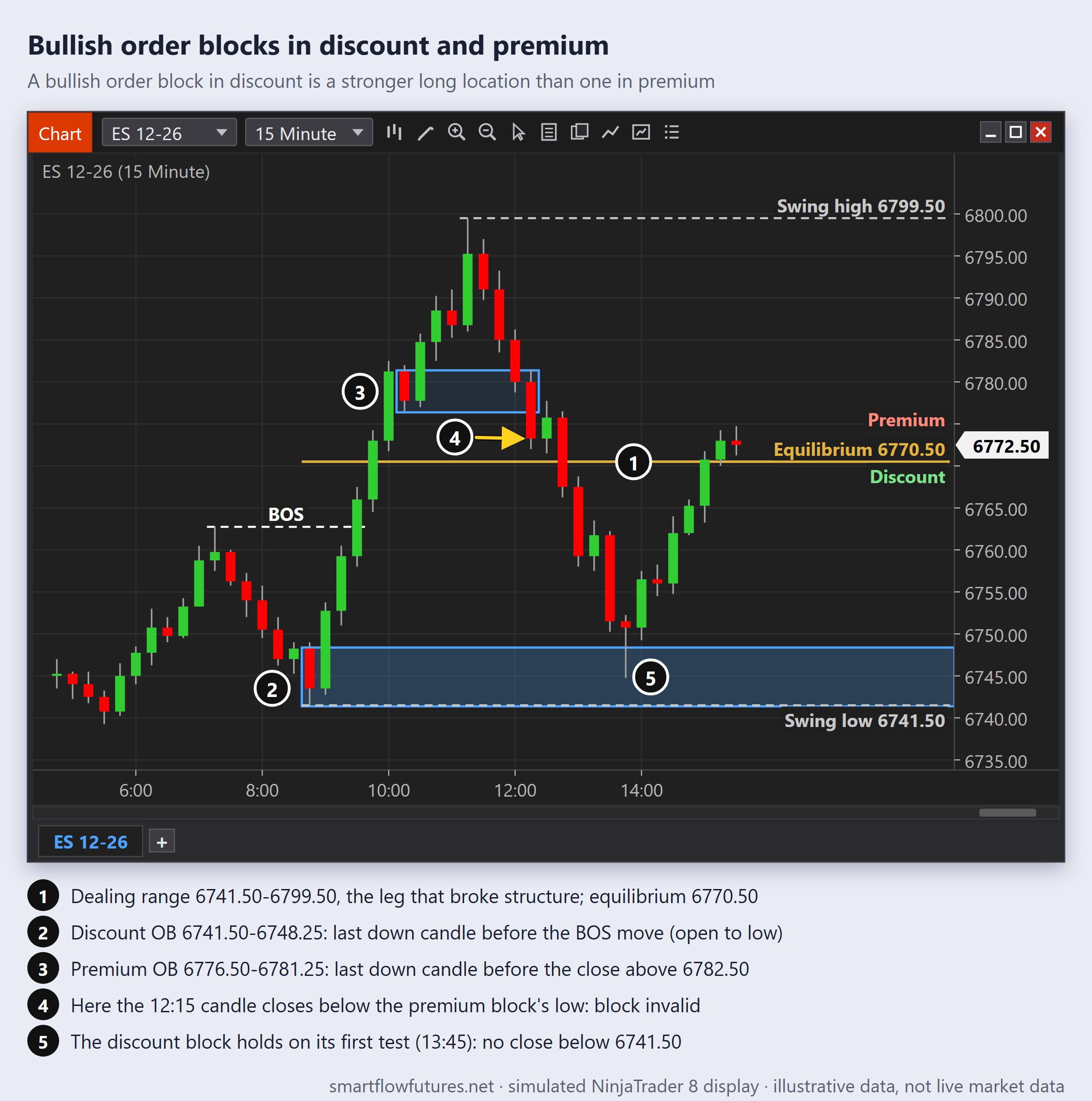
Premium/discount becomes more useful when combined with order blocks. A bullish order block in the discount zone is a stronger long location than one in premium. A bearish order block in the premium zone is a stronger short location than one in discount.
When multiple concepts align (structure, order blocks, and premium/discount), each one adds confluence to the trade.
Common Mistakes
Traders often make mistakes like buying in premium (chasing moves after they’ve extended), selling in discount (shorting after big down moves), ignoring context (premium/discount matters less if structure doesn’t support it), and being too rigid (not every trade fits perfectly—use this as a filter, not an absolute rule).
Key Takeaways
Premium is above the 50% level, which makes it the better zone for selling. Discount is below the 50% level, which makes it the better zone for buying. Trade in the direction of the trend, but enter at favorable prices within that trend. Combine with order blocks for stronger setups. This concept applies to any timeframe; use the current swing as your range unless you name another one.