
Not all setups are created equal. Learning to distinguish high-probability opportunities from marginal ones improves your win rate and reduces frustration. This article compares similar setups with different quality levels.
The Quality Factors
Several factors determine setup quality:
Higher Timeframe Alignment: Trading with the trend increases probability. Counter-trend setups are inherently lower probability.
Level Confluence: Multiple concepts in the same price area (OB + FVG + round number) increase probability.
Level Freshness: First test of a level is higher probability than third or fourth test.
Session Timing: Killzone setups are higher probability than off-hours setups.
Order Flow Confirmation: Visible institutional activity at the level increases probability.
Comparison 1: Order Block Quality
High Probability OB:
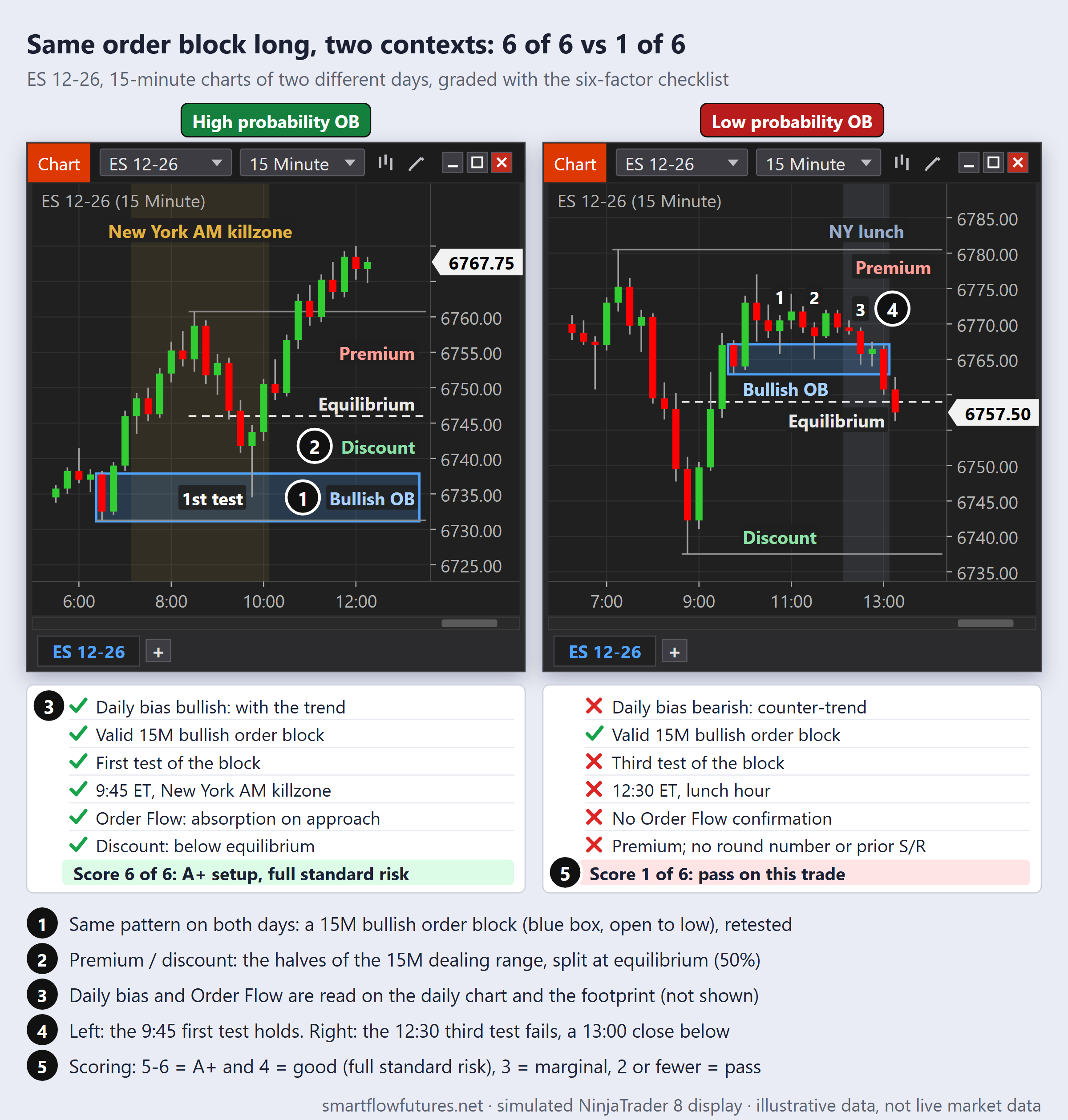
Daily bias is bullish. 15M bullish order block identified. First test of this order block. Located in discount zone. Occurring during the New York AM killzone. Order Flow shows absorption on approach.
Low Probability OB:
Daily bias is bearish (counter-trend). 15M bullish order block identified. Third test of this order block. Located in premium zone. Occurring during lunch hour. No Order Flow confirmation.
The Difference:
Same technical pattern (OB long entry), drastically different context. The high-prob setup has six supporting factors. The low-prob setup has multiple factors working against it.
Comparison 2: FVG Retest Quality
High Probability FVG:
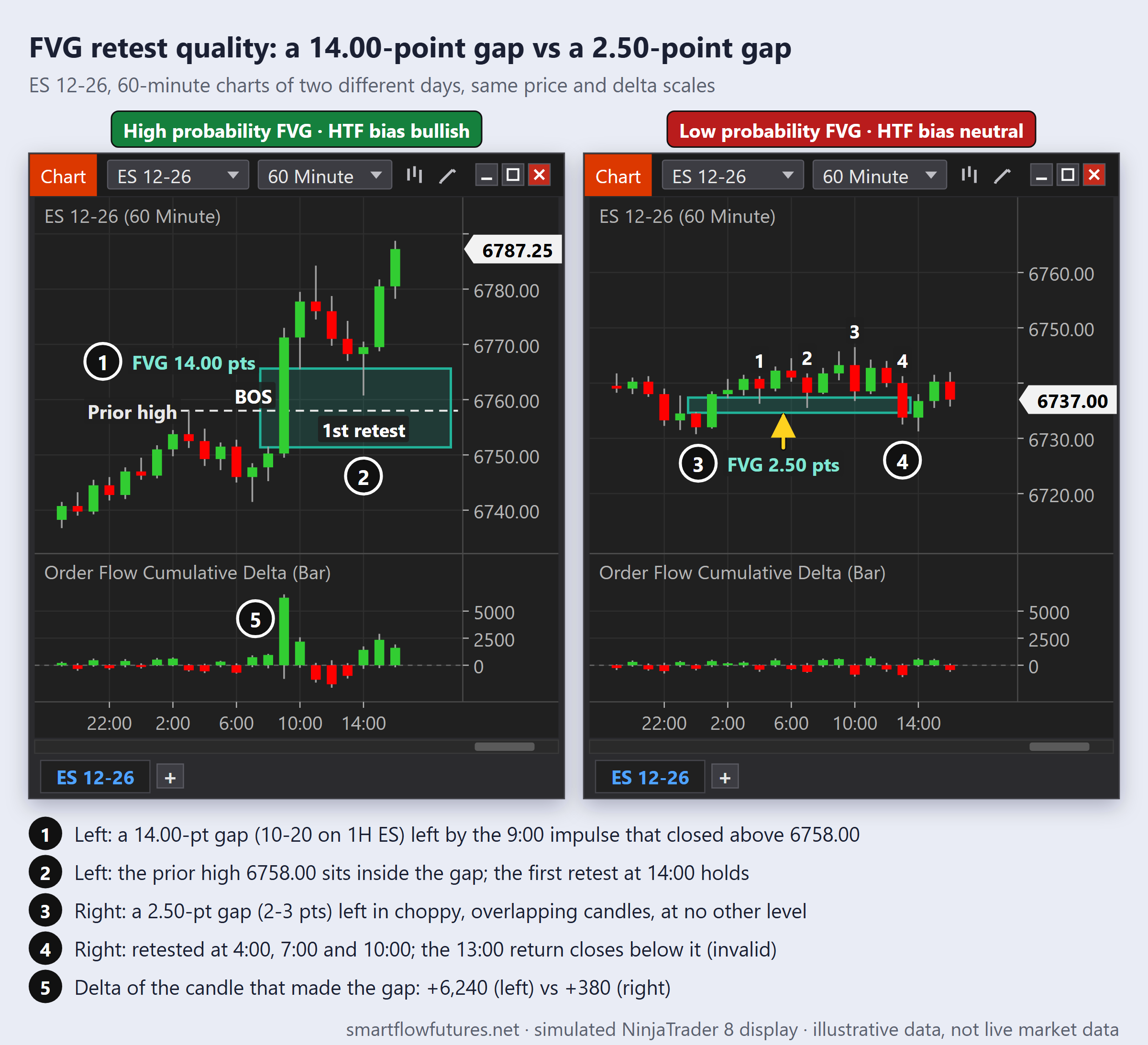
Created during strong impulse move with structure break. Size is moderate (10-20 points on a 1H ES chart). First retest since creation. Higher timeframe supports direction. Located at a prior support/resistance level. Strong delta on the impulse that created it.
Low Probability FVG:
Created during choppy, overlapping price action. Size is very small (2-3 points on the same chart). Multiple retests have already occurred. Higher timeframe is neutral or opposed. No other technical significance at this price. Weak delta on the creating move.
The Difference:
The high-prob FVG was created by institutional activity and has confluence. The low-prob FVG might just be noise in price action.
Comparison 3: Liquidity Sweep Quality
High Probability Sweep:
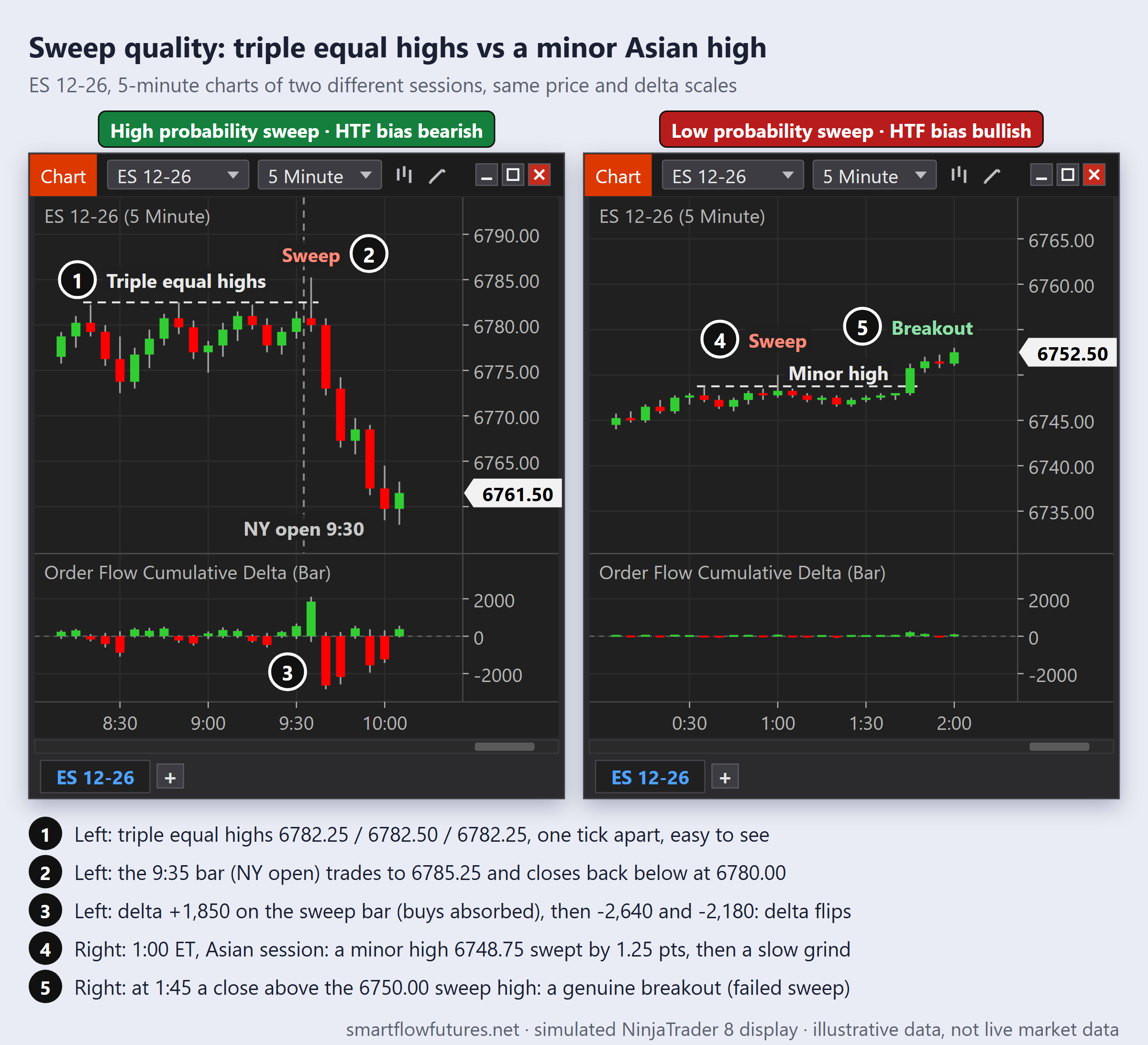
Clear, obvious liquidity (triple equal highs everyone can see). Sweep occurs during London or NY open. Immediate, aggressive rejection after sweep. Higher timeframe supports the reversal direction. Order Flow shows absorption at the extreme.
Low Probability Sweep:
Minor swing high with limited stops above. Sweep occurs during Asian session. Slow, grinding movement after sweep, not clear rejection. Higher timeframe supports continuation through the level. No visible Order Flow shift.
The Difference:
High-prob sweep has obvious liquidity, clear rejection, and context support. Low-prob sweep might not be a sweep at all. It could be a genuine breakout.
Comparison 4: Session Timing
High Probability Timing:
Setup develops at 9:45 AM ET, inside the New York AM killzone (7:00-10:00 AM ET). Volume is high. Other traders are active. Price tends to move with conviction.
Low Probability Timing:
Setup develops during lunch (12-1 PM ET). Volume is low. Price chops without direction. Even good setups often fail or take forever to work.
The Difference:
Same setup pattern, but timing changes its quality. Killzones exist for a reason.
The Confluence Checklist
Before taking any trade, count your confluence factors:
Higher timeframe bias aligned? ☐
Valid SMC structure present? ☐
Level on its first or second test? ☐
Within killzone timing? ☐
Order Flow confirms? ☐
Additional confluence (round number, prior S/R, discount for longs / premium for shorts)? ☐
Scoring:
5-6 factors: A+ setup, full standard risk. 4 factors: Good setup, full standard risk. 3 factors: Marginal, reduced risk (for example half) or pass. 2 or fewer: Pass on this trade.
The Cost of Low Probability Trades
Taking low-probability setups costs you:
Win Rate: More losses, lower overall win rate.
Psychology: Losing streaks from poor setups damage confidence.
Opportunity: Capital tied up in bad trades cannot be used for good ones.
Edge: Your edge exists in high-probability setups. Low-prob trades dilute it.
Being selective improves results even if you take fewer trades.
Key Takeaways
High probability setups have multiple confluence factors supporting them. Key factors: HTF alignment, level freshness, timing, and Order Flow confirmation. Same pattern can be high or low probability depending on context. Use a checklist to objectively assess setup quality. Be selective. Passing on marginal setups improves overall results.