
Losing trades are inevitable. What separates successful traders from unsuccessful ones is what they learn from those losses. This article examines typical losing trade scenarios and extracts actionable lessons.
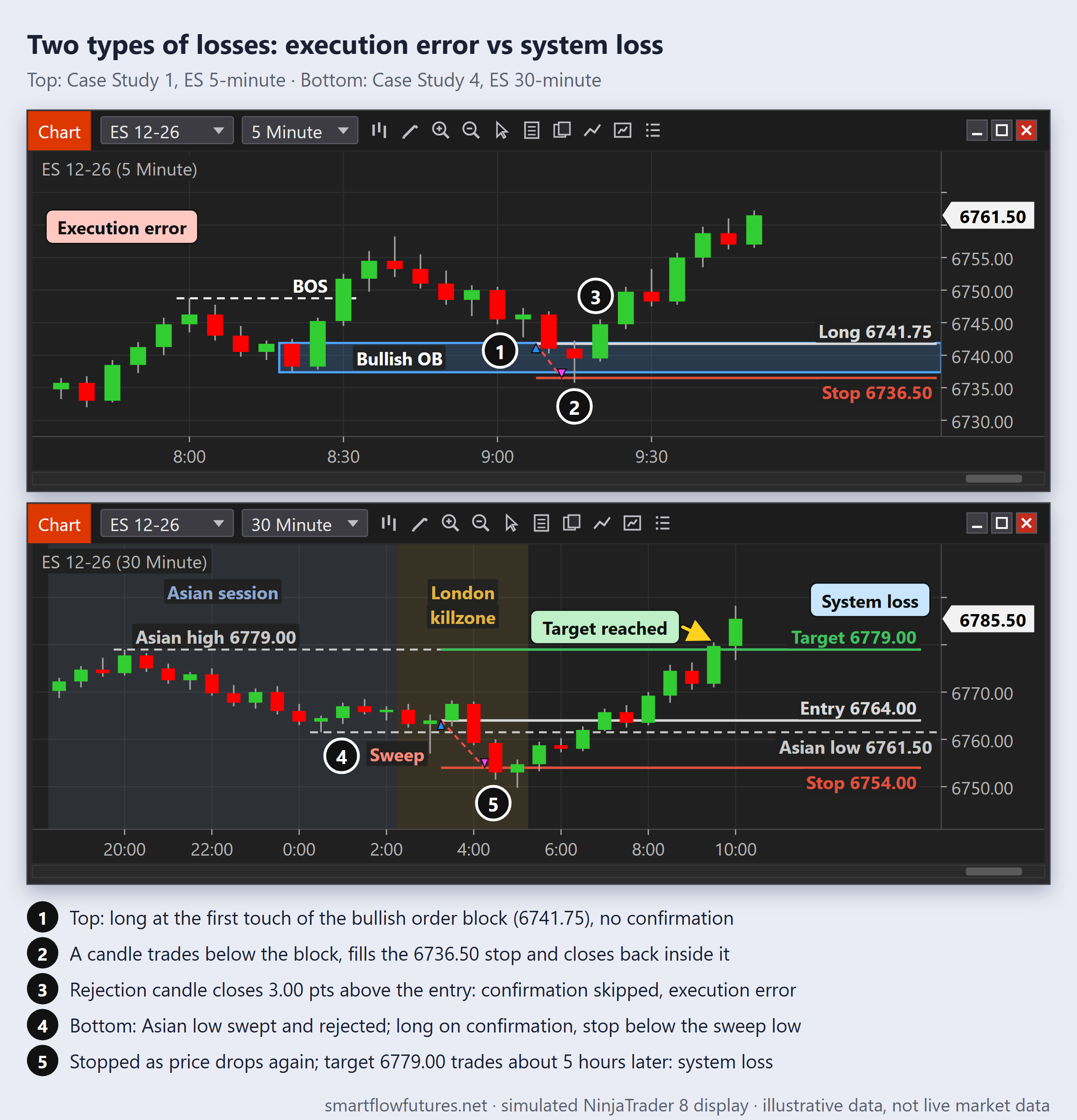
Two Types of Losses
Before analyzing specific trades, understand that losses fall into two categories:
System Losses: Trades that followed your rules perfectly but still lost. These are part of trading. No system wins 100%. Nothing to “fix” here except accepting them.
Execution Errors: Trades where you deviated from your rules or made mistakes. These require analysis and correction.
The goal of loss analysis is to distinguish between these and only try to “fix” actual errors.
Case Study 1: The Premature Entry
The Trade:
Setup: Price approaching a bullish order block on ES. Entry: Entered long as soon as price touched the order block. Stop: Below the order block. Result: Price swept the order block (a candle traded below its low and closed back inside the block), stopped out, then reversed and rallied.
What Went Wrong:
Entered without confirmation. Did not wait for rejection candle or Order Flow signal. Anticipated rather than reacted.
The Lesson:
Order blocks can be swept before holding. In this system, always wait for confirmation before entering. The extra few points of entry price are worth fewer immediate stop-outs.
Classification: Execution error. The system requires confirmation; it was skipped.
Case Study 2: Fighting the Trend
The Trade:
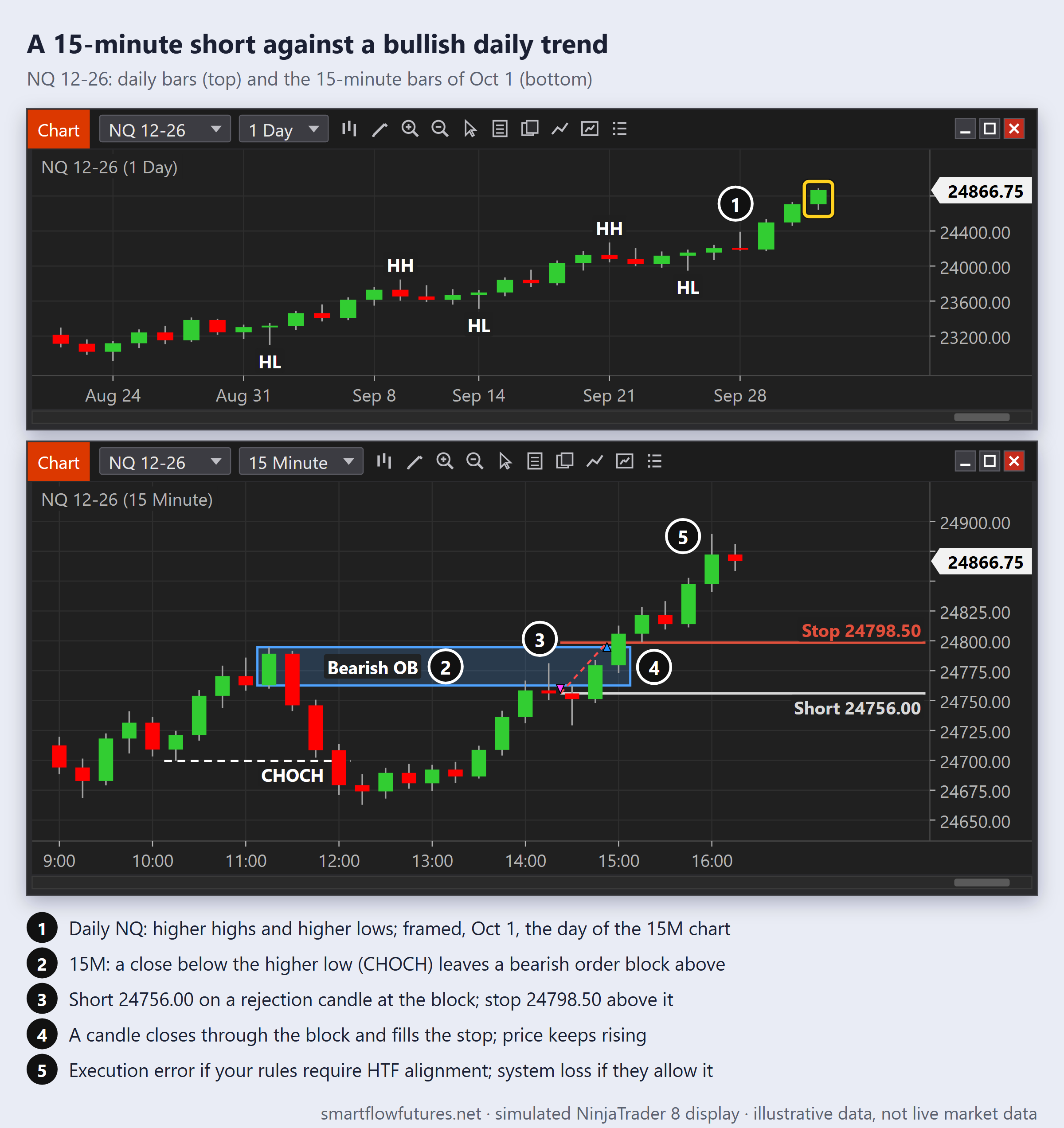
Setup: Bearish order block on 15M chart of NQ. Context: Daily chart was strongly bullish with higher highs. Entry: Shorted at the order block with confirmation. Stop: Above the order block. Result: Price moved through the order block and continued higher. Stopped out.
What Went Wrong:
Traded against the higher timeframe trend. Even with a valid lower timeframe setup, the daily bias was strongly opposed.
The Lesson:
Higher timeframe direction takes precedence. Counter-trend trades are weaker setups. When HTF is strongly trending, only take trades in that direction.
Classification: Execution error (if rules specify HTF alignment) or system loss (if counter-trend trades are allowed as weaker setups).
Case Study 3: The News Trap
The Trade:
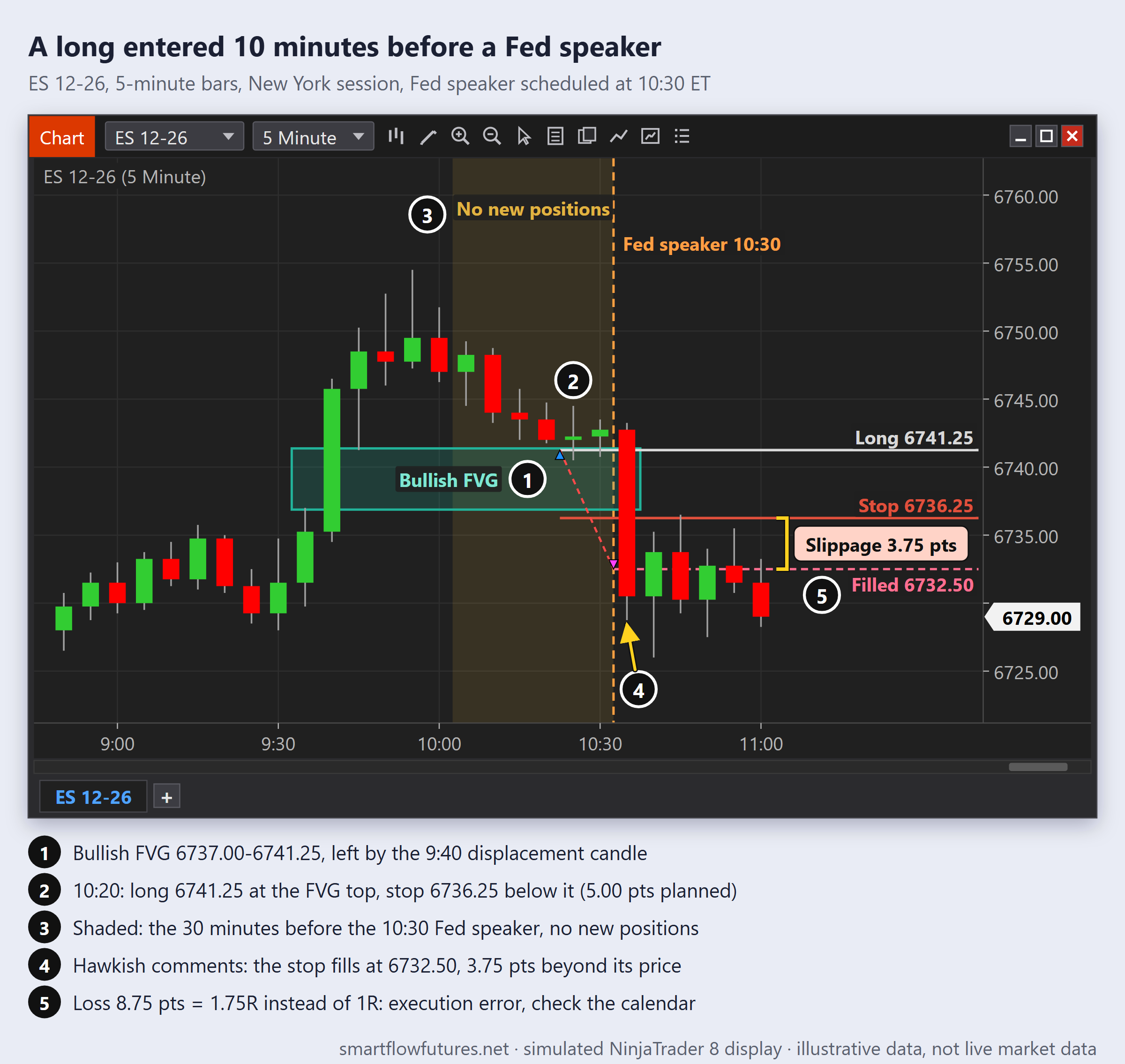
Setup: Valid FVG retest long on ES during NY session. Entry: Entered 10 minutes before scheduled Fed speaker. Stop: Below the FVG. Result: Fed speaker made unexpected hawkish comments. The stop filled several points beyond its price (slippage). Larger loss than planned.
What Went Wrong:
Entered a position immediately before a scheduled news event. News created volatility that invalidated technical analysis.
The Lesson:
Always check the economic calendar before entering. Avoid new positions 15-30 minutes before major events. If in a position, consider reducing or exiting before news.
Classification: Execution error. Calendar check should be part of pre-trade routine.
Case Study 4: The System Loss
The Trade:
Setup: Textbook London Sweep long setup. Asian low swept, immediate rejection, Order Flow confirmation with absorption. Entry: Entered on confirmation. Stop: Below the sweep low, per the setup rules. Result: Price reversed again and stopped out. Then, eventually, rallied to target hours later.
What Went Wrong:
Technically, nothing. The setup was valid. Confirmation was present. This time, it did not work.
The Lesson:
Even perfect setups do not work every time. A setup that wins more often than it loses still loses regularly; track your own win rate so you know how many losses to expect. Accept system losses as part of the process.
Classification: System loss. No correction needed. This is what losses look like when you are trading correctly.
Loss Analysis Framework
For each losing trade, ask:
1. Did I follow my rules? If no, this is an execution error. Identify which rule was broken. Determine why (emotional state, distraction, lack of preparation).
2. Was the setup valid? Review the setup criteria. Did it actually meet all requirements? Be honest. No hindsight justification.
3. What was the market context? Higher timeframe trend. Upcoming news events. Time of day and session.
4. Was anything unusual? Unexpected news. Unusual volatility. Technical issues.
5. What would I do differently? If execution error: specific behavior change. If system loss: nothing, it was correct.
Creating a Loss Review Habit
Same Day Review: Brief note on what happened. Initial emotional processing. Mark as system loss or execution error.
Weekend Review: Deeper analysis of the week’s losses. Look for patterns in execution errors. Calculate system loss percentage versus expectation.
Monthly Review: Aggregate analysis of all losses. Are execution errors decreasing? Is system loss rate within expected range? Any recurring issues?
Key Takeaways
Distinguish system losses (unavoidable) from execution errors (fixable). System losses require acceptance, not correction. Execution errors require specific, actionable changes. Use a framework: rules followed, setup validity, context, unusual factors. Review losses same-day, weekly, and monthly for patterns. The goal is reducing execution errors while accepting system losses.