
Both absorption and exhaustion result in price stalling despite volume. But they represent fundamentally different market dynamics and have different trading implications. Confusing them leads to poor trade decisions. This article clarifies the distinction.
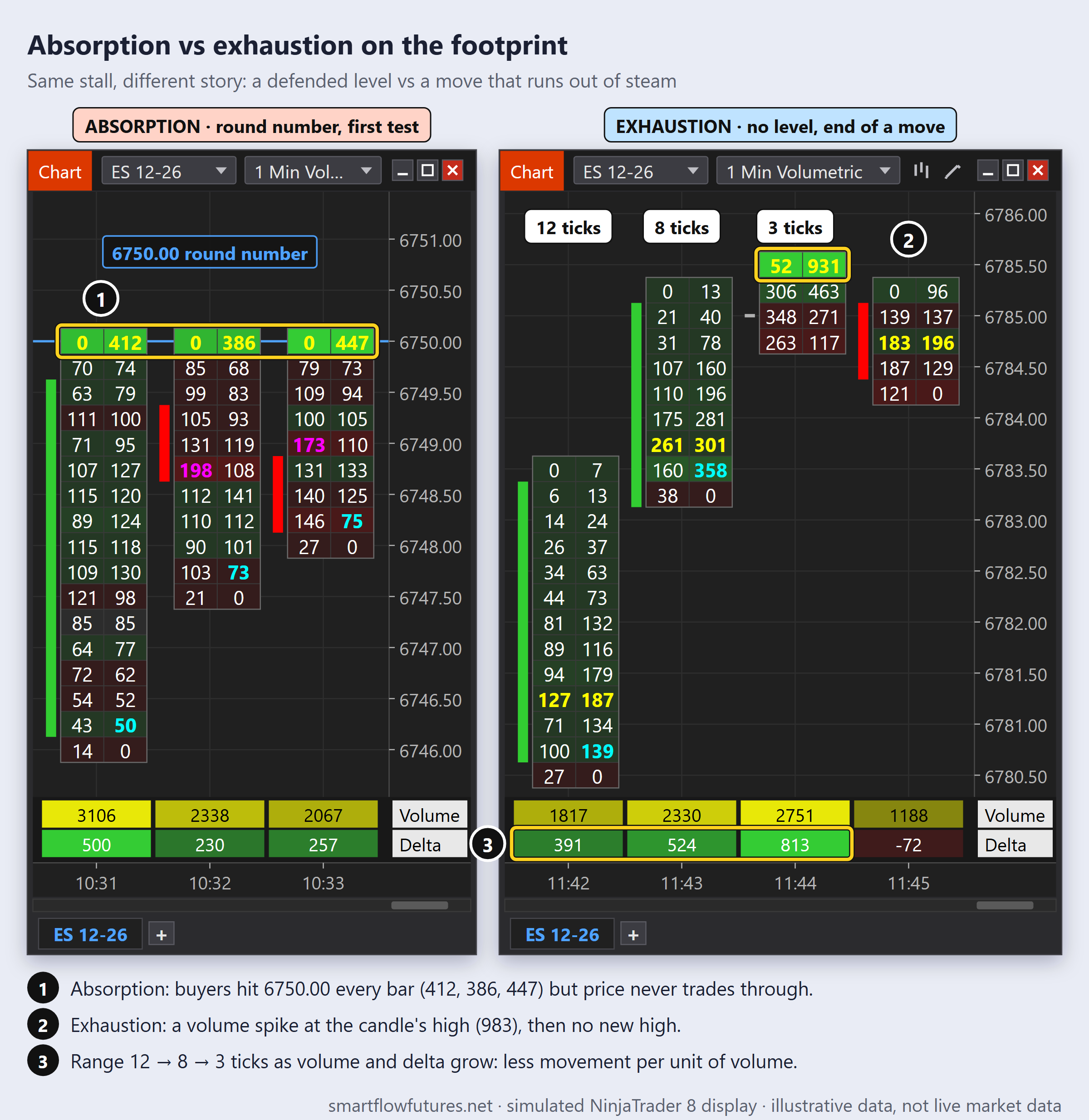
Defining the Difference
Absorption: A deliberate defensive action. One side is actively absorbing the aggression of the other. Large passive orders are being deployed to halt the move. Someone wants price to stop here and is willing to commit capital to make it happen.
Exhaustion: The aggressive side running out of steam. No deliberate defense, just a lack of follow-through. Buyers or sellers have committed their capital and have nothing left. The move dies naturally rather than being stopped.
Visual Differences
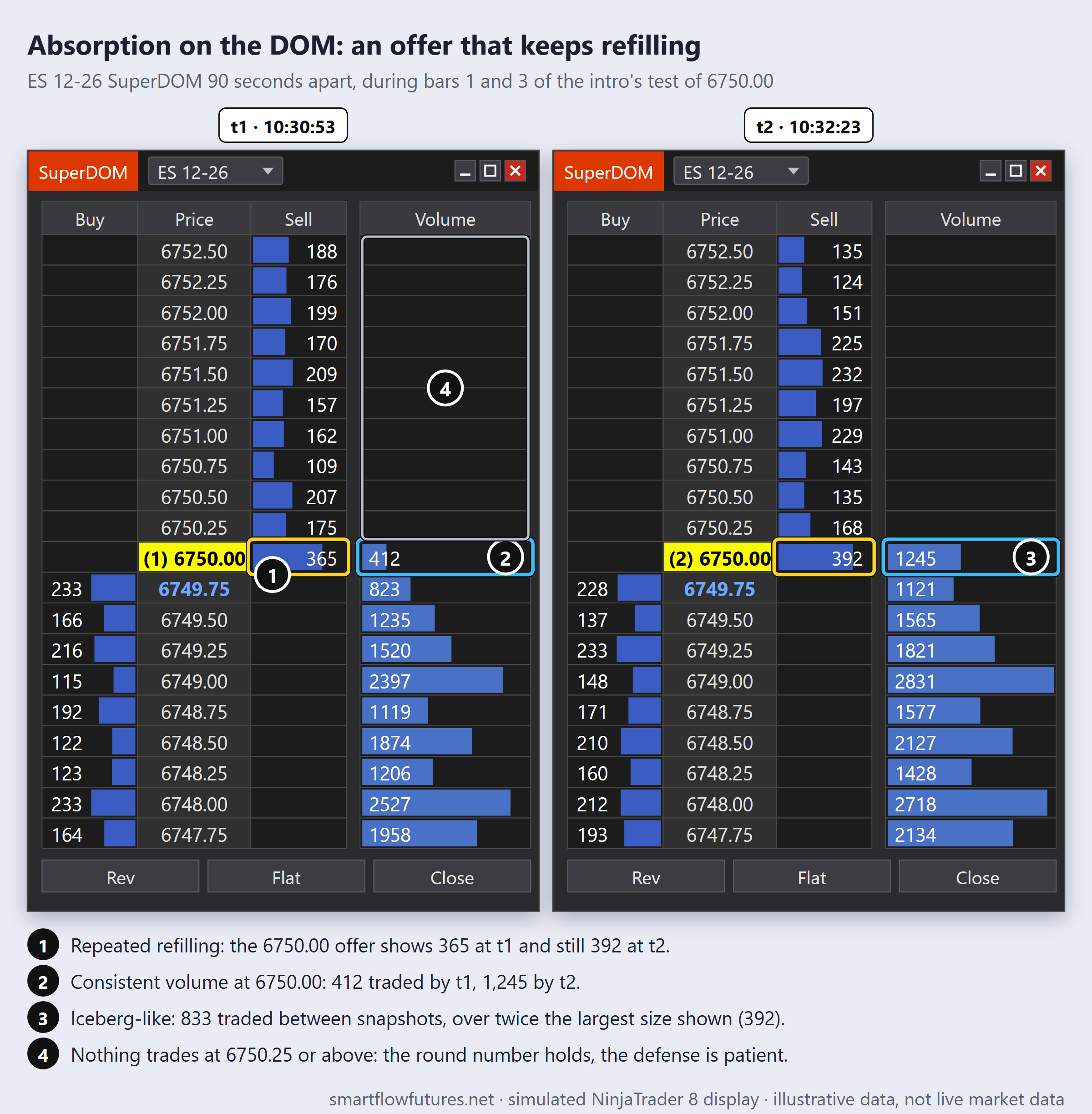
Absorption Characteristics:
Repeated refilling of orders at the same level (visible on DOM). Consistent volume at a price without price breaking through. Iceberg-like behavior with orders reappearing. Often occurs at significant levels (round numbers, prior highs/lows). The absorbing side appears prepared and patient.
Exhaustion Characteristics:
Volume spikes at the end of a move without continuation. Gradual reduction in movement per unit of volume. No clear defensive behavior, just fading momentum. Can occur at any price, not necessarily significant levels. The aggressive side appears spent and desperate.
Order Flow Signatures
Absorption on Footprint:
High volume at a level with price not moving through, often bar after bar. On a single bar this can look like exhaustion at the candle’s extreme; the level, the DOM and the next bars tell them apart. The footprint counts each trade once, by its aggressor; the passive defense shows on the DOM, where the volume traded at the level exceeds the size displayed there, yet price holds. Consistent pattern of aggression being met with passive defense.
Exhaustion on Footprint:
High volume at the extreme of a candle (the high at the end of an up-move, the low at the end of a down-move). Delta may be one-sided but price response is minimal. Volume concentrated at the end of a move, representing the last push.
Trading Implications
After Absorption:
Look for a reversal, though the defended level can still break. The absorbing side has committed capital. They likely want to move price in their direction. Absorption at a level often leads to significant moves away from that level. Trade in the direction the absorbing side is likely to push.
After Exhaustion:
Expect reversal or consolidation, but with less conviction than after absorption. There may not be aggressive opposition, just a lack of continuation. The move might simply pause before continuing. Consider taking partial profits and managing remaining position.
Context Matters
The distinction becomes clearer with context:
At a Significant Level: Stalling at a major order block, round number, or prior high/low is more likely absorption. Someone is defending that level.
In the Middle of Nowhere: Stalling at an arbitrary price with no significance is more likely exhaustion. No reason for deliberate defense here.
After a Large Move: Stalling after an extended run is often exhaustion. Participants are simply out of capital or conviction.
On First Test: Stalling on first test of a level is often absorption. The level is being actively defended.
Practical Identification Process
When you see price stalling with volume:
Step 1: Check the level. Is it significant? If yes, lean toward absorption. If no, lean toward exhaustion.
Step 2: Check the DOM/tape. Are orders refilling at the level? If yes, lean toward absorption. If no, lean toward exhaustion. The two can also occur together (see Combined Scenarios).
Step 3: Check the context. How far has price moved? After extended moves, exhaustion is more likely.
Step 4: Watch the follow-through. Absorption often leads to quick reversal. Exhaustion may lead to consolidation before continuation or reversal.
Combined Scenarios
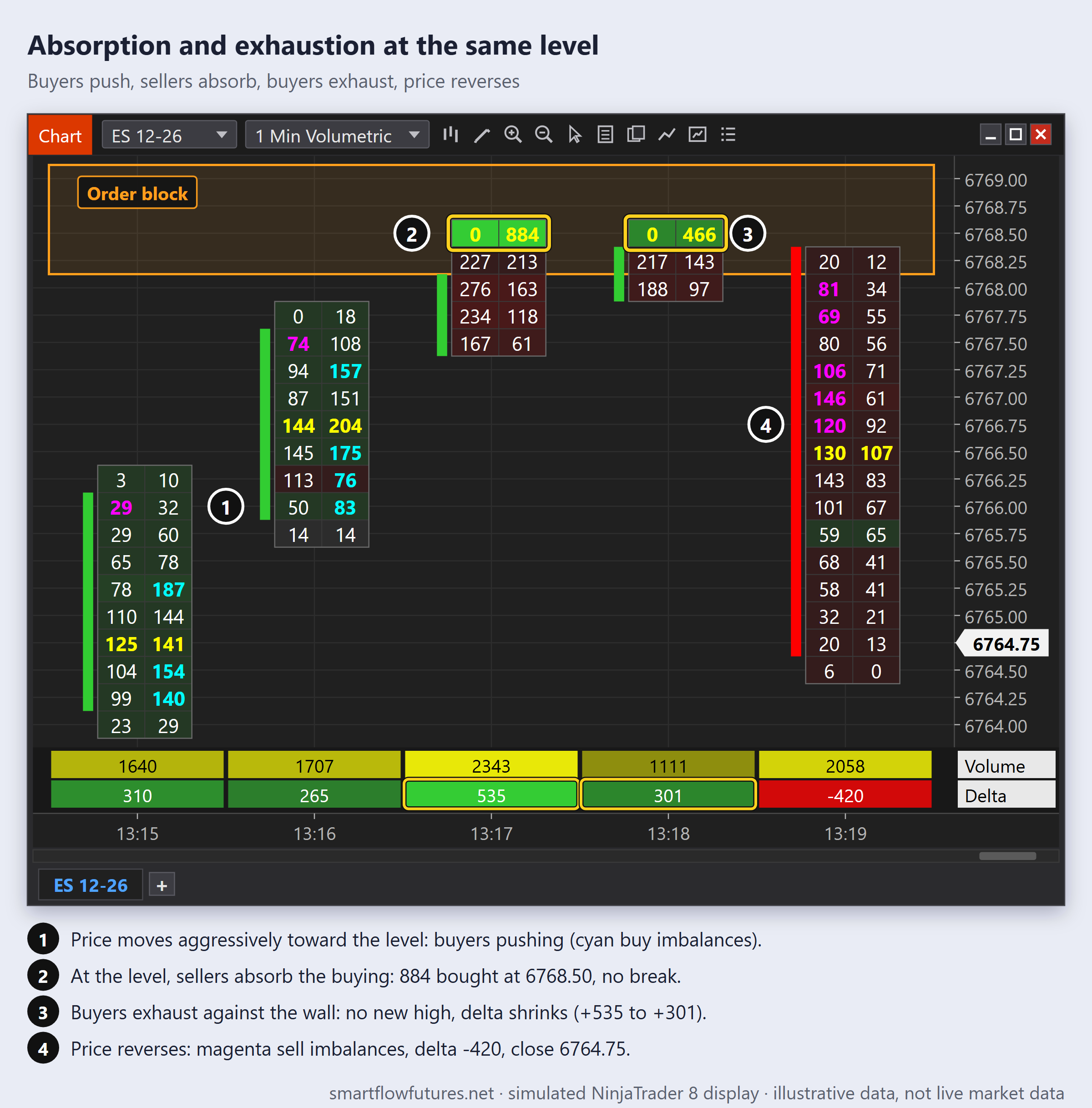
Sometimes both occur together:
Price moves aggressively toward a level (buyers pushing). At the level, sellers absorb the buying (absorption by sellers). Buyers exhaust themselves hitting the absorption wall (exhaustion of buyers). The result is often a reversal, with two signals agreeing instead of one.
This combination at SMC levels is worth watching for, though it can still fail.
Common Confusion
Assuming All Stalls are Absorption: Not every stall has a defender. Sometimes moves just run out of steam.
Assuming All Stalls Lead to Reversal: Exhaustion can be temporary. New buyers or sellers may appear after the pause.
Ignoring Level Significance: The presence of an important level changes interpretation significantly.
Key Takeaways
Absorption is deliberate defense; exhaustion is running out of steam. Absorption appears as orders refilling; exhaustion appears as volume without follow-through. Context (level significance, move extent) helps distinguish them. Absorption often precedes a reversal, though not always. Exhaustion may lead to consolidation or continuation after pause. Both can occur together at significant levels, giving two signals instead of one.