
Every move eventually ends. Learning to identify exhaustion in Order Flow allows you to exit positions before reversals and potentially enter counter-trend trades. Exhaustion patterns show when aggressive activity is no longer producing price movement, a critical warning sign.
Understanding Exhaustion
Exhaustion occurs when one side of the market is aggressively trading but failing to move price. The aggression is there, but results are not. This mismatch between effort and result signals that the move may be over.
Buying Exhaustion: Heavy buying volume (positive delta, trades at ask) but price is no longer rising or is rising very slowly. Buyers are aggressive, but sellers are absorbing or supply is overwhelming demand.
Selling Exhaustion: Heavy selling volume (negative delta, trades at bid) but price is no longer falling or is falling very slowly. Sellers are aggressive, but buyers are absorbing or demand is overwhelming supply.
Exhaustion vs Absorption
These concepts are related but distinct:
Absorption: The focus is on the passive side. Someone is deliberately absorbing the aggression. Often institutional defense of a level.
Exhaustion: The focus is on the aggressive side. They are running out of steam. May or may not involve deliberate absorption.
Both result in price stalling despite volume, but understanding the distinction helps with interpretation and trade planning.
Identifying Exhaustion Patterns
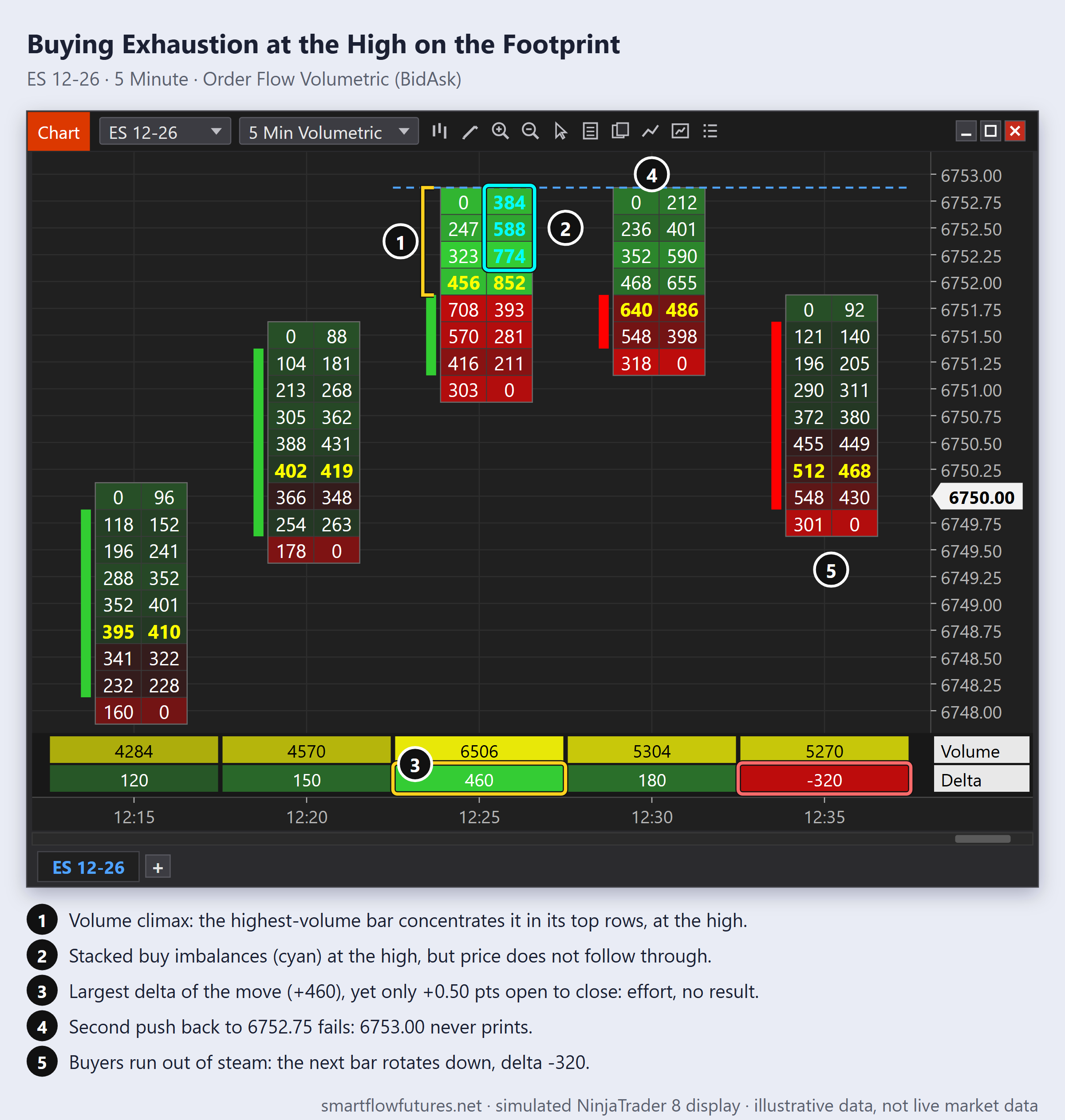
On Footprint Charts:
High volume concentrated at the extreme of a move (highs for buying exhaustion, lows for selling exhaustion). Footprint imbalances present but price not following through. Multiple attempts to push price without success.
On Delta:
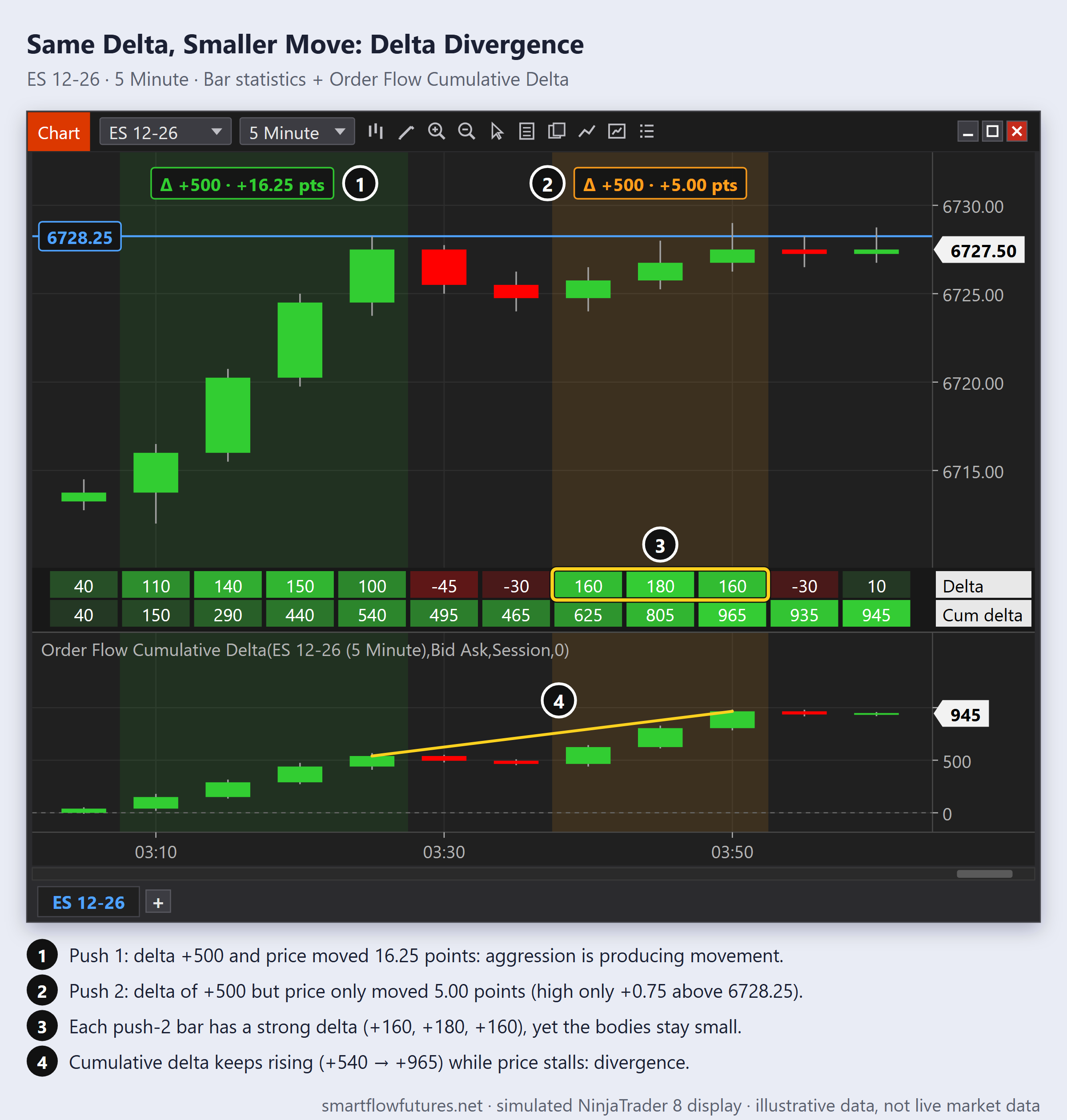
Strong delta reading but small price movement. Example: Delta of +500 but price only moved 5 points, when an earlier push with the same delta on the same chart moved 15+. There is no fixed delta-to-points ratio.
On Cumulative Delta:
Cumulative delta continuing in one direction while price stalls or diverges. This divergence between delta and price is a classic exhaustion signal.
Exhaustion Pattern Types
Pattern 1: Spike Exhaustion
A sudden spike in volume/delta at the end of a move, followed by immediate stall or reversal. The spike represents the last buyers or sellers committing. Once they are done, there may be no one left to continue the move.
Pattern 2: Grinding Exhaustion
Gradual decrease in momentum despite continued aggression. Each push produces less movement than the last. The move is slowly dying as aggressive participants run out of capital or conviction.
Pattern 3: Absorption Exhaustion
Aggression meets passive resistance. High volume at a level, but price cannot break through. The aggressive side literally exhausts itself against the passive orders.
Trading Exhaustion
For Exits:
If you are in a position and see exhaustion signals, consider: taking partial profits immediately, tightening your stop significantly, or exiting entirely if the exhaustion is clear.
Exhaustion does not guarantee reversal, but it signals the easy money in that direction is done.
For Counter-Trend Entries:
Exhaustion at a significant SMC level can signal reversal entry. Wait for: exhaustion signals to develop, price to show initial reversal (CHOCH or rejection), then enter with stop beyond the exhaustion zone.
Counter-trend entries require more confirmation than with-trend entries.
Exhaustion and SMC Confluence
Exhaustion signals carry more weight at SMC levels:
At Order Blocks: Exhaustion as price reaches an order block suggests the block may hold. Wait for confirmation before entering a reversal trade.
At Liquidity Pools: Exhaustion on the candle that trades beyond a liquidity pool (heavy aggression at the extreme that fails to extend the move) fits the order-flow signature of a sweep; the sweep is confirmed only when that candle closes back inside the level. Price has grabbed the stops and may be ready to reverse.
At Premium/Discount Zones: Buying exhaustion in premium (a possible short) or selling exhaustion in discount (a possible long) at an SMC level can provide reversal setups, once confirmed.
False Exhaustion
Not all exhaustion leads to reversal:
Pause, Not Reversal: Sometimes exhaustion is just a pause before continuation. This is why confirmation is important.
New Buyers/Sellers Enter: A fresh wave of participants can restart the move after apparent exhaustion.
News Events: Exhaustion can be overwhelmed by news-driven activity.
Use exhaustion as a warning signal and setup identifier, but require confirmation before acting.
Exhaustion Indicators
Some traders use indicators to identify exhaustion:
Volume Climax: Extremely high volume at the end of a move often signals exhaustion.
Delta Divergence: Delta continuing in trend direction while price stalls.
Momentum Divergence: Traditional indicators like RSI showing divergence can confirm exhaustion.
Multiple confirming signals increase reliability.
Key Takeaways
Exhaustion occurs when aggressive activity fails to move price. It signals the current move may be ending. Look for high volume or delta with minimal price movement. Exhaustion at SMC levels can point to reversal setups. Use exhaustion for trade exits and counter-trend entry timing. Require confirmation. Not all exhaustion leads to reversal.