
Most traders focus on charts and indicators while remaining ignorant of how markets actually work beneath the surface. Understanding market microstructure (the mechanics of how orders are processed, matched, and executed) provides insight that improves trading decisions.
What is Market Microstructure?
Market microstructure is the study of the processes and outcomes of exchanging assets under explicit trading rules. It examines how buyers and sellers find each other, how prices are determined, and how orders are executed.
This field covers: price formation and discovery, order types and their effects, the role of market makers and liquidity providers, transaction costs and market efficiency, and information asymmetry between participants.
The Exchange: The Central Marketplace
For futures trading, the exchange (like CME Group) is the central marketplace. The exchange provides:
Order Matching Engine: The computer system that matches buy and sell orders. Modern matching engines process millions of orders per second. For ES and NQ, orders are matched based on price-time priority (best price first, then earliest time); some other CME products use pro-rata or mixed allocation instead.
Price Discovery: The process by which supply and demand determine the current price. Every trade prints a price, and the sequence of prices creates the price action we analyze.
Clearing and Settlement: The exchange’s clearing house (CME Clearing) guarantees every trade, standing between buyer and seller. This greatly reduces counterparty risk, though it does not eliminate it.
Price-Time Priority
Understanding order priority is fundamental:
Price Priority: Better prices get filled first. A buy order at 100.50 will be filled before a buy order at 100.25. A sell order at 100.25 will be filled before a sell order at 100.50.
Time Priority: At the same price, earlier orders get filled first. If two buy orders are both at 100.50, the one placed first gets priority.
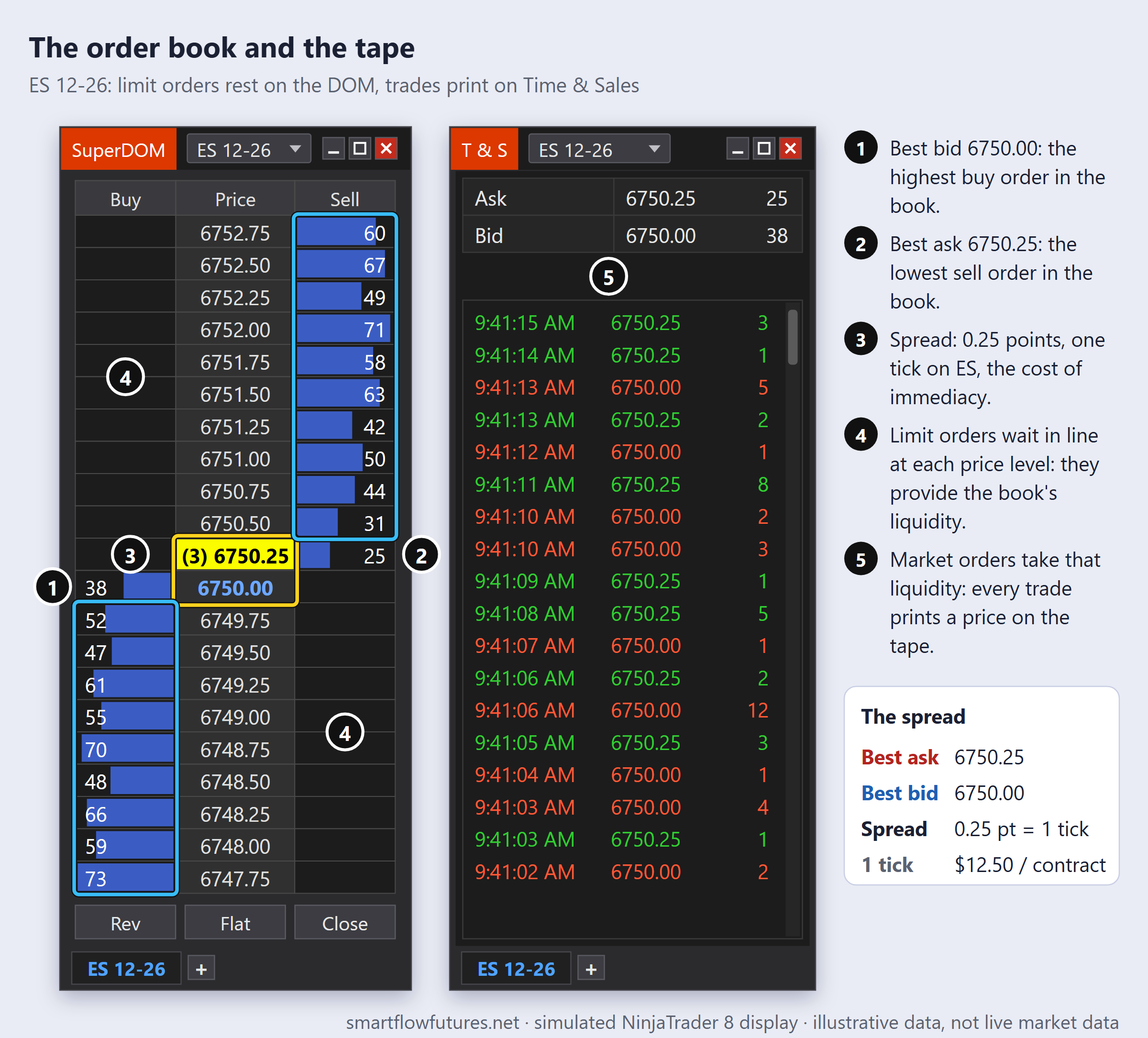
This creates the queue structure visible on the DOM. Orders wait in line at each price level.
The Bid-Ask Spread
The spread is the difference between the best bid (highest buy order) and best ask (lowest sell order).
Example: Best bid: 6750.00. Best ask: 6750.25. Spread: 0.25 points (one tick on ES).
The spread exists because of the cost of providing liquidity. Market makers must be compensated for the risk of holding inventory. Tighter spreads indicate more liquid markets.
Liquidity: The Lifeblood of Markets
What is Liquidity? The ability to buy or sell without significantly moving the price. High liquidity means large orders can execute without major impact. Low liquidity means even small orders move price significantly.
Measures of Liquidity: Bid-ask spread (tighter is more liquid). Order book depth (more orders at each level is more liquid). Volume (higher volume generally means more liquidity). Market impact (less impact per contract is more liquid).
Why Liquidity Matters: Liquid markets have lower transaction costs. Entries and exits are easier and cheaper. Price discovery is more efficient. Less susceptible to manipulation.
Order Types and Market Impact
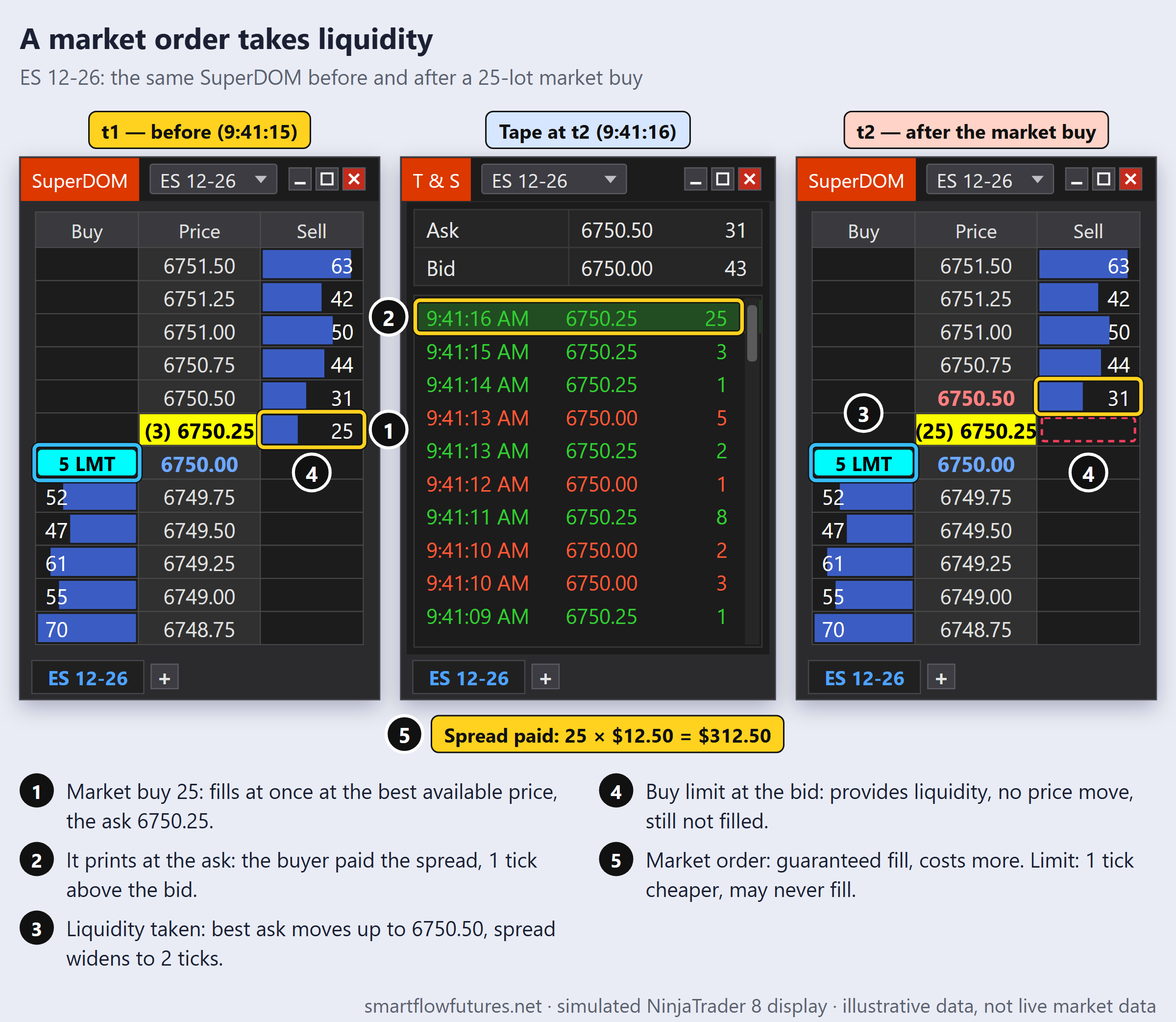
Market Orders: Execute immediately at best available price. Take liquidity from the order book. Have immediate market impact. Cost the spread to execute: a buy pays the ask, one full spread above the bid (half a spread above the mid-price), and more if a large order walks the book.
Limit Orders: Wait in the order book until matched, unless marketable (a buy limit at or above the best ask, or a sell limit at or below the best bid, executes at once, at least in part, and takes liquidity). Provide liquidity to the market. No immediate market impact. May not execute if price does not reach your level.
The Trade-off: Market orders guarantee execution but cost more. Limit orders are cheaper but risk non-execution. Your choice affects both your results and market structure.
Information and Price Discovery
Markets aggregate information from all participants:
Informed Traders: Have information not yet reflected in price. Their trades move prices toward fair value. Includes institutions with research, insiders (legally or illegally), and those with superior analysis.
Uninformed Traders: Trade for reasons unrelated to value (hedging, rebalancing, emotional decisions). Provide liquidity for informed traders. Their presence allows markets to function.
Price discovery is the process of informed trading gradually incorporating information into prices. Order Flow reveals this process in real-time.
Transaction Costs
The true cost of trading includes:
Explicit Costs: Commissions and exchange fees. Data fees. Platform costs.
Implicit Costs: Bid-ask spread (cost of immediacy). Market impact (your order moving price against you). Slippage (difference between expected and actual price).
For active traders, implicit costs often exceed explicit costs. Understanding microstructure helps minimize these costs.
Why This Matters for Trading
Microstructure knowledge improves trading:
Better Execution: Understanding order types and timing reduces transaction costs.
Reading Order Flow: Knowing what creates order flow helps interpret it correctly.
Avoiding Manipulation: Recognizing abnormal order book behavior protects you.
Realistic Expectations: Understanding liquidity helps set appropriate position sizes and targets.
Key Takeaways
Market microstructure explains how orders are matched and prices are determined. CME matches ES and NQ orders by price-time priority (FIFO). The bid-ask spread is the cost of immediacy. Liquidity is the ability to trade without moving price. Market orders take liquidity; resting limit orders provide it. Understanding microstructure improves execution and Order Flow interpretation.