
Major news events create both opportunity and danger. This case study walks through a complete Non-Farm Payrolls (NFP) news event scenario, showing how to prepare, what to do during, and how to trade the aftermath.
The Event: Non-Farm Payrolls
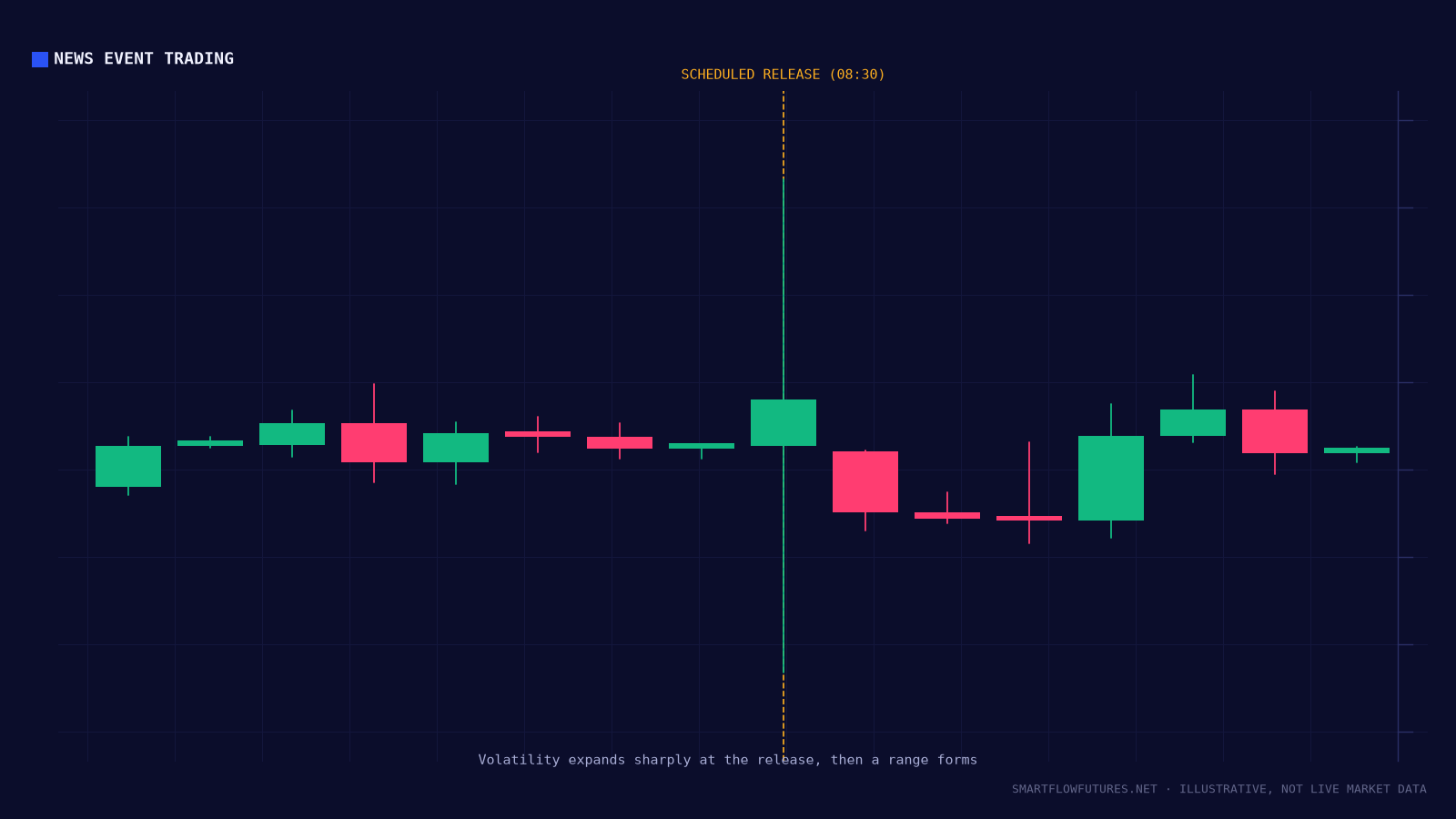
NFP is released on the first Friday of each month at 8:30 AM ET. It measures job creation in the US economy. It is one of the highest impact events for ES, NQ, and related markets. Typical reaction: 30-80 points on ES within minutes.
Phase 1: Before the Event (7:00-8:30 AM)
Analysis Steps:
Check consensus expectations. What number is “expected”? Note the range of estimates (high to low). Identify what would be “surprising” (significantly above or below expectations).
Chart Preparation:
Mark the overnight range (important reference). Identify key levels above and below current price. Note where liquidity sits (stops above highs, below lows). Clean up charts. Remove clutter.
Position Check:
Any open positions? Consider closing or reducing. If holding, widen stops to account for spike (or accept they may be hit). Do not enter new positions in the 30 minutes before.
Scenario Planning:
Scenario A: Better than expected (bullish) – expect spike up, potential long opportunity after confirmation. Scenario B: Worse than expected (bearish) – expect spike down, potential short opportunity after confirmation. Scenario C: As expected – expect brief volatility then return to pre-news levels.
Phase 2: During the Event (8:30-8:45 AM)
The Release Moment:
NFP comes in significantly higher than expected (bullish). Price immediately spikes up 50 points on ES. Volume explodes. DOM shows massive buying.
What NOT to Do:
Do not chase the initial spike or try to catch the falling knife if it reverses. Market orders have no place in this kind of chaos, and missing the move is not a reason to panic into one.
What TO Do:
Observe. Note the direction and magnitude of the spike. Watch how price behaves after the initial reaction. Look for the first signs of stabilization.
The First 5-10 Minutes:
Price spikes to +50 points. Then retraces to +30 points (normal profit-taking). Starts building a base at +25-35 level. This is the accumulation phase post-news.
Phase 3: After the Event (8:45-10:00 AM)
Waiting for Setup:
By 8:50 AM, initial chaos has subsided. Price has formed a range between +25 and +40 from pre-news. Watch for breakout of this post-news range OR watch for retest of news spike levels.
The Trade Setup:
At 9:00 AM, price pulls back to +20 area. This coincides with pre-news resistance turned support. 5M shows bullish rejection candle. Footprint shows buying absorption. This is the entry opportunity.
Trade Execution:
Entry: Long at ES +22 from pre-news price. Stop: Below post-news low (+12 level) – 10 points risk. Target 1: Post-news high (+50) – 28 points, 2.8R. Target 2: Overnight high or measured move extension.
Management:
At 9:30 (cash open), additional buying comes in. Price pushes past +50 to new highs. Take partial at +50. Trail stop on remainder. Final exit at +75 when momentum slows.
The Numbers
Entry: +22 from pre-news. Stop: +12 (10 points risk). Exit 1: +50 (50% of position, 28 points, 2.8R). Exit 2: +75 (50% of position, 53 points, 5.3R). Average R: 4.0R.
Alternative Scenario: The Fade
Sometimes the news spike reverses. If the spike had gone +50 then immediately reversed:
Signs of Fade Setup:
Spike creates long wick (rejection). Price falls back through the pre-news level. Order Flow shows aggressive selling after initial buying spike.
Fade Entry:
Enter short after price falls back below key level. Stop above the news spike high. Target pre-news support levels.
Fading news is higher risk. The initial move is often correct. Only fade with strong confirmation.
News Trading Rules
Rule 1: Never trade the initial spike. Too fast, too random.
Rule 2: Wait 5-15 minutes for dust to settle.
Rule 3: Trade the second move (post-news setup), not the first.
Rule 4: Use wider stops. Volatility remains elevated.
Rule 5: Respect the news direction. Fading requires exceptional confirmation.
Key Takeaways
Prepare before news: scenarios, levels, position check. During news: observe only, do not trade the spike. After news: wait for setup, trade the second move. Post-news setups often offer excellent R:R with clear levels. Wider stops and patience are essential around news events.