
Economic news events create some of the most significant moves in futures markets. Whether to trade through news, fade it, or trade the aftermath is a decision every trader has to make. This article provides a framework for news trading.
Understanding Event Impact
High Impact Events:
Federal Reserve Decisions (FOMC) and press conferences. Non-Farm Payrolls (NFP) – first Friday monthly. CPI (Consumer Price Index) inflation data. GDP releases. Can move ES 50+ points, NQ 150+ points.
Medium Impact Events:
ISM Manufacturing/Services. Retail Sales. Producer Price Index (PPI). Jobless Claims. Can move ES 15-30 points typically.
Low Impact Events:
Housing data. Consumer Confidence. Trade Balance. Usually absorbed within normal price action.
Pre-News Preparation
Know the Calendar: Check the economic calendar daily. Know what is releasing and when. High-impact events should be highlighted on your trading plan.
Understand Expectations: Markets move on surprise versus expectations, not absolute numbers. A “good” number that misses expectations is bearish. A “bad” number that beats expectations can be bullish.
Mark Pre-News Levels: Before news, mark your SMC levels. Identify where liquidity sits. Know your levels for both bullish and bearish scenarios.
Trading Approaches Around News
Approach 1: Stand Aside
The safest approach. Exit all positions before high-impact news. Wait for the dust to settle. Re-engage after volatility subsides. Best for traders uncomfortable with event risk.
Approach 2: Reduce Size
Keep positions but reduce size significantly (50%+ reduction). Widen stops to account for volatility. Accept reduced P&L potential in exchange for reduced risk.
Approach 3: Trade the Aftermath
Avoid the initial spike. Wait 5-15 minutes for direction to clarify. Trade the continuation or reversal with SMC confirmation. Often the best risk-adjusted approach.
Approach 4: Straddle/Fade
Advanced approach. Position for the volatility itself rather than direction. Requires experience and quick execution. High risk, high potential reward.
The News Spike Pattern
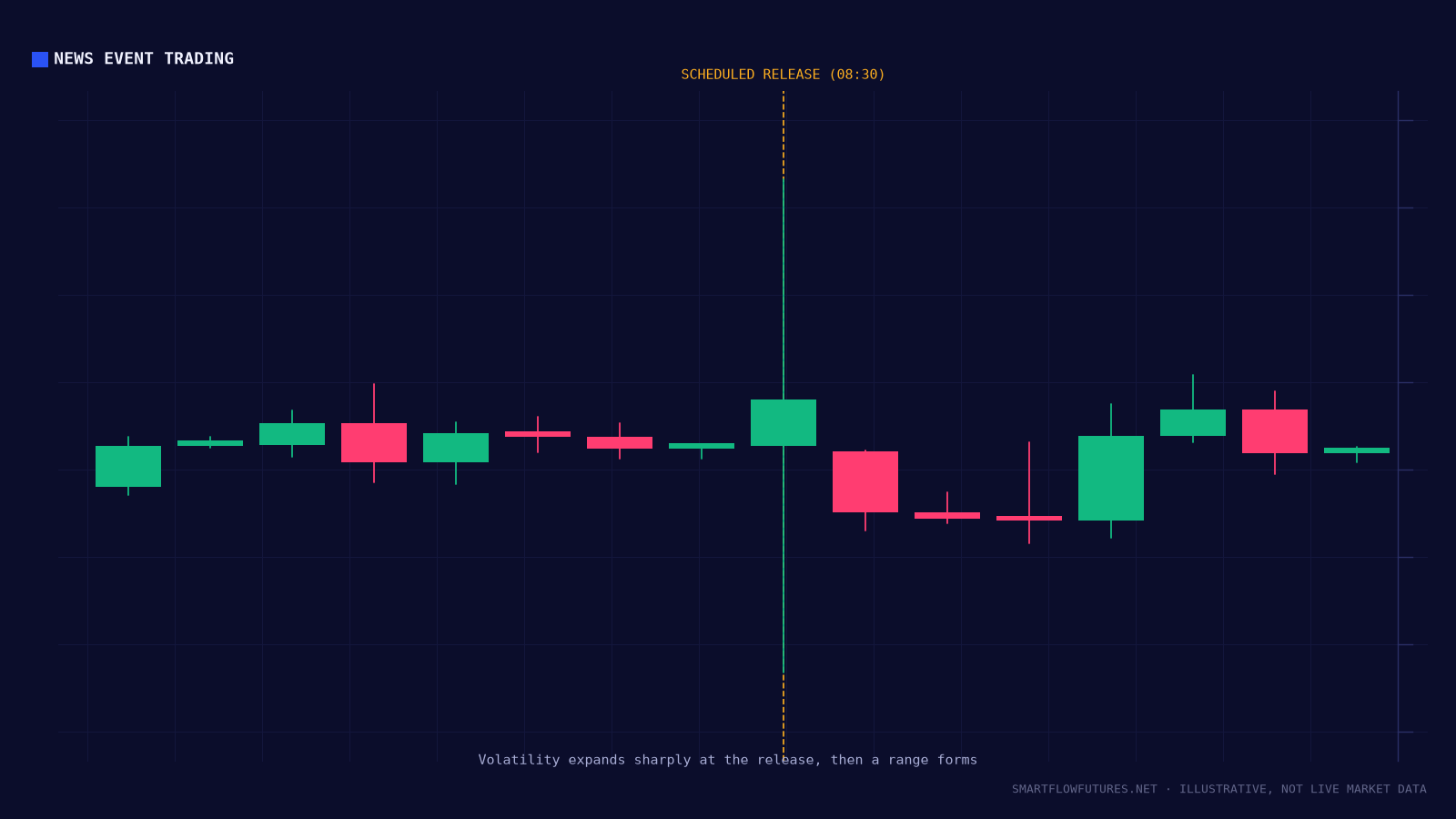
Many news events follow a pattern:
Phase 1: Initial Spike
Immediate reaction to the headline. Often extreme and driven by algorithms. Can spike both directions rapidly.
Phase 2: Retracement
Initial spike often retraces significantly. Traders take profits; others enter for reversal. This is where liquidity gets swept.
Phase 3: Direction Clarification
After 5-15 minutes, true direction often emerges. Markets digest the full data and implications. This is often the best entry point.
Phase 4: Trend or Reversal
Rest of session continues in clarified direction. Or, if news was fully priced in, may reverse entirely.
SMC and News Events
SMC concepts apply to news trading:
Liquidity Sweeps: News spikes often sweep liquidity (stops above/below) before reversing. The spike itself is frequently a stop hunt.
Order Blocks: Mark pre-news order blocks. If the spike reaches these levels and shows SMC reversal, high-probability entry.
FVGs Created: News creates large FVGs. These often fill in subsequent sessions, providing trade opportunities.
Specific Event Strategies
FOMC Strategy:
Statement at 2 PM ET, press conference at 2:30 PM. Initial reaction to statement often fades. Real move often comes from press conference nuance. Wait for 3 PM ET for clearer direction.
NFP Strategy:
Release at 8:30 AM ET Friday. Extreme volatility in first 15 minutes. Wait for 9 AM ET minimum before trading. Often reverses initial direction.
CPI Strategy:
Release at 8:30 AM ET. Spike is often genuine (less reversal than NFP). But wait for confirmation before trading the move.
Risk Management for News
Wider Stops: If trading around news, stops must be wider than normal. A stop that is 10 points on ES normally might need to be 30+ points around news. Slippage adds to that widened distance too, a cost covered in this guide to slippage in trading.
No Stop is Safe: Understand that gaps can occur. Your stop might not fill at your level. Accept this risk or do not trade the news.
Reduced Size: If you must trade news, reduce position size proportionally to increased volatility.
Maximum Loss: Define the worst-case scenario and ensure you can accept it.
Common News Trading Mistakes
Trading the Initial Spike: The first move is often fake. Waiting for clarification improves odds significantly.
Tight Stops: Normal stops get hit by news volatility. Either widen stops or do not trade.
Ignoring Context: News does not occur in a vacuum. Higher timeframe context still matters.
Over-Trading: Multiple entries trying to catch the move. One well-timed entry beats five impulsive ones.
Key Takeaways
Know the economic calendar. High-impact events require planning. Standing aside is a valid strategy; you do not have to trade news. If trading, wait for Phase 3 (direction clarification) for better odds. News spikes often sweep liquidity. Use SMC reversal signals. Wider stops and reduced size are essential for news trading. Each major event type (FOMC, NFP, CPI) has specific behavior patterns to learn.