
Position sizing is arguably the most important aspect of trading that most traders neglect. You can have the best strategy in the world, but poor position sizing will eventually destroy your account. Conversely, proper position sizing can turn a mediocre strategy into a profitable one by ensuring survival through inevitable losing streaks. Before any of that math applies, you first need a stop distance to work from. See how to set that stop using structure and volatility.
Why Position Sizing Matters
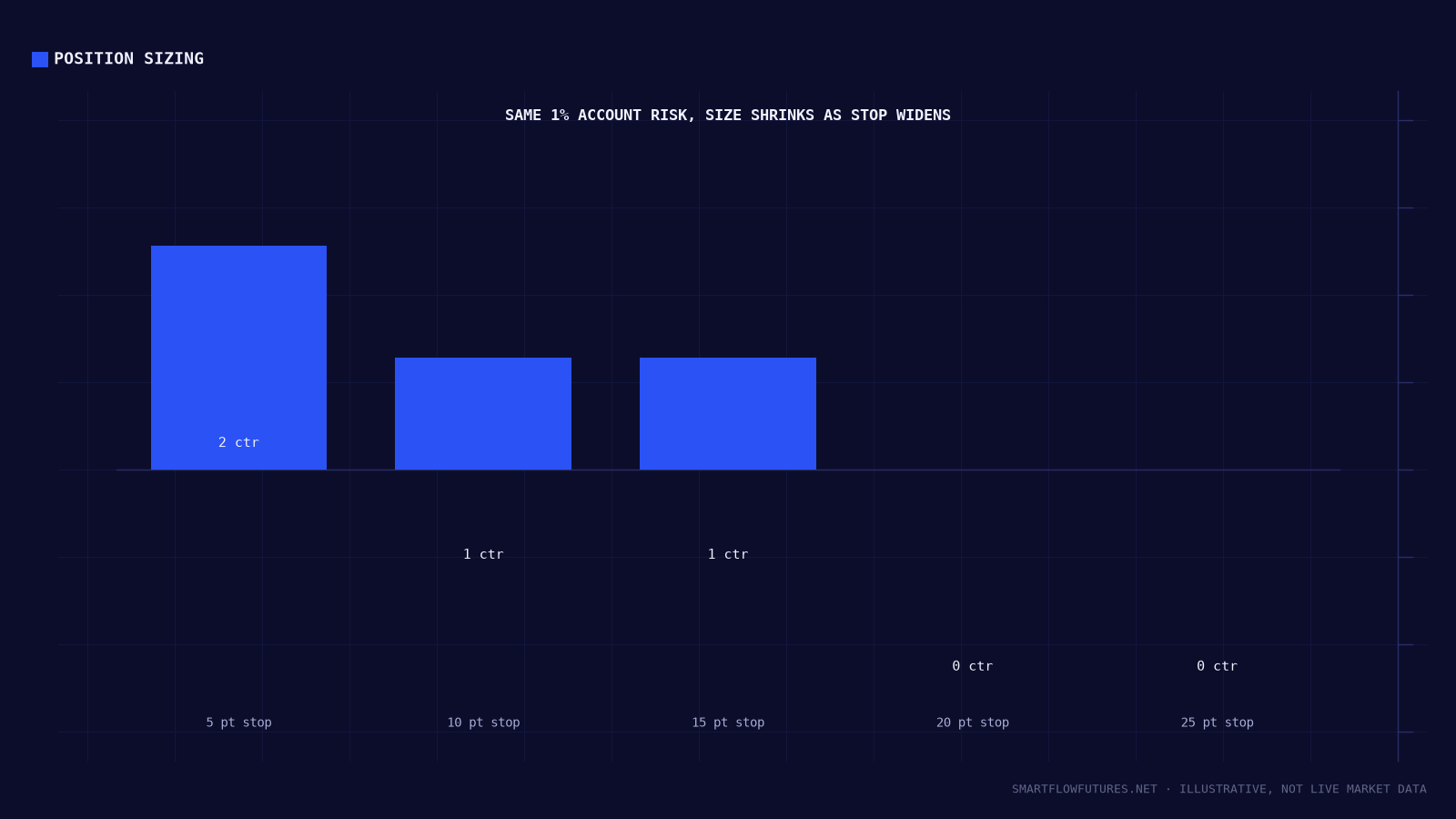
Consider two traders with identical strategies and win rates:
Trader A: Risks 10% per trade. After 5 consecutive losses (which will happen eventually), the account is down 41%. Needs a 69% gain just to break even.
Trader B: Risks 1% per trade. After 5 consecutive losses, the account is down only 4.9%. Easily recoverable with a few winning trades.
Both traders have the same strategy. But Trader B will survive to trade another day, while Trader A may blow the account before the strategy has a chance to prove itself.
The Mathematics of Ruin
Understanding the math helps illustrate why position sizing is critical:
A 10% loss requires an 11% gain to recover. A 25% loss requires a 33% gain to recover. A 50% loss requires a 100% gain to recover. A 75% loss requires a 300% gain to recover.
The relationship is not linear. Larger losses become exponentially harder to recover from. This is why preservation of capital must be the first priority.
Fixed Fractional Position Sizing
The most common and recommended method for most traders:
The Formula:
Position Size = (Account Balance x Risk Percentage) / Dollar Risk Per Contract
Example:
Account Balance: $50,000
Risk Percentage: 1%
Dollar Risk = $50,000 x 0.01 = $500
Stop Loss: 20 points on NQ ($20 per point = $400 per contract)
Position Size = $500 / $400 = 1.25 contracts = 1 contract (round down)
This method automatically adjusts position size based on account equity. As your account grows, position sizes grow proportionally. As your account shrinks, positions shrink, protecting remaining capital.
Recommended Risk Percentages
Conservative (Recommended for most): 0.5% – 1% per trade. Allows for significant losing streaks without major damage. Best for newer traders and those building consistency.
Moderate: 1% – 2% per trade. For experienced traders with proven track records. Still provides good capital protection.
Aggressive: 2% – 3% per trade. Only for very experienced traders with high win rates. Requires strong psychological resilience.
Most professional traders risk 1% or less per trade. There is no prize for being aggressive.
Volatility-Based Position Sizing
Adjust position size based on current market volatility:
The Concept: In high volatility, markets move more. Your stops need to be wider to avoid noise. To maintain consistent dollar risk, you must trade smaller size.
Using ATR (Average True Range):
Calculate the ATR for your timeframe. Set stops as a multiple of ATR (e.g., 2x ATR). Calculate position size based on this ATR-derived stop.
Example:
NQ 15M ATR = 25 points
Stop = 2 x ATR = 50 points = $1,000 per contract
Account Risk = 1% of $50,000 = $500
Position Size = $500 / $1,000 = 0.5 contracts = sit out or reduce risk
This method ensures your risk exposure remains consistent regardless of market conditions.
The Kelly Criterion
A mathematical formula for optimal position sizing based on your edge:
The Formula:
Kelly % = W – [(1-W) / R]
Where W = Win Rate and R = Average Win / Average Loss
Example:
Win Rate = 55%
Average Win = $800
Average Loss = $400
R = 800/400 = 2
Kelly % = 0.55 – [(1-0.55) / 2] = 0.55 – 0.225 = 32.5%
Important: Full Kelly is too aggressive for real trading. Most traders use Half Kelly or Quarter Kelly (8-16% in this example). Even then, this requires a precisely known edge, which most traders do not have.
Position Sizing for Multiple Positions
When trading multiple positions simultaneously:
Portfolio Heat: Total risk across all open positions. Recommended maximum: 5-6% of account in total risk at any time.
Example:
Maximum portfolio heat: 5%
Risk per trade: 1%
Maximum simultaneous positions: 5
If you have 3 trades open risking 1% each, you have 2% of capacity remaining for new trades.
Scaling Into Positions
Instead of entering full size immediately:
Method 1: Fixed Scaling
Enter 50% at initial entry. Add 50% on confirmation or at better price. Reduces average entry price and initial risk.
Method 2: Pyramid Scaling
Enter 50% initially. Add 30% on first profit target. Add 20% on breakout. Each add is smaller than the last.
Scaling allows for larger eventual positions while managing initial risk. However, it requires the market to prove you right before committing fully.
Position Sizing Mistakes to Avoid
Increasing Size After Losses: The temptation to “make it back” leads to larger losses. Stick to your fixed percentage.
Inconsistent Sizing: Randomly choosing position sizes based on confidence or gut feeling. Every trade should follow your rules.
Ignoring Correlation: Taking multiple correlated positions that effectively multiply your risk. ES, NQ, and YM often move together.
Over-Leveraging: Using maximum allowed leverage just because you can. Leverage amplifies both gains and losses.
Practical Position Sizing Worksheet
Before every trade, calculate:
1. Account Balance: $_____
2. Risk Percentage: _____%
3. Dollar Risk = Balance x Risk % = $_____
4. Stop Loss Distance: _____ points
5. Dollar Value Per Point: $_____
6. Dollar Risk Per Contract = Stop x Point Value = $_____
7. Position Size = Dollar Risk / Risk Per Contract = _____ contracts
Always round down. Never round up to fit a trade.
Key Takeaways
Position sizing determines long-term survival more than entry strategy. Fixed fractional sizing (1% risk) is recommended for most traders. Adjust for volatility—trade smaller in wild markets. Never increase size after losses. Track portfolio heat when holding multiple positions. Calculate position size before every trade, not after entry.