
Scaling In and Out: Advanced Position Management
Learn how to build positions strategically and take profits in stages to optimize your risk-reward and capture more of winning moves.
Most traders enter and exit positions all at once. While simple, this approach leaves significant edge on the table. Professional traders use scaling techniques to build positions as trades confirm, reduce risk at key levels, and let winners run while locking in profits. This article covers scaling strategies you can apply to your own trade management.
Benefits of Scaling
- Reduces timing pressure on entries
- Allows adding to winners
- Locks in partial profits early
- Keeps runners for home runs
- Smooths equity curve
- Psychologically easier to manage
Drawbacks to Consider
- More complex execution
- Higher commission costs
- Requires larger account for multiple contracts
- Can reduce profit on clean moves
- Needs clear rules to avoid overtrading
Scaling In Techniques
Technique 1: Confirmation Add
Enter with partial size at your initial level, then add when price confirms your direction. For example, enter with 50% at the order block, add the remaining 50% when price breaks structure in your favor. This reduces risk on failed setups while allowing full size on confirmed moves.
Technique 2: Zone Scaling
When trading into a zone rather than a precise level, divide your entry across the zone. If your order block spans 10 points, enter 33% at the top, 33% at the middle, and 34% at the bottom. This averages your entry price and ensures you get filled if the zone holds.
Technique 3: Pyramid Adding
Start with your full planned size, then add smaller amounts as the trade moves in your favor. Enter 3 contracts initially, add 2 after first target, add 1 after second target. Each add should be smaller than the previous and only at predefined levels.
Never scale into a losing position to average down. Scaling in should only occur at planned levels with the trade moving in your direction or at least holding at your entry zone. Adding to losers is the fastest way to blow up an account.
Scaling Out Techniques
Technique 1
Technique 2
Technique 3
Technique 4
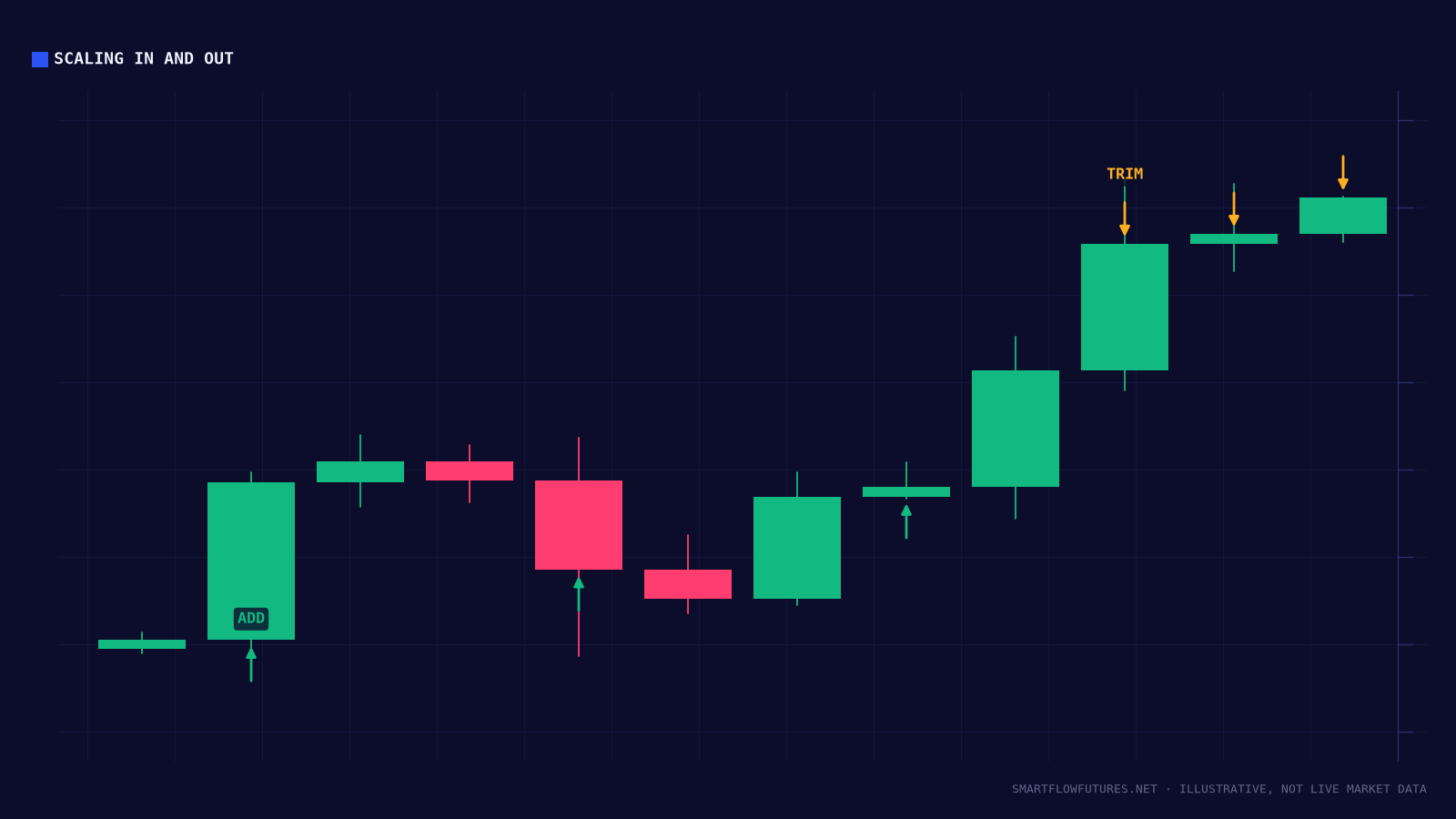
Complete Scaling Example
| Action | Price | Contracts | Reason |
|---|---|---|---|
| Initial Entry | 4500 | +2 | Order block entry |
| Confirmation Add | 4508 | +2 | CHOCH confirmed direction |
| First Partial Exit | 4520 | -2 | First target reached, move stop to 4504 |
| Second Partial Exit | 4540 | -1 | Second structure target |
| Runner Exit | 4565 | -1 | Major liquidity pool reached |
Initial risk: 10 points × 2 contracts = 20 points. First exit: +20 points on 2 contracts = 40 points. Second exit: +36 points on 1 contract = 36 points. Runner: +61 points on 1 contract = 61 points. Total: 137 points on 20 points risk = 6.85R. Compare this to exiting all at 4520 (40 points, 2R) or holding all to 4565 (130 points but with more stress and risk of giving back).
Scaling Rules to Follow
- Predefine your scaling plan: Know your entry levels, add levels, and exit targets before the trade. No improvising during the trade.
- Always move stop after first partial: Once you take the first exit, move your stop to breakeven or better on remaining position. This makes the trade risk-free.
- Smaller adds as price moves: Each scale-in should be the same size or smaller than the previous. Never pyramid into a larger position as price extends.
- Keep a runner: Always leave at least one contract or small portion to capture extended moves. The biggest winners often come from runners.
- Track results separately: In your journal, track how your scaling strategy performs versus hypothetical all-in/all-out execution. Measure the actual impact.
Scaling Mistakes to Avoid
Never add to a position that is going against you unless this was a pre-planned zone entry. “It will come back” is not a valid reason to add size.
Taking all profits at the first sign of resistance defeats the purpose. Trust your targets and let partials run. One runner to a major target can pay for multiple stopped-out trades.
After taking partials, you must protect the remaining position. Failure to move stops turns winning trades into losers when price reverses.
Five scaling levels on a 2-contract position makes no sense. Keep scaling appropriate to your position size. Two or three exits are sufficient for most traders.
Scaling in allows you to add to winning trades while limiting initial risk. Scaling out locks in profits while keeping exposure for larger moves. Always predefine your scaling plan, move stops after first partials, and keep a runner for home runs. Track your results to confirm scaling improves your performance. Start with simple two-level scaling before advancing to more complex strategies.