
Dark Pools: Hidden Liquidity Venues
Understand the alternative trading venues where institutional orders are executed away from public exchanges and how this affects your trading.
While you watch the order book and tape for clues about institutional activity, a significant portion of institutional trading happens where you cannot see it: in dark pools. These private trading venues allow large orders to execute without displaying to the public market. Understanding dark pools helps you interpret what you see on the public tape and recognize when the visible order flow tells only part of the story.
What Are Dark Pools?
Definition
Dark pools are private exchanges or alternative trading systems (ATS) that allow institutional investors to trade large blocks of shares without publicly displaying their orders. The term “dark” refers to the lack of pre-trade transparency: you cannot see orders in a dark pool until after they execute.
Lit Markets (Public)
- NYSE, NASDAQ, CME
- Orders visible in order book
- Real-time price transparency
- Anyone can see and access
- Pre-trade information on displayed orders
Dark Pools (Private)
- Private trading venues
- Orders hidden until execution
- Prices reported after trade
- Limited to approved participants
- No pre-trade transparency
Why Do Dark Pools Exist?
Reason 1
Reason 2
Reason 3
Reason 4
Types of Dark Pools
| Type | Operator | Participants | Examples |
|---|---|---|---|
| Broker-Dealer Owned | Large banks/brokers | Clients of the broker | Goldman Sachs Sigma X, Morgan Stanley MS Pool |
| Independent | Independent companies | Multiple brokers/institutions | Liquidnet, ITG Posit |
| Exchange Owned | Public exchanges | Exchange members | NYSE Arca Dark, NASDAQ OMX |
| Consortium | Group of institutions | Consortium members | BIDS Trading |
Dark Pool Market Share
Significant and Growing
Off-exchange trading (dark pools plus wholesalers and internalizing brokers) accounts for 30-40% or more of US equity trading volume; dark pools alone are a smaller share. This percentage has grown significantly over the past two decades. In some stocks, particularly large-caps with heavy institutional ownership, off-exchange volume can exceed 50% of daily trading.
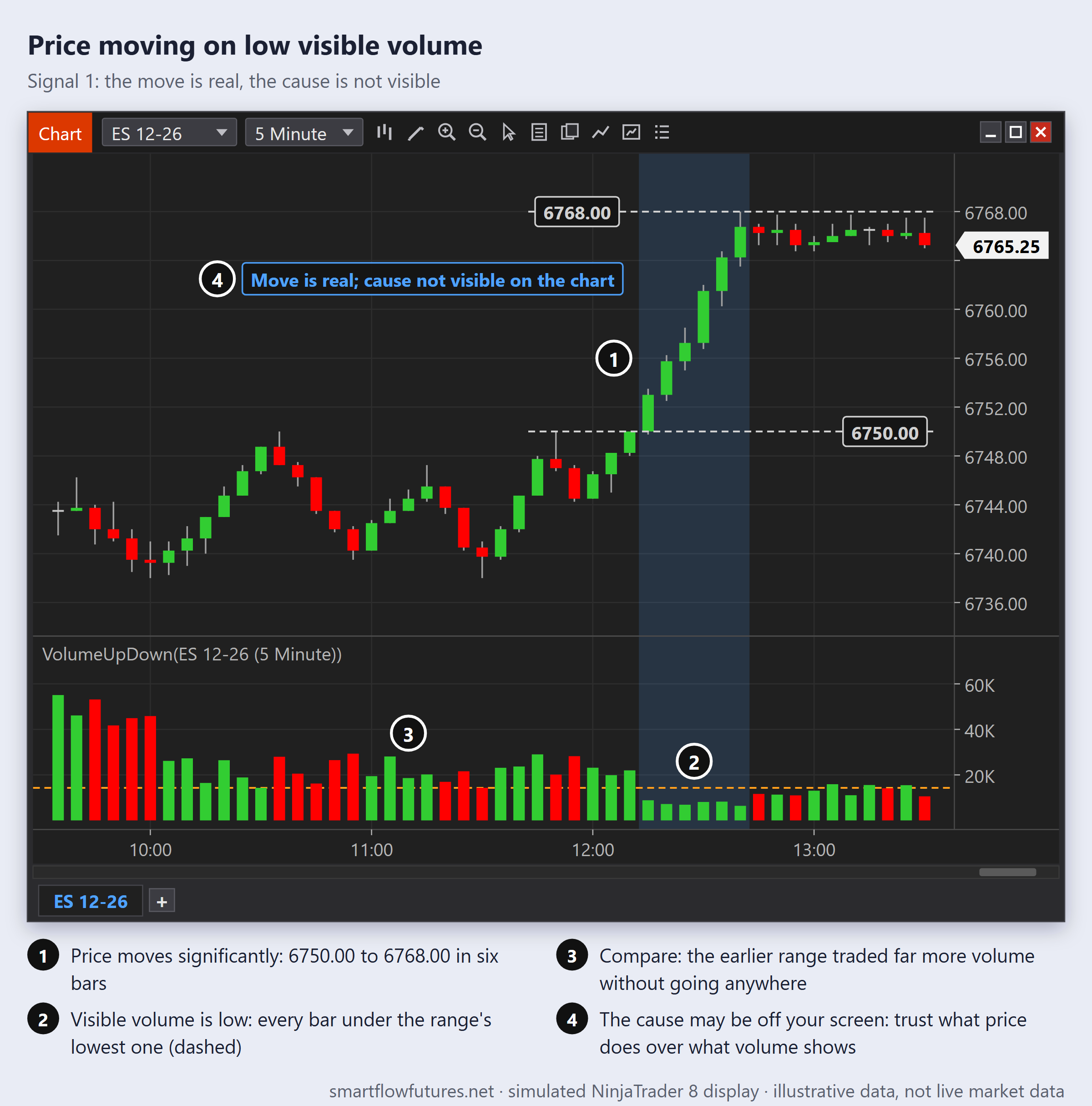
When you watch the order book on a stock, you are seeing only the lit venues, at best 60-70% of actual trading activity. Large institutional moves may be happening that do not appear on your screen until after the fact. This is one reason why price can move dramatically on what appears to be low visible volume.
Dark Pools and Futures Trading
Futures Are Different
Traditional dark pools are primarily an equity market phenomenon. Futures markets like ES, NQ, and YM trade on centralized exchanges (CME) with much more transparency than equities, though it is not complete. However, institutional futures traders use other methods to hide their activity:
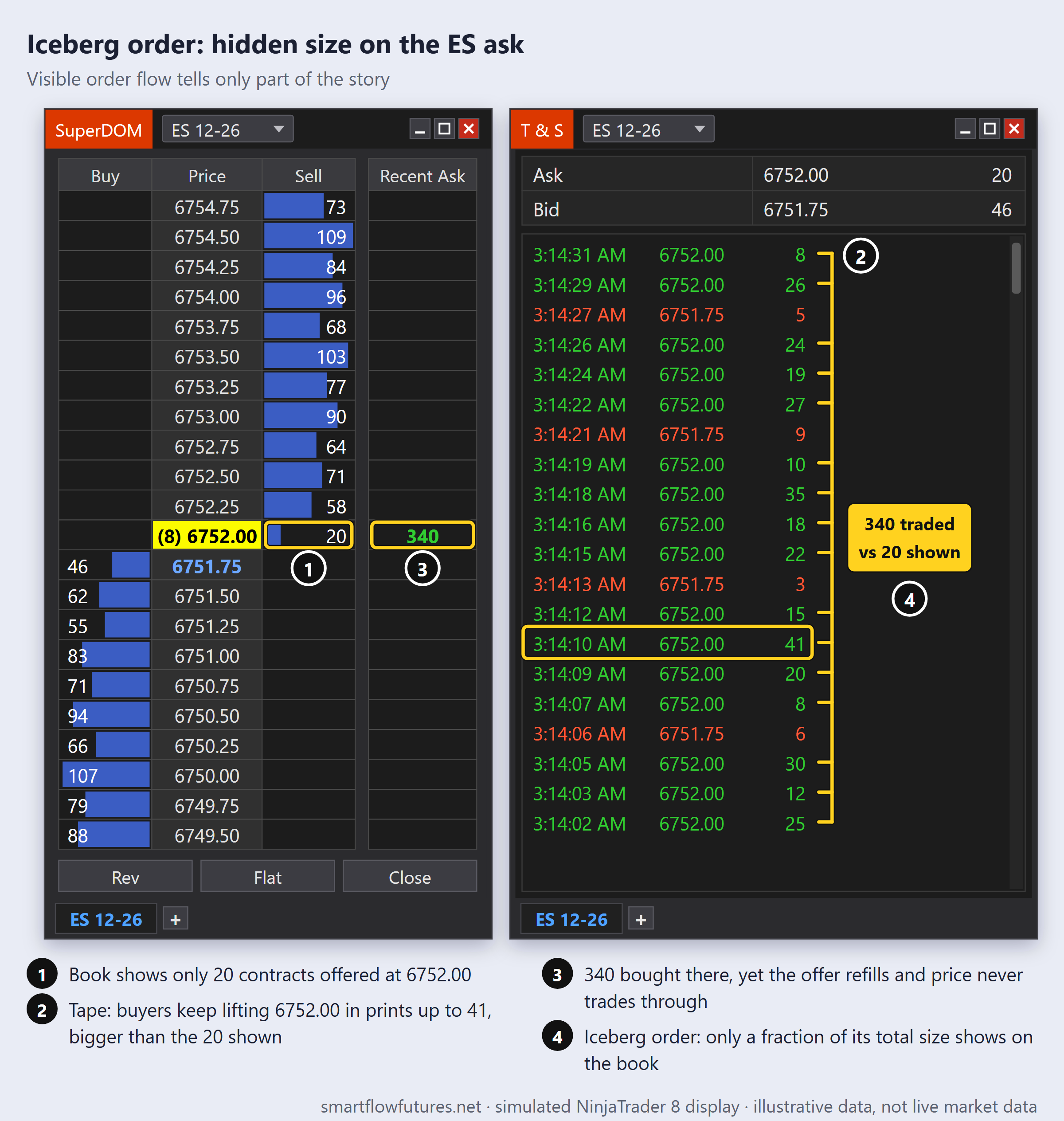
- Iceberg orders: Only display a fraction of total size on the book.
- Block trades: Large negotiated trades reported after execution.
- EFRP transactions: Exchange for Related Position trades done off-exchange.
- Spread trading: Executing in related instruments to obscure directional intent.
- Algorithmic execution: Breaking large orders into small pieces over time.
While futures have better transparency than equities, institutions still hide their activity. This is why order flow analysis looks for footprints of institutional activity (absorption, delta divergence) rather than expecting to see large visible orders.
Detecting Hidden Activity
Signal 1
Signal 2
Signal 3
Signal 4
Practical Implications
- Do not trust visible volume alone: Low volume can still accompany significant institutional activity happening off your screen.
- Focus on price action: Price incorporates all activity, visible and hidden. Trust what price is doing over what volume shows.
- Use multiple confirmation: Confirm order flow signals with structure and price action. Do not rely solely on tape reading.
- Understand the limitations: Your view of the market is incomplete. Accept this and trade with appropriate humility.
- Trade futures for transparency: While not perfect, futures markets offer better visibility than equity markets, where much of the volume trades off-exchange.
Dark pools are private trading venues that, with other off-exchange venues, handle 30-40% or more of equity volume without pre-trade transparency. Futures markets are more transparent but institutions still use iceberg orders, block trades, and algorithms to hide activity. Recognize that your view of order flow is incomplete and use multiple confirmation methods. Focus on price action as the ultimate arbiter of institutional activity, whether visible or hidden.