
The Asian session typically builds a consolidation range that sets up trades for the more volatile London and New York sessions. The Asian Range Breakout strategy capitalizes on this volatility expansion. It offers both breakout and fade setups.
Defining the Asian Range
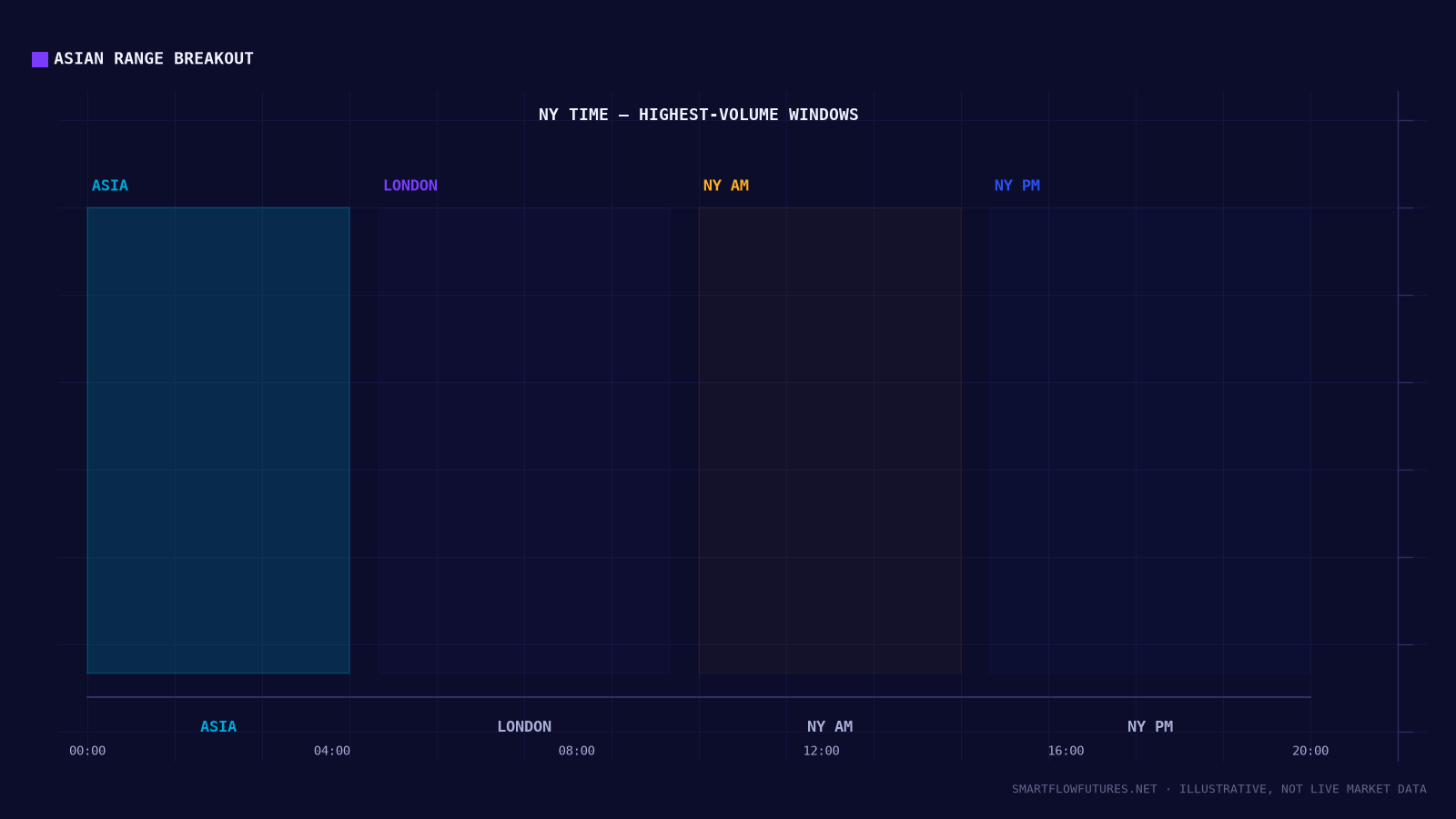
Time Window: 6:00 PM – 2:00 AM ET (or 00:00 – 08:00 London time). Some traders use a tighter window of 8:00 PM – 12:00 AM ET to focus on the quietest period.
The Range: Mark the highest high and lowest low during this window. This creates your Asian Range Box. The range represents consolidation and liquidity accumulation.
Characteristics of a Good Range: Clear, defined boundaries. Not excessively wide (less than 50% of average daily range is ideal). Not excessively tight (some range needed for meaningful breakout).
Two Trading Approaches
Approach 1: Trade the Breakout
When London or NY breaks the Asian range with conviction, trade the continuation. This works when the breakout is genuine and the session has established direction.
Approach 2: Fade the False Break
When the range gets broken but quickly fails, trade the reversal. This is the London Sweep concept applied to Asian ranges.
Knowing which approach to apply is what matters most.
Breakout Trade Setup
Conditions for Breakout:
Clean break of Asian high or low (not just a wick).
Candle closes beyond the range boundary.
Follow-through: price continues in breakout direction.
Volume/Order Flow confirms aggression in breakout direction.
Entry: Enter on pullback after breakout is confirmed. Or enter on break with tight stop.
Stop: Inside the Asian range (typically at the opposite boundary or midpoint).
Target: Project the Asian range width from the breakout point (measured move). Or target the next significant SMC level.
Fade Trade Setup
Conditions for Fade:
Price breaks Asian high or low.
Breakout immediately fails (long wick, quick reversal).
Price returns inside the range.
Order Flow shows rejection (absorption, delta reversal).
Entry: Enter after confirmation that breakout has failed. Typically when price reclaims the range boundary.
Stop: Beyond the failed breakout extreme.
Target: Opposite side of Asian range. Or the midpoint of the range for conservative exit.
How to Distinguish Breakout from Fake
The critical skill is knowing which scenario is developing:
Signs of Real Breakout:
Higher timeframe trend supports direction.
Strong momentum on break (big candles, volume).
Order Flow shows conviction (stacked imbalances).
Follow-through candles confirm direction.
Signs of False Break:
Higher timeframe suggests opposite direction.
Weak momentum on break (small candles, low volume).
Immediate rejection after break.
Order Flow shows absorption at the extreme.
When in doubt, wait. Clarity usually develops within 15-30 minutes of the break.
Time Filters
London Open (2-5 AM ET): First opportunity for range break. London sweep (fake break then reversal) is common.
Pre-NY (7-9:30 AM ET): Often continues or extends London direction. Breakouts during this window often have follow-through.
NY Open (9:30-10:30 AM ET): If range is still intact, NY open often provides the decisive break. Most volatile and potentially profitable window.
Order Flow for Asian Breakout
On Breakout:
Look for aggressive delta in breakout direction.
Stacked imbalances confirm conviction.
Volume should expand on the breakout candles.
On Fade:
Look for absorption at the extreme.
Delta should reverse after initial break.
Trapped traders exiting visible on tape.
Managing the Trade
For Breakout Trades:
Trail stop as new swing points form.
Take partials at measured move target.
Let runner target next major level.
For Fade Trades:
Take first profits at range midpoint.
Move stop to breakeven.
Take remaining at opposite range boundary.
Key Takeaways
Define the Asian Range as the high-low between 6 PM and 2 AM ET. Two approaches: trade the genuine breakout or fade the false break. Real breakouts show conviction, volume, and Order Flow confirmation. False breaks show immediate rejection and absorption. Time filters: London often sweeps and reverses; NY often provides real direction. Use Order Flow to distinguish breakout from fake break.