
Trailing Stops: Protecting Profits Dynamically
Master trailing stop techniques to lock in profits while allowing winning trades to reach their full potential.
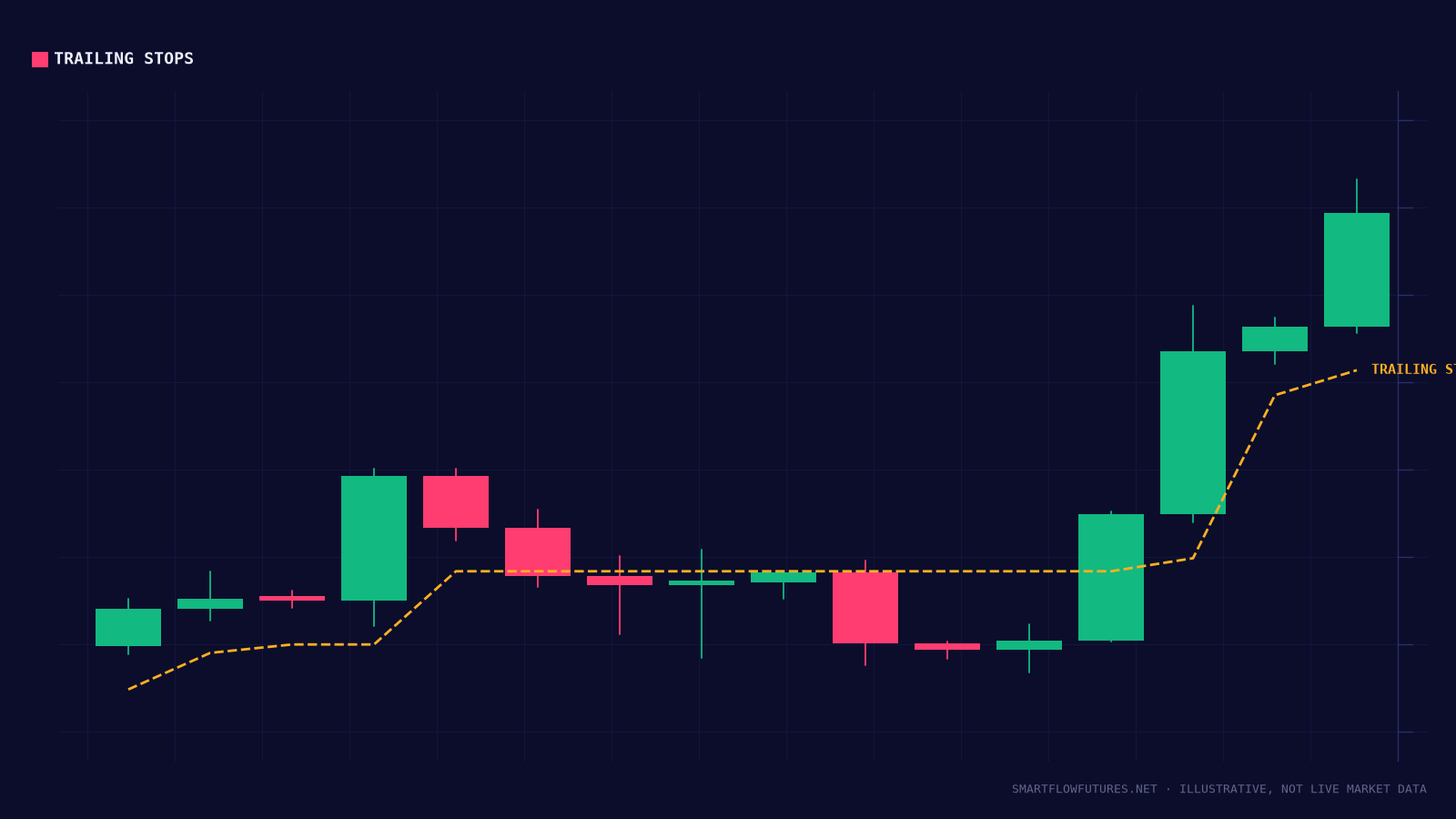
One of the most frustrating experiences in trading is watching a profitable trade turn into a loss. Trailing stops solve this problem by moving your stop loss in the direction of your trade as it becomes profitable. The challenge is finding the right balance between giving your trade room to breathe and protecting your gains. This article covers multiple trailing stop methods so you can choose what fits your trading style.
Benefits
- Locks in profits as trade progresses
- Removes emotional exit decisions
- Allows winners to run further
- Systematic approach to exits
- Reduces regret from early exits
Challenges
- Can get stopped out on normal retracements
- May leave money on the table
- Requires tuning to market conditions
- Not ideal for all trade types
- Can create overtrading if too tight
Trailing Stop Methods
Method 1
Example: Long ES at 4500, initial stop 4490. Price reaches 4520, move stop to 4510. Price reaches 4540, move stop to 4530.
Method 2
Example: If 14-period ATR is 8 points, trail 12-16 points behind current price.
Method 3
Example: Long trade makes new swing low at 4515 after entry at 4500. Move stop to just below 4515.
Method 4
Example: Trail stop at the 20 EMA minus a small buffer for noise.
Method 5
Example: First hour: 15-point trail. Second hour: 10-point trail. Third hour: 5-point trail or manual management.
Method Comparison
| Method | Best For | Pros | Cons |
|---|---|---|---|
| Fixed Point | Beginners, simple systems | Easy to execute | Ignores volatility |
| ATR-Based | Adapting to conditions | Volatility-adjusted | Requires indicator |
| Structure-Based | SMC traders | Respects price action | Subjective at times |
| Moving Average | Trend following | Clear objective level | Lags in reversals |
| Time-Based | Day traders | Accounts for time decay | More complex rules |
When to Start Trailing
- After first target hit: The most common approach. Take partial profits at first target, then begin trailing the remaining position.
- At breakeven: Once you can move stop to breakeven (entry price), begin trailing from there. This ensures no loss on the trade.
- After 1R profit: Once the trade has moved 1R in your favor (equal to your initial risk), begin trailing. This guarantees a profitable trade.
- After structure confirmation: Wait for price to create a new swing point in your direction, then trail behind it.
- Immediately: Some traders trail from the start. This results in tighter stops and more stop-outs but protects capital aggressively.
For most traders, the best approach is to take partial profits at first target, move stop to breakeven, then begin trailing the runner using structure-based or ATR-based method. This balances profit protection with allowing the trade to develop.
Trailing Stop Mistakes
A trailing stop that is too close gets triggered by normal market noise. You will get stopped out repeatedly only to watch price continue in your direction. Give the trade room to breathe.
A trailing stop that is too far away does not protect profits effectively. You give back too much when the market reverses. Find the balance for your market and timeframe.
Never move your trailing stop away from price to give the trade more room. This defeats the entire purpose. Once moved, the stop only moves forward or stays in place.
Trailing stops work best in trending markets. In ranging or choppy conditions, you will get stopped out repeatedly. Consider fixed targets instead of trailing in these conditions.
Structure-Based Trailing Example
Long NQ at 15,000 from order block. Initial stop at 14,970 (30 points risk). First target at 15,060 (2R).
Price hits 15,060. Take 50% profit. Move stop on remaining position to 15,000 (breakeven).
Price pulls back to 15,040, then continues higher. Move stop to 15,035 (below the new swing low).
Price reaches 15,100, pulls back to 15,075, then continues. Move stop to 15,070.
Price reaches 15,130 then reverses sharply, triggering stop at 15,070. Runner captured 70 additional points beyond first target.
Trailing stops protect profits while allowing winners to run. Choose a method that matches your style: fixed point for simplicity, ATR for volatility adaptation, structure-based for SMC alignment, or moving average for trend following. Start trailing after taking partial profits and reaching breakeven. Never trail too tight or move stops backward. Remember that trailing works best in trending markets.