
CFDs vs Futures: The Key Differences
When choosing how to trade financial markets, you’ll encounter various instruments including CFDs (Contracts for Difference) and Futures. Understanding the differences between these instruments helps you select the right vehicle for your trading strategy.
What Are CFDs?
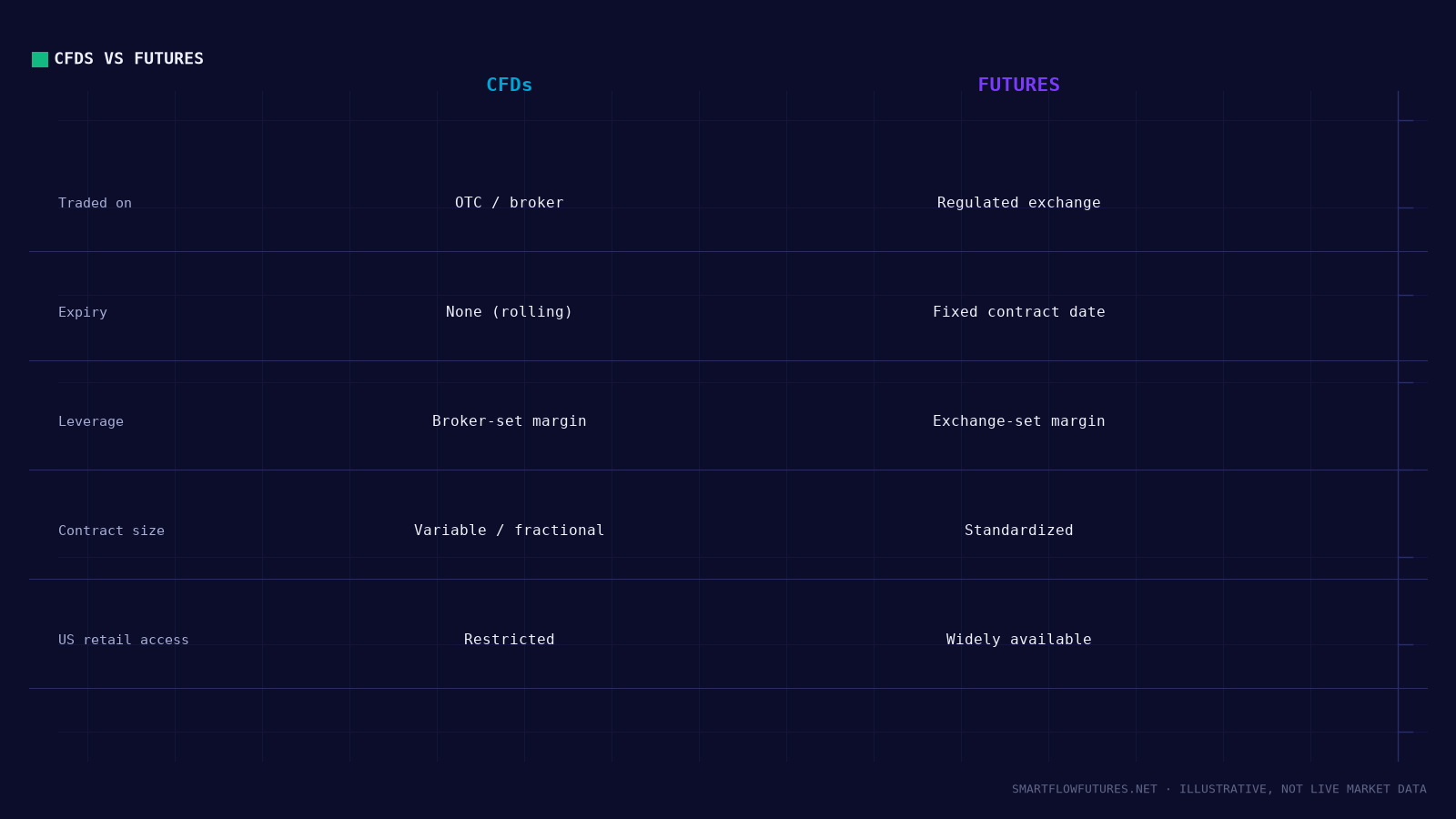
A CFD (Contract for Difference) is a derivative product that allows you to speculate on price movements without owning the underlying asset. When you trade a CFD, you enter into a contract with a broker to exchange the difference in an asset’s price from when you open the trade to when you close it.
CFDs are offered by retail brokers on stocks, indices, commodities, forex, and cryptocurrencies. They’re popular because they offer easy access and the ability to trade with smaller account sizes.
What Are Futures?
Futures are standardized contracts traded on regulated exchanges like the CME (Chicago Mercantile Exchange). A futures contract represents an agreement to buy or sell a specific asset at a predetermined price on a specific future date.
Unlike CFDs, futures contracts are standardized in terms of quantity, quality, and delivery time. They’re used by both speculators and hedgers, with significant institutional participation.
Key Differences
1. Market Structure and Regulation
CFDs: Traded over-the-counter (OTC) through brokers. The broker is your counterparty, which creates potential conflicts of interest. Regulation varies by jurisdiction; CFDs are banned in the US.
Futures: Traded on centralized, regulated exchanges. Transactions are cleared through a central clearinghouse, reducing counterparty risk. Subject to strict regulatory oversight.
2. Transparency
CFDs: Prices are set by the broker. While they typically mirror underlying markets, there’s less transparency in how prices are determined.
Futures: Complete transparency with real-time order book data. You can see all bids, asks, and trade volume. This transparency is essential for Order Flow analysis.
3. Counterparty Risk
CFDs: Your broker is your counterparty. If the broker fails, you may lose your funds. Some brokers also trade against their clients.
Futures: The exchange clearinghouse guarantees all trades, virtually eliminating counterparty risk.
4. Contract Specifications
CFDs: Flexible sizing: you can trade small positions. No expiration dates on most CFDs.
Futures: Standardized contract sizes (e.g., E-mini S&P 500 = $50 × index value). Contracts have expiration dates requiring rollover.
5. Costs
CFDs: Typically charge spreads (difference between bid/ask). May include overnight financing fees for holding positions. Some brokers add commissions.
Futures: Exchange fees and broker commissions (often very low for active traders). No overnight financing for most contracts. Spreads are market-determined and typically tight.
6. Leverage
CFDs: Leverage set by broker and regulations. Can range from 2:1 to 500:1 depending on jurisdiction and asset.
Futures: Leverage determined by exchange margin requirements. Typically ranges from 5% to 15% margin depending on the contract. Day trading margins can be even lower.
Why We Focus on Futures
At Smart Order Flow, we focus exclusively on futures markets for several compelling reasons:
Transparency: Futures markets provide complete visibility into the order book and trade data. This transparency is essential for Order Flow analysis—you can’t read what you can’t see.
No Conflict of Interest: When you trade futures, you’re trading against other market participants, not your broker. This eliminates potential conflicts where brokers might benefit from your losses.
Institutional Participation: Futures markets are where major institutions trade. If you want to learn Smart Money Concepts, you need to trade in the same arena as the smart money.
Tax Advantages: In the US, futures receive favorable tax treatment under Section 1256 (60% long-term / 40% short-term capital gains regardless of holding period).
24-Hour Trading: Major futures contracts trade nearly 24 hours, allowing you to react to global events and find opportunities across multiple sessions.
The Case for CFDs
CFDs aren’t without merit. They offer easier access for beginners, smaller position sizing, and simpler account setup. For some traders, especially those with very small accounts or in regions where futures aren’t accessible, CFDs provide a way to participate in markets.
However, be aware of the limitations: you won’t have access to real order flow data, your broker may have interests misaligned with yours, and you’re typically paying more in spreads and financing costs.
Making Your Choice
Consider these factors when choosing:
Choose Futures if: You have sufficient capital for margin requirements, want complete market transparency, plan to use Order Flow analysis, want to trade like professionals, and are US-based (where CFDs are unavailable).
Consider CFDs if: You’re starting with very limited capital, want more flexible position sizing, aren’t focused on order flow, and are in a jurisdiction where futures aren’t easily accessible.
For serious traders committed to developing professional-level skills, futures remain the superior choice. The transparency and institutional participation create an environment where skill genuinely matters.